By Scooter M. · Last updated September 21, 2026
Shovel Report earns a commission when you buy through the links on this page, at no extra cost to you. It does not change what we recommend, and we publish a skip-this verdict on products we could otherwise earn from. Full disclosure.
On a steep driveway, traction is the whole problem. Choose a self-propelled machine so you steer rather than wrestle it, pre-treat before the storm so ice never bonds, and keep grit on hand for the moments when no chemistry works fast enough. Throughput matters less here than footing does.
Three problems a slope creates
Your footing. You are working on an inclined surface that was recently ice. Every push, lift and turn happens with reduced grip, and a fall on a slope carries further than a fall on the flat.
The machine's footing. A snow blower on a slope wants to go downhill. A push-only machine has to be held back on the descent and forced up on the climb; a self-propelled machine drives its own wheels and you steer.
The car. A driveway you cannot drive up is not cleared, regardless of how much snow you moved. On a steep drive, the last thin layer of ice is the whole job, which is why chemistry and timing matter more here than on flat ground.
How we picked
- Surface compatibility first — it eliminates entire product categories before any other spec matters
- Auger or blade clearance against what the surface can tolerate being scraped or picked up
- Throughput or blade width matched to the area, so the tool suits the job rather than the price tier
- De-icer chemistry chosen against the surface's actual failure mode, not a generic warning
- A complete answer: a shovel, a powered option and a de-icer that all work on the same surface
We have not physically tested these products. We do not own them, we have no lab, and we do not accept free product. Everything above is compiled from published manufacturer specifications, published manuals, published standards and live retailer data - and we tell you which is which on every claim. How we pick.
Quick picks
Ranked against the criteria below. Tap a row to jump to the full write-up; the price button goes straight to Amazon.
| # | Product | Best for | Score | Price |
|---|---|---|---|---|
| 1 |  EGO Power+ SNT2400 24-in Two-Stage A true two-stage, self-propelled 24-inch machine — the only configuration in this build that belongs on a gravel driveway. | Gravel, and everything else hard | 8.8/10 | $1,178.99 - View on Amazon #ad affiliate link · Price as of October 15, 2026 |
| 2 | 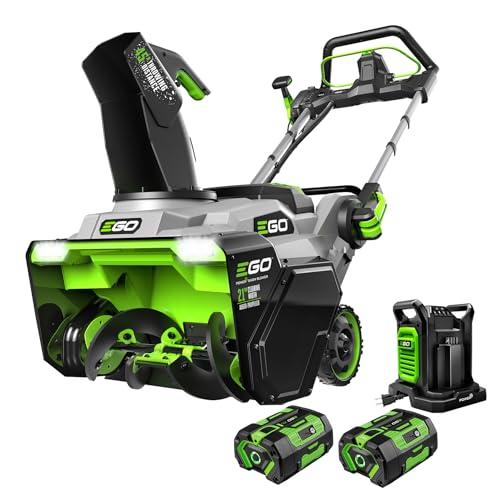 EGO Power+ SNT2125AP 21-in Auger-Propelled Two 7.5 Ah packs instead of two 5.0 Ah — 50% more stored energy, which is the whole answer on a long driveway. | Long driveways on battery | 8.3/10 | |
| 3 |  Peladow Calcium Chloride Pellets, 50 lb OxyChem's round calcium chloride pellet at about 90% purity, working to a published -25°F and dissolving exothermically — the chemistry for ice that has already bonded. Our skip-this pick | Breaking an existing bond on a cold morning | 7.5/10 | $50.99 - View on Amazon #ad affiliate link · Price as of October 15, 2026 |
| 4 |  The Snowplow Original Snow Pusher, 30 in A UHMW polyethylene blade that snow slides off rather than sticks to, in the width that actually changes your clearing time. | Wide, flat driveways | 8.9/10 | $69.99 - View on Amazon #ad affiliate link · Price as of October 15, 2026 |
| 5 |  Snow Joe SJ627E 22-in Corded Snow Blower 840 pounds of snow a minute from a wall socket, at 35 pounds and a fraction of a cordless machine's price. Our skip-this pick | Most snow moved per dollar | 8.6/10 | $249.99 - View on Amazon #ad affiliate link · Price as of October 15, 2026 |
Gravel, and everything else hard
EGO Power+ SNT2400 24-in Two-Stage
A true two-stage, self-propelled 24-inch machine — the only configuration in this build that belongs on a gravel driveway.
The single most useful thing to understand about snow blowers is the difference between one stage and two, because it decides which surfaces you can use the machine on at all.
A single-stage machine has one auger that both picks the snow up and throws it, and it does that by contacting the surface. That is why it clears down to bare pavement — and why it will pick up gravel and fling it at your garage door. A two-stage machine has a serrated auger that gathers snow and a separate impeller that throws it, and the whole assembly rides on adjustable skid shoes with the auger held above the ground. That gap is the entire reason two-stage machines work on gravel.
So on a gravel driveway this is not a preference, it is the requirement. Set the skid shoes so the auger clears the stone by roughly an inch, accept that you will leave a thin layer of packed snow, and stop expecting bare-surface results.
The catch is that it ships as a bare tool. EGO sells it without batteries or charger, and on a 56V two-stage machine you want large packs — so budget for them. See single-stage versus two-stage for the full decision.
What works
- Two-stage design keeps the auger off the ground, which is the requirement on gravel
- 24 inches is a genuine two-car-driveway width
- Self-propelled, so the machine's weight stops being your problem
What does not
- Sold as a bare tool — batteries and charger are a substantial extra
- Two-stage machines are heavy and take real storage space
- Overkill for a short concrete drive
Long driveways on battery
EGO Power+ SNT2125AP 21-in Auger-Propelled
Two 7.5 Ah packs instead of two 5.0 Ah — 50% more stored energy, which is the whole answer on a long driveway.
On a long driveway the question is not how fast a machine clears, it is whether it finishes. Battery capacity is the constraint, and it is one you can compute rather than guess: watt-hours equal volts times amp-hours. Two 56 V 7.5 Ah packs give 840 Wh nominal. Two 5.0 Ah packs give 560 Wh. That is 50 percent more work available before you are standing in the snow waiting for a charger.
What that converts to in driveway length depends on snow density, depth and how fast you walk, and no honest source can give you a single number. But the ratio is real: if a 5.0 Ah kit gets you three quarters of the way down your drive, the 7.5 Ah kit finishes it.
Auger propulsion is the second difference. Instead of a separate wheel drive, the auger's contact with the ground pulls the machine forward. It is simpler and lighter than a wheel drive and works well on pavement. It also means propulsion disappears when the auger is not biting.
Everything else follows the 21-inch EGO pattern, including the surface limits. Gravel is still out; see gravel driveways for what actually works there.
What works
- 840 Wh of nominal stored energy is 50% more than the 5.0 Ah kits' 560 Wh
- Auger propulsion pulls the machine forward so you steer rather than push
- Same 56V platform, so the packs run every other EGO tool
What does not
- Auger propulsion only works while the auger is engaged with the surface
- The largest packs are the most expensive part of the machine
- Still single-stage, still not for gravel
Breaking an existing bond on a cold morning
Peladow Calcium Chloride Pellets, 50 lb
OxyChem's round calcium chloride pellet at about 90% purity, working to a published -25°F and dissolving exothermically — the chemistry for ice that has already bonded.
Skip this one
Do not use calcium chloride on concrete poured within the last twelve months, on pavers, on composite decking, or where runoff drains straight into planting beds. It is the right chemistry for breaking a bond that has already formed and the wrong one for a new driveway.
The Green Gobbler calcium chloride we used to list here is no longer available. Peladow is the closest comparable product we can verify is in stock, and it is the reference calcium chloride pellet that most of the category is measured against: made by OxyChem, at about 90% calcium chloride.
The reason to reach for calcium chloride is its mechanism. It dissolves exothermically — it releases heat as it goes into solution — so it starts working the moment it lands rather than depending on sunlight or ambient warmth. OxyChem also points to the round pellet shape, which penetrates an ice layer and attacks the bond with the pavement instead of sitting on top.
Be precise about the temperature. OxyChem publishes an effective temperature of -25°F. That is very cold, and it is consistent with the chemistry: the Minnesota Pollution Control Agency puts calcium chloride's lowest practical pavement temperature at -20°F, ten degrees colder than magnesium chloride's. Calcium chloride wins on both counts that matter in deep cold — it works colder, and it starts faster on an existing bond.
The cost is what it does to surfaces. Calcium chloride drives the most freeze-thaw cycling of any common de-icer, which is the mechanism that damages concrete, and its brine washes jointing sand out of pavers. Use it to rescue a driveway that has already iced — how to get ice off a driveway — not as routine pre-treatment.
What works
- Exothermic: it generates heat as it dissolves, so it starts working on contact rather than waiting for sun
- Round pellets bore down through an ice layer instead of sitting on top of it
- Published compliance with the ASTM and AASHTO calcium chloride standards
- 50 lb bag is the economical way to buy the coldest-working chloride
What does not
- Rated high risk for corrosion of reinforcing steel and for vegetation by the Minnesota Pollution Control Agency, like the other chlorides
- Hardest on paws of anything we list
- The maker's "up to 3x faster" claim is theirs, not a figure we can verify
- 50 pounds is a heavy bag, and calcium chloride absorbs moisture and cakes if stored open
Wide, flat driveways
The Snowplow Original Snow Pusher, 30 in
A UHMW polyethylene blade that snow slides off rather than sticks to, in the width that actually changes your clearing time.
UHMW — ultra-high-molecular-weight polyethylene — is the material specification that separates this from a $25 pusher. It is the same family of plastic used for conveyor wear strips and truck-bed liners, chosen for a very low coefficient of friction and high impact resistance at low temperature. The practical consequence is that snow slides off it, including the heavy wet snow that packs solid onto a cheap blade and turns pushing into scraping.
The maker states the edge self-sharpens with use and needs no maintenance, and lists the tool as usable on concrete, blacktop, pavers, decks, roofs and ice rinks. That surface list is unusually broad and is the reason we recommend it where a metal edge would be a liability.
Width is the other half of the argument. A 30-inch blade covers 67 percent more ground per pass than an 18-inch shovel. On a 20-by-30-foot driveway that is the difference between roughly 20 passes and roughly 12 — and each of those passes is a push, not a lift.
It is not a complete answer. Nothing that pushes deals with the plow berm, and on a long driveway you eventually run out of anywhere to push to. Pair it with a shovel, or with a machine.
What works
- UHMW is the reason wet snow releases instead of packing onto the blade
- 30 inches is the width where pass count drops noticeably on a two-car drive
- Rated by the maker for decking and pavers, unlike any steel-edged pusher
What does not
- Costs multiples of a hardware-store pusher
- Still cannot lift, and still cannot cut refrozen crust
- The wider the blade, the more it wanders on uneven ground
Most snow moved per dollar
Snow Joe SJ627E 22-in Corded Snow Blower
840 pounds of snow a minute from a wall socket, at 35 pounds and a fraction of a cordless machine's price.
Skip this one
A push-only machine on a steep, icy driveway is a machine you are wrestling downhill. On any real grade, self-propelled is not a convenience feature — it is the difference between steering the machine and being pulled by it.
This machine exists to make a point about arithmetic. Snow Joe states it moves up to 840 pounds of snow per minute through a 22-inch by 13-inch intake. The best-documented electric shovel in this build, the Toro Power Shovel, is rated at 300 pounds per minute through a 12-by-6-inch path. That is not a small difference in degree; it is a different job.
Work through a driveway with it. A 20-by-40-foot drive under 6 inches of fresh snow contains very roughly two to four thousand pounds of snow depending on density. At the stated 840 lb/min that is a few minutes of actual throughput — the clock is dominated by walking and turning, not by the machine.
The 13-inch intake depth is the underrated spec. Most single-stage machines in this price class top out around 8 to 10 inches, which means a foot of snow needs layered passes. Thirteen inches takes most storms in one.
The cord is the price. Fifteen amps over a long, thin extension cord is a voltage-drop problem, so you need a heavy-gauge, cold-flexible outdoor cord, and you spend the whole clear aware of where it is. Measure your outlet-to-far-corner distance before you buy — beyond about 100 feet, go cordless.
What works
- 840 lb/min is roughly triple what the best electric shovel here moves
- 13 inches of intake depth handles a real storm in one pass
- 35 lb published weight makes it manageable to turn and store
What does not
- Corded, so your working radius is a cord length
- 15 amps needs a properly rated cold-weather extension cord
- Single-stage: no gravel, and limited on steep grades
Self-propelled is not optional on a real grade
On the flat, self-propulsion is a convenience. On a slope it changes what the job is. A self-propelled two-stage machine drives its own wheels, so your effort goes into steering and your feet stay planted. A push machine on a slope has you providing the propulsion on a surface designed to slide.
There is a second reason to prefer a two-stage machine here: weight over the wheels. Heavier machines have more traction, and on a slope traction is the limiting factor rather than power.
Auger propulsion — where the auger's ground contact pulls the machine forward — is a middle option. It works, and its grip disappears the moment the auger is not biting, which on ice is exactly when you need it.
Work across the slope, not up and down
- Clear in horizontal passes across the slope rather than driving up and down it. Your footing is more stable and the machine is not fighting gravity along its length.
- Start at the top. Snow thrown downhill lands on ground you have not cleared yet, so working down means you never re-clear.
- Throw downhill and to the side. Uphill throws come back.
- Never pull a machine toward you on a descent. If it starts to run away, let it go. Machines are replaceable.
- Wear real traction devices. Cleats or ice grips over boots do more for your safety on a steep drive than any equipment choice on this page.
Pre-treatment is the whole strategy
On a slope, the thin bonded layer of ice left after clearing is what stops a car. Breaking that bond after the fact is slow, and on a cold night it may not happen at all.
Pre-treating a clean surface before a storm prevents the bond forming in the first place, which uses far less product and is far more reliable. That is true everywhere and it is most valuable on a slope. See when to apply ice melt.
Choose the chemistry for the temperature, not for gentleness. On a cold night on a slope, a product published to -25°F and a product that stops at 20°F are not two options — one of them does nothing. See calcium chloride versus rock salt.
And keep grit on hand. Sand gives traction instantly at any temperature and asks nothing of the chemistry, which on a slope in deep cold is often the honest answer. See ice melt versus sand.
Traction is the other half of a slope. If the machine slides where it should climb, check tire pressure first and then consider snow blower tire chains, which are bought by exact tire size rather than by machine model.
Questions people ask
What snow blower is best for a steep driveway?
How do I get traction on a steep icy driveway?
Should I shovel a steep driveway from the top or bottom?
Is a snow blower safe on a slope?
Sources
Next stage
Timing is the difference
On a slope, pre-treating before the storm is worth more than any product upgrade. Here is the timing that keeps ice from bonding at all.
Keep goingAbout the author
Scooter M.
An enthusiast who is genuinely into this. I read the manuals, compile the published specs, and do the math on door clearances. No lab coat, no test bench, and nothing here is a product I have used - which is exactly why every claim carries a source.
Published by Slate Mill Group, with the Shovel Report team. Published August 16, 2026; last updated September 21, 2026. Editorial policy.
Read next
Melt vs Traction
Ice Melt vs Sand
Melting versus traction, the temperature where sand wins, and why using both is common.

Timing Guide
When to Apply Ice Melt
Pre-treat, then clear, then spot-treat — the sequence that uses least product for most effect.

Single vs Two-Stage
Single-Stage vs Two-Stage Snow Blowers
Auger clearance is the whole decision: what each type can clear, and what it will destroy.

Best for Long Drives
Best Snow Removal for a Long Driveway
Capacity, not width — sizing battery watt-hours and throughput to distance rather than to price.