Every de-icer lowers the freezing point of the water film on ice. Which one you buy depends on two things: how cold it gets where you live, and what the runoff lands on. Calcium chloride starts fastest and works coldest; chloride-free products are gentlest and stop working sooner.
How de-icers actually work
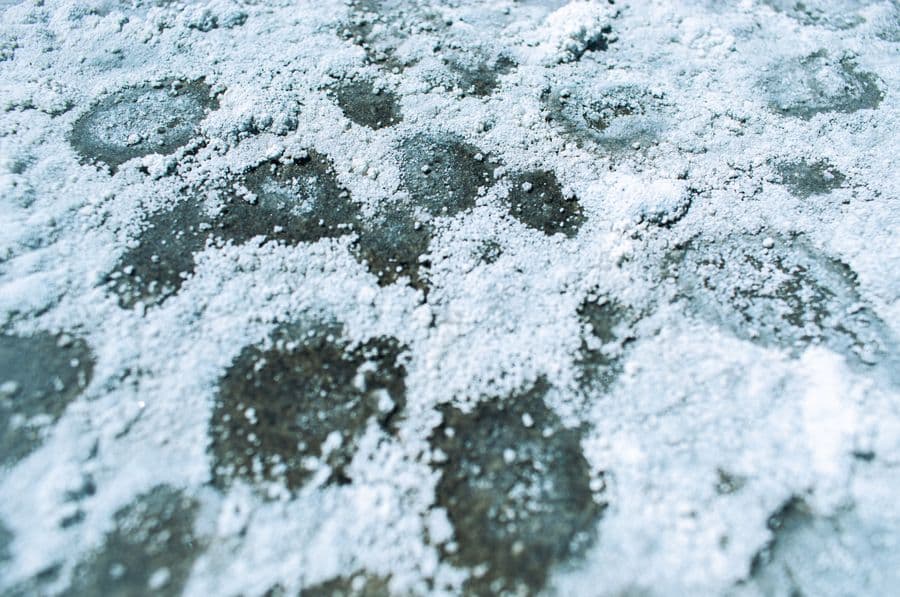
Ice always carries a microscopically thin film of liquid water on its surface. Dissolve a salt into that film and you lower its freezing point, so the ice in contact with it melts. The brine that forms spreads, works down through the ice, and eventually breaks the bond between the ice and the pavement — which is the point. You are not melting the ice away, you are breaking it loose so you can move it.
Two consequences follow immediately. First, de-icer needs liquid water to start, which is why it works badly on a dry, powdery surface at very low temperature. Second, more product is not faster: past the point where the film is saturated, extra pellets sit there doing nothing except running off into your soil.
The four chemistries
De-icer chemistry, by working temperature
Every temperature below is either published by the manufacturer of a product we link to, or labeled as a practical range. Where a maker publishes no figure, the cell says so. We have not measured any of this ourselves — here is what we did instead.
Published working temperatures are manufacturer figures for the specific products we link to, not generic chemistry constants. Two makers publish no figure at all, and those cells say so rather than borrowing a number from a competitor.
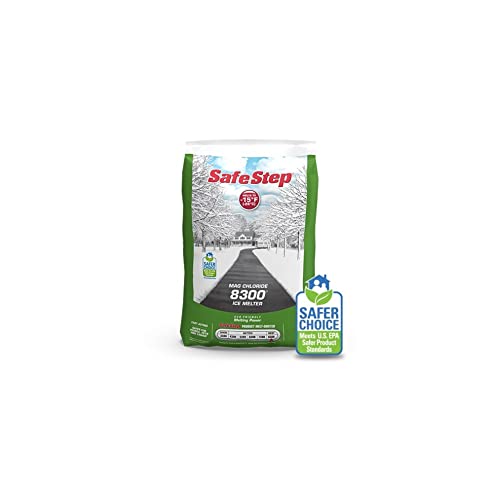
Sodium chloride (rock salt) is cheap and stops doing useful work somewhere around 15 to 20°F. On a cold night it is decoration. Magnesium chloride is the least irritating of the working chlorides — the sensible default around pets — with a practical floor of about -10°F and -15°F published on most bags; magnesium chloride ice melt covers it in full. Calcium chloride dissolves exothermically so it starts fast, is published to -25°F on the pellets we list, and works colder than any other chloride. Chloride-free amide and acetate products remove the corrosion argument entirely and give up cold performance in exchange.
The surface table
This is the reference the site exists to publish. Nothing comparable is available for free, and it is the thing most people actually need before they buy a bag.
Every product on this site, by driveway surface
Color is not the only signal here: every cell carries a word as well as a mark. “Caution” means it works with a specific limitation, and the limitation is stated on the product’s own entry. Nothing in this table comes from testing — it is compiled from published specifications and maker statements.
Generated from the surface field on every product in our registry, so it cannot disagree with the individual product write-ups. Where a maker states a surface explicitly — The Snowplow lists decks and pavers, Manplow lists aggregate and gravel — we use their claim and say whose it is.
What ice melt does and does not do to concrete
The popular belief is that salt dissolves concrete. It does not. The damage mechanism is physical rather than chemical for the most part: de-icer keeps water liquid in the concrete's pores at temperatures where it would otherwise be frozen, so the surface goes through far more freeze-thaw cycles than it otherwise would, and each cycle expands water inside the pore structure. That is what causes scaling and spalling.
There is a genuine chemical component too — chloride ions migrating to embedded steel and corroding it, which is why bridge decks are a chloride problem. On a residential driveway with no reinforcement near the surface, the freeze-thaw mechanism is the one that will get you.
The practical rules that follow: keep de-icer off concrete poured within the last twelve months, seal decorative and stamped concrete, and do not over-apply. We work through it properly in does ice melt damage concrete.
Applying it correctly
- Spread before the storm where you can. A thin pre-treatment stops ice bonding to the pavement in the first place and uses far less product than breaking a bond after the fact.
- Shovel first, then treat. De-icer is for the thin layer bonded to the surface, not for melting six inches of snow. Using it that way is expensive and mostly ineffective.
- Check the temperature against the product. Applying rock salt at 10°F accomplishes nothing except cost and runoff.
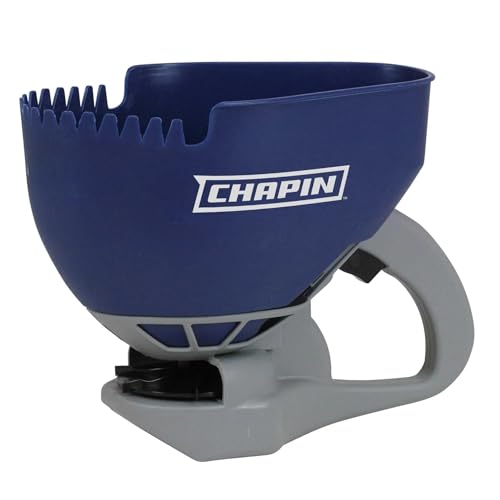
- Use a spreader. Hand-broadcasting delivers several times the intended rate, which is where residue, slipperiness and plant damage come from.
Timing gets its own page, because getting it wrong is the most common and most expensive mistake in this category: when to apply ice melt. Treating before a storm is also the one job liquid ice melt does better than any bag of pellets. The published working temperatures, chemistry by chemistry, are collected in the temperature guide.