
By Scooter M. · Last updated September 13, 2026
Shovel Report earns a commission when you buy through the links on this page, at no extra cost to you. It does not change what we recommend, and we publish a skip-this verdict on products we could otherwise earn from. Full disclosure.
The lightest genuinely useful powered snow tools are corded powered shovels: Toro publishes 13 pounds for its Power Shovel, and Snow Joe publishes 17.2 pounds for the cordless 24V-SS13. Full-size blowers start around 35 pounds — Snow Joe's published figure for the 22-inch corded SJ627E — and most makers in this category do not publish a weight at all.
Start with the scandal: most of these have no published weight
We set out to rank this category by weight and immediately hit a wall. Of the twelve powered snow tools in our registry, three publish a weight. Three. For a class of tool that is explicitly carried in front of your body or pushed by hand, that is a remarkable omission, and it is not an accident — a specification that is inconvenient tends not to appear on the box.
So this page ranks on published figures only, and says so on every entry where one is missing. We are not going to weigh a tool we do not own, and we are not going to estimate. Where a maker declines to print a number, our entry says "Not published" and that is the end of it.
Every published weight we could find in this class
Why weight decides whether a tool gets used
A powered shovel is held out in front of your body for the entire clear. That is a cantilevered load — the further from your spine, the more torque it applies to your lower back — and it is sustained rather than momentary. Thirteen pounds held at arm's length is not the same experience as thirteen pounds in a bag.
The failure mode is not injury on day one. It is that a tool which is tiring to use gets used less, and a driveway cleared less often accumulates the packed, refrozen layer that is far harder to remove than fresh snow. The lightest tool you will actually pick up beats the most capable one you will not.
This is the same argument we make about hand tools in snow shovels for a bad back, and it applies with more force here because the powered tools are heavier.
How we picked
- Stage — single or two — because it decides which surfaces the machine can be used on at all
- Published clearing width and intake depth, which set pass count and whether a deep storm needs two passes
- Stated throughput in lb/min or tons/hour where a maker publishes it: the only spec that converts to minutes
- Energy available: cord amperage for corded machines, watt-hours (volts x amp-hours) for battery ones
- Auger material and skid-shoe adjustment, which together decide surface risk and ground clearance
We have not physically tested these products. We do not own them, we have no lab, and we do not accept free product. Everything above is compiled from published manufacturer specifications, published manuals, published standards and live retailer data - and we tell you which is which on every claim. How we pick.
Quick picks
Ranked against the criteria below. Tap a row to jump to the full write-up; the price button goes straight to Amazon.
| # | Product | Best for | Score | Price |
|---|---|---|---|---|
| 1 |  Toro 38361 Power Shovel 12 inches, 13 pounds, 300 lb/min, 20-foot throw — Toro publishes every number, which almost nobody else here does. | Best-documented specs in the class | 7.5/10 | Check price on Amazon #ad affiliate link · no live price for this item |
| 2 | 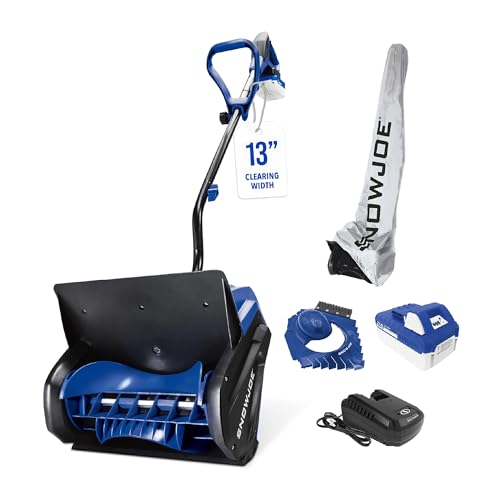 Snow Joe 24V-SS13-TV1 Cordless Snow Shovel Kit 13 inches wide, 17.2 pounds, dual-handle — the cordless shovel that publishes the number that decides whether you finish. | Lightest cordless with a published weight | 7.8/10 | $199.99 - View on Amazon #ad affiliate link · Price as of September 14, 2026 |
| 3 |  EGO Power+ SNS1201 12-in Snow Shovel A 12-inch 56V shovel with 60 degrees of chute control, on the battery platform with the most tools to grow into. | The best cordless platform | 8.0/10 | $359.00 - View on Amazon #ad affiliate link · Price as of September 14, 2026 |
| 4 | 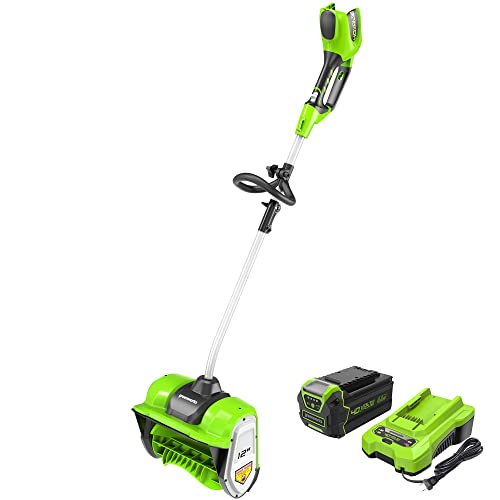 Greenworks 40V 12-in Cordless Snow Shovel The obvious pick if you already own Greenworks 40V yard tools; a middling one if you do not. Our skip-this pick | Greenworks 40V owners | 7.4/10 | $301.99 - View on Amazon #ad affiliate link · Price as of September 14, 2026 |
| 5 |  Snow Joe SJ625E 21-in Corded Snow Blower A 21-inch, 15-amp machine at up to 800 lb/min — the SJ627E's slightly smaller, slightly cheaper sibling. | Mid-size driveways on a budget | 8.2/10 | Check price on Amazon #ad affiliate link · no live price for this item |
Best-documented specs in the class
Toro 38361 Power Shovel
12 inches, 13 pounds, 300 lb/min, 20-foot throw — Toro publishes every number, which almost nobody else here does.
Toro publishes what everyone else omits: 12 inches of clearing width, up to 6 inches of depth, a 7.5-amp motor, a 20-foot throw, 300 pounds per minute of capacity, 13 pounds of tool weight, and 6 inches of telescoping handle adjustment. On a site that scores products on published specifications, that transparency counts for a lot.
The 300 lb/min figure is the one to reason from, because it lets you do arithmetic nobody usually can. A 20-by-30-foot driveway under 4 inches of fresh snow holds very roughly 1,500 to 2,500 pounds of snow depending on density. At 300 pounds a minute that is something like 5 to 8 minutes of continuous machine time, plus the walking, turning and repositioning. Compare that with the Snow Joe SJ627E's stated 840 lb/min and the size difference becomes concrete rather than vague.
At 13 pounds it is the lightest powered tool here, and for a carried tool that is the spec that determines whether you finish the job or put it down.
It is a light-snow, small-area machine and Toro says so — sidewalks, steps, decks and small driveways. Point it at a two-car driveway after eight inches of wet snow and you will be disappointed for reasons that were printed on the box.
What works
- Every spec we wanted is published on Toro's own product page, including weight and lb/min
- 13 lb is light enough to hold out in front of you for a long clear
- Telescoping handle with 6 inches of adjustment actually fits different-height users
What does not
- 7.5 amps is the least powerful motor here
- 300 lb/min is roughly a third of what a 15-amp corded blower moves
- Corded, with all the cord problems that implies
Lightest cordless with a published weight
Snow Joe 24V-SS13-TV1 Cordless Snow Shovel Kit
13 inches wide, 17.2 pounds, dual-handle — the cordless shovel that publishes the number that decides whether you finish.
Weight is the spec that decides whether an electric shovel gets used, because you carry it — there are no wheels on any of these. At a published 17.2 pounds this is a tool most adults can hold out in front of them for twenty minutes. That is not true of everything in the category.
The path is 13 inches wide by 6 inches deep. Read the depth carefully: six inches is the maximum bite, not the maximum storm. In a 10-inch snowfall you take two passes at different heights, which is slower but perfectly workable — and is how you should be clearing anyway.
The 24-volt platform is the compromise. It keeps the tool light and cheap, and it is the reason the machine bogs in dense, wet snow where a 56-volt tool keeps its speed. If your snow is typically wet and heavy, the extra voltage is worth paying for.
One thing no cordless snow shovel currently offers is wheels. It is a common search and the answer is honest: this class is carried, not pushed. If you need something that rolls, you need an electric snow blower, not a shovel.
What works
- 17.2 lb is published, and it is genuinely light for a powered tool
- 13-inch path is a usable step up from the 11- and 12-inch class
- Dual-handle design keeps both hands on the tool and your back straighter
- The TV1 kit includes the storage cover and scraper rather than selling them separately
What does not
- 24 V has less headroom than 40 V or 56 V systems in wet, heavy snow
- 6-inch depth means you clear twice in a real storm
- Snow Joe's 24V platform is narrower than EGO's 56V
The best cordless platform
EGO Power+ SNS1201 12-in Snow Shovel
A 12-inch 56V shovel with 60 degrees of chute control, on the battery platform with the most tools to grow into.
Buying a cordless snow shovel is mostly a decision about which battery ecosystem you are joining, because the shovel is the cheap part and the batteries are not. EGO's 56V line is the strongest argument in this category: the same pack that runs this shovel runs their 21-inch two-battery snow blower, so the natural upgrade path costs you a tool and not a tool plus a battery set.
The tool itself is a 12-inch paddle auger with a directional chute the maker rates at 60 degrees of adjustment and a throw of up to 25 feet. Chute control matters more than it sounds: without it you throw snow wherever the machine points, which on a walkway means onto the part you just cleared.
Twelve inches is the honest limitation. That is a path width for steps, a deck, a walk to the mailbox, and the strip in front of a garage door. It is not a driveway machine. Point a 12-inch shovel at a two-car drive and you will be there a long time, and the battery will not last.
EGO does not publish a weight on the listing we read. For a tool you carry in front of you, that is the number we most wanted. See how the class compares to a real machine in snow shovel versus snow blower.
What works
- Directional chute control, which most electric shovels in this class do not have
- 56V EGO packs also run their blowers, mowers and the 21-inch snow blower
- Cordless removes the extension-cord problem that makes corded shovels miserable
What does not
- 12 inches is a walkway and step tool, not a driveway tool
- A 2.5 Ah battery is small for sustained snow work
- Costs more than a corded shovel with more clearing width
Greenworks 40V owners
Greenworks 40V 12-in Cordless Snow Shovel
The obvious pick if you already own Greenworks 40V yard tools; a middling one if you do not.
Skip this one
Skip this one if weight is genuinely your deciding factor, because Greenworks does not publish a figure for it. That is not a criticism of the tool — it may well be light — but this page ranks on published weight, and a tool whose maker will not print the number cannot be recommended on it. Buy it for the 40V platform, not for its heft.
Cordless outdoor tools are a platform purchase, and this is the clearest case of it in the category. If there is already a Greenworks 40V mower or blower in your garage, this shovel costs you a bare tool and a charge cycle. If there is not, you are buying a battery, a charger and an ecosystem for one seasonal 12-inch tool, and that math rarely works.
On the voltage question, 40 V sits between Snow Joe's 24 V and EGO's 56 V. Higher pack voltage means the motor can draw the same power at lower current, which generally means less sag under load in dense snow. It is not a guarantee — motor and auger design matter too — but as a rule of thumb it holds.
Greenworks rates it for snow up to about 6 inches deep, consistent with every 12-inch paddle-auger tool here, and does not publish a weight or throw distance on the listing we read.
Twelve inches remains a walkway, step and deck width. For a driveway of any size the honest comparison is an electric snow blower, which costs more but moves several times the snow per minute — the published figures are in electric snow shovel versus snow blower.
What works
- 40 V sits between Snow Joe's 24 V and EGO's 56 V in headroom
- The 40V line covers mowers, trimmers and blowers, so the battery earns its keep year-round
- 4.0 Ah battery included is a reasonable pack size for the tool
What does not
- 12 inches is a walkway width
- Greenworks publishes little detail on throw distance or weight
- Buying into a platform for one seasonal tool rarely makes sense
Mid-size driveways on a budget
Snow Joe SJ625E 21-in Corded Snow Blower
A 21-inch, 15-amp machine at up to 800 lb/min — the SJ627E's slightly smaller, slightly cheaper sibling.
The SJ625E and the SJ627E are close enough that the choice is usually made on price and on one inch of width. Snow Joe states 800 pounds per minute here against 840 for the wider machine — a 5 percent difference that will never be noticeable in a driveway.
The specification that is genuinely missing is intake depth. The SJ627E publishes 13 inches; the SJ625E listing we read does not publish a figure at all. That matters in a deep storm, because intake depth is what decides whether you take one pass or two, and we are not going to assume the two machines share it.
Both are 15-amp corded single-stage machines with steel augers and 180-degree chutes, and both are subject to the same cord constraint: a heavy-gauge, cold-rated outdoor extension cord is not optional, and your working radius is however long it is.
If the price difference is small, take the SJ627E for the published depth spec and the second headlight. If it is not, this is a lot of capable machine for the money on a short or mid-size driveway.
What works
- 800 lb/min stated capacity is within 5% of the bigger SJ627E
- One inch narrower, which is easier between a car and a garage wall
- Same constant corded power with no runtime limit
What does not
- Intake depth is not published on the listing we read
- No published weight
- Single LED rather than the SJ627E's pair
Light enough for whom, exactly
"Lightest" is only useful against a person and a job, so here is the practical mapping rather than a single winner.
- Someone who cannot manage a full-size machine at all. A 13-pound corded powered shovel is the lightest powered option that does real work. Below that you are into hand tools, and snow shovels for seniors is the better page.
- Someone who can push but not lift. Weight matters much less on a wheeled blower than on a carried shovel, because the ground takes the load. A 35-pound blower you push is easier than a 17-pound shovel you carry for the same area.
- Someone clearing steps and a deck. Carried weight dominates, because you are lifting the tool between levels. Lightest wins outright — see decks and steps.
- Someone with a two-car driveway. Do not optimize for weight here. The extra minutes a narrow tool costs you outweigh the arm strain of a wheeled machine.
The trade you make by going light
Every pound you remove comes out of clearing width or motor size, and both convert into time outside. Toro publishes 300 pounds per minute for the 13-pound Power Shovel against Snow Joe's 840 for the 35-pound corded blower. That is nearly three times the throughput for less than three times the weight — which, on a large enough surface, is the better trade.
So the right way to use this page is not to buy the lightest thing on it. It is to find the lightest thing that will finish your driveway in a reasonable time, and the crossover sits somewhere around a one-car apron. Snow shovel vs snow blower works that arithmetic through properly.
Questions people ask
What is the lightest snow blower you can buy?
How much does a snow blower weigh?
What is the easiest snow blower to use?
Is a lighter snow blower less powerful?
What is a good snow blower for someone with limited strength?
Sources
Next stage
The same question, framed around the person
Weight is one constraint. Start effort, chute controls and how much the machine pulls you along are the others that decide whether a tool suits an older user.
Keep goingAbout the author
Scooter M.
An enthusiast who is genuinely into this. I read the manuals, compile the published specs, and do the math on door clearances. No lab coat, no test bench, and nothing here is a product I have used - which is exactly why every claim carries a source.
Published by Slate Mill Group, with the Shovel Report team. Published September 13, 2026; last updated September 13, 2026. Editorial policy.
Read next

Best Blower for Seniors
Best Snow Blowers for Seniors
Starting, self-propulsion and weight — plus the honest limit on when to clear at all.

Best Powered Shovel for Seniors
Best Electric Snow Shovels for Seniors
Powered shovels ranked on published weight, because you carry these for the whole clear.

Shovel vs Blower
Snow Shovel vs Snow Blower
The throughput arithmetic that decides whether a machine earns its price on your driveway.

Best for a Bad Back
Best Snow Shovels for a Bad Back
Strain-reducing shovels ranked on published weight, leverage geometry and shaft length.