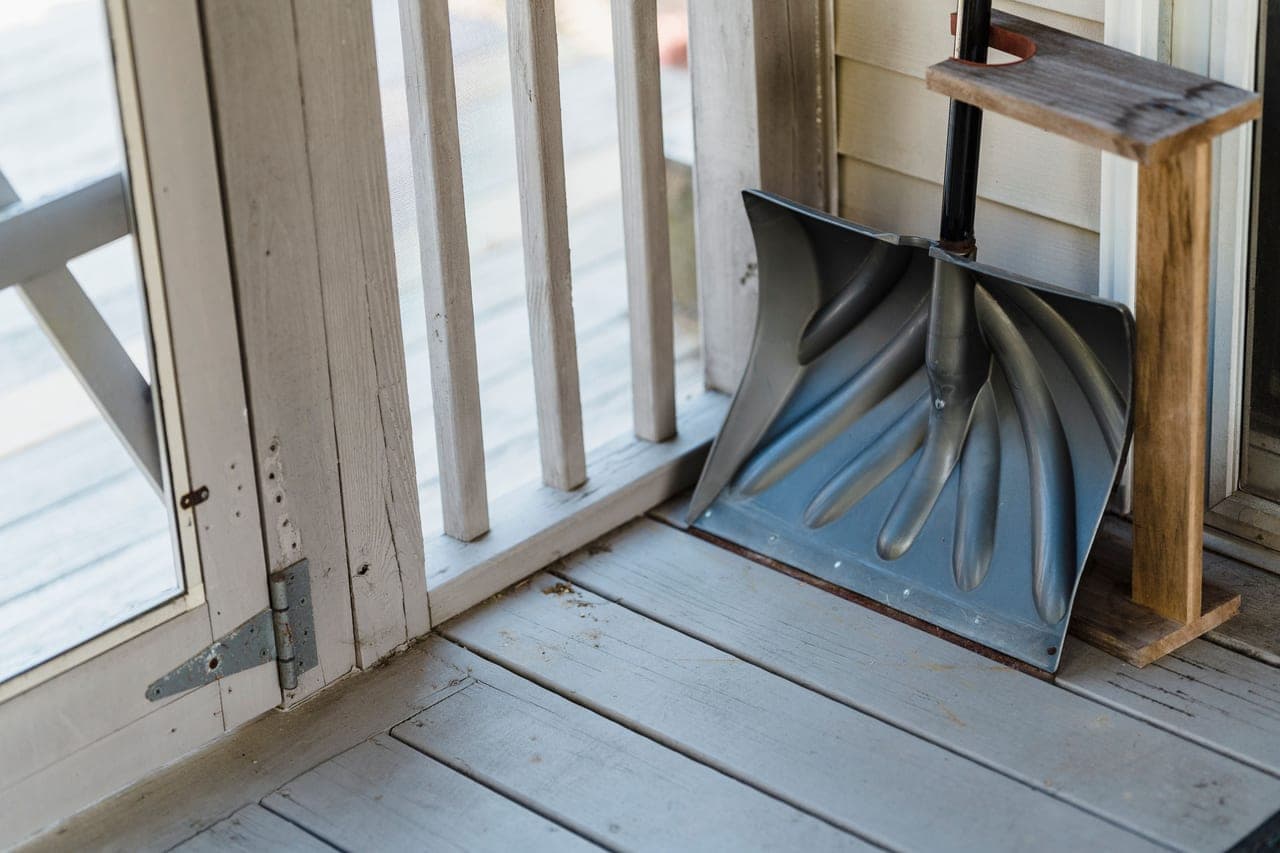
By Scooter M. · Last updated October 3, 2026
Shovel Report earns a commission when you buy through the links on this page, at no extra cost to you. It does not change what we recommend, and we publish a skip-this verdict on products we could otherwise earn from. Full disclosure.
For decks and steps you need two things a driveway tool does not provide: a head narrow enough to fit a 10- to 11-inch stair tread, and an edge that will not mark composite boards. That points to an 11- or 12-inch powered shovel, or a poly or UHMW pusher — and rules out every steel edge.
Two constraints, both dimensional
Tread depth. A standard residential stair tread runs about 10 to 11 inches deep. An 11-inch powered shovel head clears one in a single pass; a 13-inch one hangs over both edges and cannot sit flat. That single dimension is why the smallest tool in the category is the right one here, and why 'bigger is better' fails on stairs.
Surface hardness. Composite decking is softer than concrete and shows scratches permanently. Wood shows them too and can splinter. Any steel edge — a full steel blade or an aluminum wear strip — is capable of marking both. That eliminates most general-purpose shovels.
The tools that satisfy both are a narrow paddle-auger powered shovel, or a poly or UHMW blade with no metal on it at all. The Snowplow explicitly lists decks among its rated surfaces, and Manplow states its glide edge will not gouge wood or composite — those are the specific claims worth buying on.
How we picked
- Published clearing width and depth, which together set how much snow the tool can physically take per pass
- Published tool weight — every one of these is carried in front of the body for the whole clear
- Stated throughput or runtime where a maker publishes one, because it is the only spec that converts to minutes
- Battery energy in watt-hours (volts x amp-hours), which is comparable across platforms in a way 'voltage' is not
- Surface behavior: every paddle auger in this class contacts the ground, which rules gravel out entirely
We have not physically tested these products. We do not own them, we have no lab, and we do not accept free product. Everything above is compiled from published manufacturer specifications, published manuals, published standards and live retailer data - and we tell you which is which on every claim. How we pick.
Quick picks
Ranked against the criteria below. Tap a row to jump to the full write-up; the price button goes straight to Amazon.
| # | Product | Best for | Score | Price |
|---|---|---|---|---|
| 1 |  EGO Power+ SNS1201 12-in Snow Shovel A 12-inch 56V shovel with 60 degrees of chute control, on the battery platform with the most tools to grow into. | The best cordless platform | 8.0/10 | $359.00 - View on Amazon #ad affiliate link · Price as of October 15, 2026 |
| 2 | 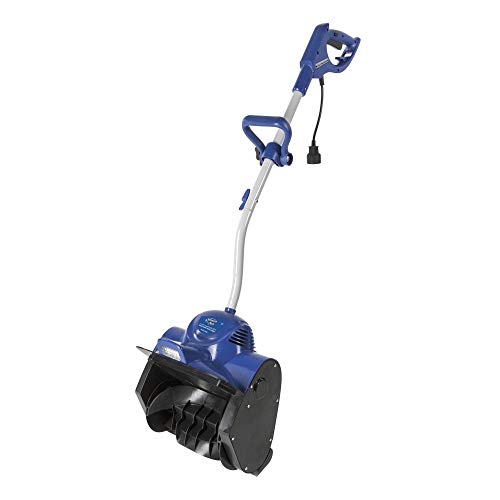 Snow Joe 324E Electric Snow Shovel A corded 11-inch shovel that publishes the two numbers that matter — 13.6 pounds and 300 lb/min — and a 20-foot throw. | The lightest powered shovel with published numbers | 8.1/10 | $124.99 - View on Amazon #ad affiliate link · Price as of October 15, 2026 |
| 3 | 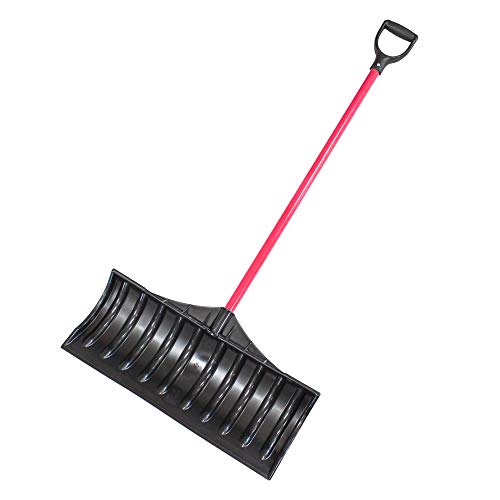 Bully Tools 92813 27-in Poly Snow Pusher A 27-inch poly scoop on a fiberglass D-grip handle — wide enough to matter, soft enough for pavers and decking. | A pusher that will not mark a surface | 8.2/10 | $51.94 - View on Amazon #ad affiliate link · Price as of October 15, 2026 |
| 4 |  The Snowplow Original Snow Pusher, 30 in A UHMW polyethylene blade that snow slides off rather than sticks to, in the width that actually changes your clearing time. Our skip-this pick | Wide, flat driveways | 8.9/10 | $69.99 - View on Amazon #ad affiliate link · Price as of October 15, 2026 |
The best cordless platform
EGO Power+ SNS1201 12-in Snow Shovel
A 12-inch 56V shovel with 60 degrees of chute control, on the battery platform with the most tools to grow into.
Buying a cordless snow shovel is mostly a decision about which battery ecosystem you are joining, because the shovel is the cheap part and the batteries are not. EGO's 56V line is the strongest argument in this category: the same pack that runs this shovel runs their 21-inch two-battery snow blower, so the natural upgrade path costs you a tool and not a tool plus a battery set.
The tool itself is a 12-inch paddle auger with a directional chute the maker rates at 60 degrees of adjustment and a throw of up to 25 feet. Chute control matters more than it sounds: without it you throw snow wherever the machine points, which on a walkway means onto the part you just cleared.
Twelve inches is the honest limitation. That is a path width for steps, a deck, a walk to the mailbox, and the strip in front of a garage door. It is not a driveway machine. Point a 12-inch shovel at a two-car drive and you will be there a long time, and the battery will not last.
EGO does not publish a weight on the listing we read. For a tool you carry in front of you, that is the number we most wanted. See how the class compares to a real machine in snow shovel versus snow blower.
What works
- Directional chute control, which most electric shovels in this class do not have
- 56V EGO packs also run their blowers, mowers and the 21-inch snow blower
- Cordless removes the extension-cord problem that makes corded shovels miserable
What does not
- 12 inches is a walkway and step tool, not a driveway tool
- A 2.5 Ah battery is small for sustained snow work
- Costs more than a corded shovel with more clearing width
The lightest powered shovel with published numbers
Snow Joe 324E Electric Snow Shovel
A corded 11-inch shovel that publishes the two numbers that matter — 13.6 pounds and 300 lb/min — and a 20-foot throw.
Weight is the specification that decides whether a powered shovel gets used, because you carry it in front of your body for the whole clear, and it is the number most makers in this class decline to print. Snow Joe prints it: 13.6 pounds. That is the lightest published figure of any powered snow tool we can verify is currently in stock.
It also publishes throughput, which is rarer still. Snow Joe states up to 300 pounds of snow a minute through an 11-by-6-inch path, with a throw of up to 20 feet. That is roughly a third of what a 15-amp corded blower moves, which is exactly the right expectation: this is a tool for steps, decks, walkways and short aprons, not a driveway.
A note on the width, because listings disagree. Some retail listings describe this model as clearing a 14-inch path; Snow Joe's own product page says 11 inches, and we go with the maker. Eleven inches is also the useful number, because a standard stair tread is 10 to 11 inches deep.
The cost of being corded is the cord. Snow Joe specifies a 12-gauge extension cord no longer than 100 feet, and a heavy cord trailing around a spinning auger is a genuine trip hazard, particularly for an older user. If that matters more than weight, a cordless tool is the better buy — corded vs cordless works through the distance question.
What works
- 13.6 lb is the lightest published weight of any powered snow tool we can verify is in stock
- Publishes throughput — 300 lb/min — which almost nothing else in this class does
- 11-inch head fits a standard stair tread
- Corded, so there is no battery to buy, charge or replace
What does not
- Corded: a stiff, cold extension cord around a spinning auger is a real trip hazard
- Maker requires a heavy 12-gauge cord, and no more than 100 feet of it
- 6-inch depth means two passes in a real storm
- Far too narrow for a driveway
A pusher that will not mark a surface
Bully Tools 92813 27-in Poly Snow Pusher
A 27-inch poly scoop on a fiberglass D-grip handle — wide enough to matter, soft enough for pavers and decking.
The single largest reduction in shoveling effort available to a homeowner is not an ergonomic handle. It is not lifting at all. A pusher slides the snow off the surface instead of picking it up, which removes the entire lift-and-throw motion that hurts people.
The constraint is that pushing only works while the snow is loose and while you have somewhere to push it to. On a 60-foot driveway you are moving snow 30 feet, and at some point the windrow in front of the blade is bigger than the blade. The technique is to push at an angle across the drive, peeling snow to the side in strips, not to bulldoze the whole length.
Poly is the right material here specifically because it is soft. Nothing on this tool can scratch a paver or a composite board, which is why it is our default recommendation on paver driveways and on decks.
It cannot chop. When the plow berm freezes you will need a steel edge or an ice chisel — the pusher will ride over the top of it.
What works
- No metal edge means no scratches on pavers, sealed asphalt or composite decking
- 27 inches clears a two-car driveway in far fewer passes than an 18-inch shovel
- Fiberglass handle survives the leverage a wide pusher generates
What does not
- A pusher does not lift — you still need a shovel for the plow ridge
- Poly will not cut refrozen crust
- Wide blades wander on an uneven surface
Wide, flat driveways
The Snowplow Original Snow Pusher, 30 in
A UHMW polyethylene blade that snow slides off rather than sticks to, in the width that actually changes your clearing time.
Skip this one
A 30-inch blade is the wrong shape for a deck or a flight of steps, even though the UHMW material is ideal for the surface. It cannot get onto a tread and it is awkward in a confined space. Buy it for the driveway and use something narrow up here.
UHMW — ultra-high-molecular-weight polyethylene — is the material specification that separates this from a $25 pusher. It is the same family of plastic used for conveyor wear strips and truck-bed liners, chosen for a very low coefficient of friction and high impact resistance at low temperature. The practical consequence is that snow slides off it, including the heavy wet snow that packs solid onto a cheap blade and turns pushing into scraping.
The maker states the edge self-sharpens with use and needs no maintenance, and lists the tool as usable on concrete, blacktop, pavers, decks, roofs and ice rinks. That surface list is unusually broad and is the reason we recommend it where a metal edge would be a liability.
Width is the other half of the argument. A 30-inch blade covers 67 percent more ground per pass than an 18-inch shovel. On a 20-by-30-foot driveway that is the difference between roughly 20 passes and roughly 12 — and each of those passes is a push, not a lift.
It is not a complete answer. Nothing that pushes deals with the plow berm, and on a long driveway you eventually run out of anywhere to push to. Pair it with a shovel, or with a machine.
What works
- UHMW is the reason wet snow releases instead of packing onto the blade
- 30 inches is the width where pass count drops noticeably on a two-car drive
- Rated by the maker for decking and pavers, unlike any steel-edged pusher
What does not
- Costs multiples of a hardware-store pusher
- Still cannot lift, and still cannot cut refrozen crust
- The wider the blade, the more it wanders on uneven ground
Technique on steps
- Clear from the top down. Snow you throw from an upper step lands on a lower one; working downward means you only clear each tread once.
- Keep both hands on the tool. You are standing on a surface that was icy a moment ago, holding something with a spinning auger. This is not the time for one-handed work.
- Do not chip at bonded ice with a poly blade. Cold polymer is brittle and stair nosings are exactly where it breaks. Treat the ice chemically instead.
- Treat the treads after clearing, not before. De-icer under snow does far less than de-icer on a cleared surface.
The de-icer question on a deck
This is where most people get into trouble, and it is a chemistry question rather than a tool question.
Chloride de-icers are the ones with a documented history of complaints on composite decking, and the sensible default on a deck is a chloride-free product. Safe Paw is the one in this build with no chloride in it at all, and its maker states it is non-corrosive and rated for wood decks. Why an entrance is the worst place on a property to put a chloride — railing posts, tread fasteners and step nosings all sit in it — is covered in how to stop ice building up on steps and porches.
But do not take our word for it over your decking manufacturer's. Trex, TimberTech and the rest publish their own maintenance guidance naming which de-icers they permit, and that guidance is what your warranty is written against. We go through what they actually publish in ice melt and composite decking.
Where a manual tool wins outright
On a small deck or a short flight of steps, a light poly pusher or a small scoop is faster than fetching, charging and carrying a powered tool. The powered option earns its place when you have a long walkway as well — enough linear feet that the throwing motion starts to add up.
If the deck is the only thing you clear, buy the poly pusher and keep the money.
Questions people ask
What is the best snow shovel for a composite deck?
Can you use an electric snow shovel on a deck?
What width snow shovel fits a stair tread?
What ice melt is safe on a deck?
Sources
Next stage
Then pick a de-icer that will not void the warranty
Clearing the deck is the easy half. The chemistry you spread afterward is what decking manufacturers write their maintenance guidance about.
Keep goingAbout the author
Scooter M.
An enthusiast who is genuinely into this. I read the manuals, compile the published specs, and do the math on door clearances. No lab coat, no test bench, and nothing here is a product I have used - which is exactly why every claim carries a source.
Published by Slate Mill Group, with the Shovel Report team. Published August 20, 2026; last updated October 3, 2026. Editorial policy.
Read next

Best Cordless Starter Kit
Snow Joe 24V-SS13 Review
The cordless kit reviewed on its published numbers — and the honest limit of a single 4.0 Ah pack.
Discontinued — See 324E
Toro Power Shovel 38361 Review
The discontinued Toro Power Shovel, reviewed against its published numbers — and the live Snow Joe 324E that replaces it.

Best for Decking
Best Ice Melt for Composite Decking
Chloride-free defaults for composite boards, and why the manufacturer's guidance is authoritative.

Decking & De-icer
Will Ice Melt Damage Composite Decking?
Why the manufacturer's care documentation is authoritative, and the chloride-free default.
Best Pusher
Best Snow Pushers
Wide pusher blades from 27 to 42 inches, and why the widest is rarely the right buy.
Best Powered Shovel for Seniors
Best Electric Snow Shovels for Seniors
Powered shovels ranked on published weight, because you carry these for the whole clear.

Powered Shovel vs Blower
Electric Snow Shovel vs Snow Blower
Published throughput and width compared, and the driveway size where the shovel stops being enough.