By Scooter M. · Last updated September 13, 2026
Shovel Report earns a commission when you buy through the links on this page, at no extra cost to you. It does not change what we recommend, and we publish a skip-this verdict on products we could otherwise earn from. Full disclosure.
At the bottom of this market you are choosing between a corded snow blower and a powered shovel, not between cheap and expensive blowers — cordless and two-stage machines simply do not exist at these prices. A 15-amp corded blower is the most capable thing you can buy cheaply, and on a driveway under about 40 feet a powered shovel costs less and does the job.
What 'budget' actually means in this category
Every other category on this site has a genuine budget tier — a cheaper version of the same kind of tool. Snow blowers do not work like that. Below a certain price the machine is not a smaller two-stage, it is a completely different architecture, and pretending otherwise is how people end up disappointed.
Three things disappear as the price comes down, in this order. Self-propulsion goes first — you push the machine yourself. Then the second stage goes, which means no impeller and a machine that cannot be used on gravel at all. Then the battery goes, and you are on a cord.
What is left at the bottom is a 15-amp corded single-stage blower, and the honest news is that it is a lot of machine. Snow Joe states up to 840 pounds per minute for the 22-inch SJ627E, which is roughly three times what a powered shovel moves. A cord is genuinely annoying. It is not a performance compromise.
Where the cord stops being acceptable
A corded machine is tethered to an outdoor outlet, and the practical limit is about 100 feet of extension cord before voltage drop starts costing you motor performance. That is not a marketing number — a long thin cord drops voltage, the motor draws more current to do the same work, and it runs hotter and slower.
So the geometry of your property decides this, not your budget. If every part of the area you clear is within about 100 feet of an outdoor receptacle, corded is the best value in snow removal. If it is not, you are looking at gas or a serious battery platform and this page is not going to help you — long driveways is.
How we picked
- Stage — single or two — because it decides which surfaces the machine can be used on at all
- Published clearing width and intake depth, which set pass count and whether a deep storm needs two passes
- Stated throughput in lb/min or tons/hour where a maker publishes it: the only spec that converts to minutes
- Energy available: cord amperage for corded machines, watt-hours (volts x amp-hours) for battery ones
- Auger material and skid-shoe adjustment, which together decide surface risk and ground clearance
We have not physically tested these products. We do not own them, we have no lab, and we do not accept free product. Everything above is compiled from published manufacturer specifications, published manuals, published standards and live retailer data - and we tell you which is which on every claim. How we pick.
Quick picks
Ranked against the criteria below. Tap a row to jump to the full write-up; the price button goes straight to Amazon.
| # | Product | Best for | Score | Price |
|---|---|---|---|---|
| 1 |  Snow Joe SJ627E 22-in Corded Snow Blower 840 pounds of snow a minute from a wall socket, at 35 pounds and a fraction of a cordless machine's price. | Most snow moved per dollar | 8.6/10 | $249.99 - View on Amazon #ad affiliate link · Price as of September 14, 2026 |
| 2 |  Snow Joe SJ625E 21-in Corded Snow Blower A 21-inch, 15-amp machine at up to 800 lb/min — the SJ627E's slightly smaller, slightly cheaper sibling. | Mid-size driveways on a budget | 8.2/10 | Check price on Amazon #ad affiliate link · no live price for this item |
| 3 | 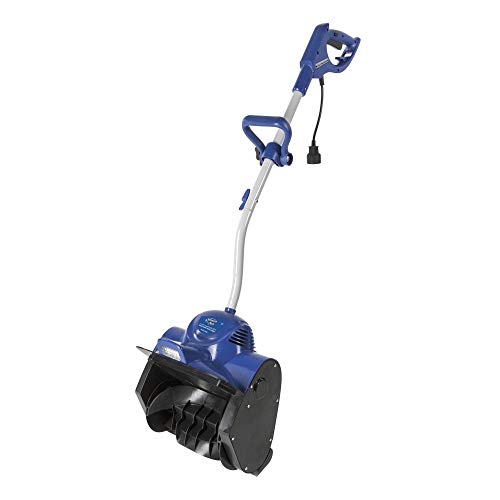 Snow Joe 324E 14-in Electric Snow Shovel A 14-inch path and a 2W LED — the small upgrades that matter when you shovel in the dark. | Clearing before sunrise | 7.5/10 | Check price on Amazon #ad affiliate link · no live price for this item |
| 4 |  Snow Joe 323E 13-in Electric Snow Shovel A corded 10-amp, 13-inch shovel at a fraction of a cordless price — if your outlet is close enough. Our skip-this pick | Cheapest powered option | 7.4/10 | Check price on Amazon #ad affiliate link · no live price for this item |
| 5 |  EGO Power+ SNT2102 21-in Snow Blower The rubber-edged predecessor to the SNT2112 — slower through crust, kinder to whatever is underneath it. Our skip-this pick | The gentler auger | 7.8/10 | Check price on Amazon #ad affiliate link · no live price for this item |
Most snow moved per dollar
Snow Joe SJ627E 22-in Corded Snow Blower
840 pounds of snow a minute from a wall socket, at 35 pounds and a fraction of a cordless machine's price.
This machine exists to make a point about arithmetic. Snow Joe states it moves up to 840 pounds of snow per minute through a 22-inch by 13-inch intake. The best-documented electric shovel in this build, the Toro Power Shovel, is rated at 300 pounds per minute through a 12-by-6-inch path. That is not a small difference in degree; it is a different job.
Work through a driveway with it. A 20-by-40-foot drive under 6 inches of fresh snow contains very roughly two to four thousand pounds of snow depending on density. At the stated 840 lb/min that is a few minutes of actual throughput — the clock is dominated by walking and turning, not by the machine.
The 13-inch intake depth is the underrated spec. Most single-stage machines in this price class top out around 8 to 10 inches, which means a foot of snow needs layered passes. Thirteen inches takes most storms in one.
The cord is the price. Fifteen amps over a long, thin extension cord is a voltage-drop problem, so you need a heavy-gauge, cold-flexible outdoor cord, and you spend the whole clear aware of where it is. Measure your outlet-to-far-corner distance before you buy — beyond about 100 feet, go cordless.
What works
- 840 lb/min is roughly triple what the best electric shovel here moves
- 13 inches of intake depth handles a real storm in one pass
- 35 lb published weight makes it manageable to turn and store
What does not
- Corded, so your working radius is a cord length
- 15 amps needs a properly rated cold-weather extension cord
- Single-stage: no gravel, and limited on steep grades
Mid-size driveways on a budget
Snow Joe SJ625E 21-in Corded Snow Blower
A 21-inch, 15-amp machine at up to 800 lb/min — the SJ627E's slightly smaller, slightly cheaper sibling.
The SJ625E and the SJ627E are close enough that the choice is usually made on price and on one inch of width. Snow Joe states 800 pounds per minute here against 840 for the wider machine — a 5 percent difference that will never be noticeable in a driveway.
The specification that is genuinely missing is intake depth. The SJ627E publishes 13 inches; the SJ625E listing we read does not publish a figure at all. That matters in a deep storm, because intake depth is what decides whether you take one pass or two, and we are not going to assume the two machines share it.
Both are 15-amp corded single-stage machines with steel augers and 180-degree chutes, and both are subject to the same cord constraint: a heavy-gauge, cold-rated outdoor extension cord is not optional, and your working radius is however long it is.
If the price difference is small, take the SJ627E for the published depth spec and the second headlight. If it is not, this is a lot of capable machine for the money on a short or mid-size driveway.
What works
- 800 lb/min stated capacity is within 5% of the bigger SJ627E
- One inch narrower, which is easier between a car and a garage wall
- Same constant corded power with no runtime limit
What does not
- Intake depth is not published on the listing we read
- No published weight
- Single LED rather than the SJ627E's pair
Clearing before sunrise
Snow Joe 324E 14-in Electric Snow Shovel
A 14-inch path and a 2W LED — the small upgrades that matter when you shovel in the dark.
The 324E is the 323E with an inch more width and a headlight. Whether that is worth the difference depends almost entirely on when you clear. If you shovel at 6 a.m. in January, in the dark, the 2-watt LED is not a gimmick — you can see the edge of the walk and the ice you are about to stand on.
The extra inch of clearing width is close to noise. Going from 13 to 14 inches is a 7.7 percent reduction in pass count, which on a walkway saves you well under a minute. Do not buy it for the width; buy it for the light, or buy the 323E.
Everything else in the class carries over: a 10-amp corded motor with no runtime limit, a two-blade paddle auger that contacts the surface, and a 6-inch maximum bite that means a real storm gets cleared in two passes at different heights.
As with every paddle-auger tool, keep it off gravel. The auger touches the ground by design, so on a gravel surface it picks up stone and throws it at whatever is 20 feet away.
What works
- 14 inches is the widest path in the electric-shovel class here
- The LED is genuinely useful for anyone clearing before work
- Same constant corded power as the 323E
What does not
- Same cord management problem as every corded tool
- The extra inch of width over the 323E is marginal
- Still 6 inches of depth, so deep storms need two passes
Cheapest powered option
Snow Joe 323E 13-in Electric Snow Shovel
A corded 10-amp, 13-inch shovel at a fraction of a cordless price — if your outlet is close enough.
Skip this one
Skip any corded snow tool if your outdoor outlet is not within about 75 feet of everything you need to clear. Beyond that you are fighting voltage drop and a frozen cord, and the tool stops being worth owning.
Corded tools have one genuine advantage over battery tools and it is a big one: constant power, forever. A 10-amp motor on a 120-volt circuit does not fade at minute fifteen, and there is no charging cycle to plan around. In a category where every cordless spec sheet quotes runtime under ideal conditions, that is worth something.
The cost is the cord, and it is a real cost. You need an outdoor-rated, cold-flexible extension cord in a gauge heavy enough for the amperage — ordinary indoor cords stiffen into a coil at 20°F, and undersized cords cause voltage drop that makes the motor work harder. Then you spend the entire clear managing where the cord is relative to the auger.
The path is 13 by 6 inches, the same width as the cordless 24V-SS13. Snow Joe states a 20-foot throw, and the tool has a push-button start with a safety switch, which is the standard arrangement in this class.
The decision is geometric, not technical. Measure from your outdoor outlet to the farthest point you need to clear. Under 50 feet, corded is the value buy. Over 75, buy cordless or a blower and stop thinking about it.
What works
- Never runs out of power mid-driveway
- Cheapest way into a powered tool by a wide margin
- Adjustable handle helps fit taller and shorter users
What does not
- The cord is the whole experience — you manage it constantly
- Needs a cold-weather-rated outdoor extension cord, which is an extra cost
- Cord length caps your working radius, so it is unusable on a long driveway
The gentler auger
EGO Power+ SNT2102 21-in Snow Blower
The rubber-edged predecessor to the SNT2112 — slower through crust, kinder to whatever is underneath it.
Skip this one
This is here to mark the edge of the category, not as a budget pick. It is the cheapest way into EGO's 56V blowers, and it is still several times the price of the corded machines above it — because you are buying two 5.0 Ah packs and a charger as well as a blower. If your budget is the constraint, a cord costs nothing and never runs flat.
This is the baseline 21-inch EGO and the machine the steel-auger SNT2112 is measured against. EGO states the newer model cuts 50 percent faster; the corollary is that this one is 50 percent slower through the hard stuff, which tells you exactly what you are trading.
There is a case for the rubber edge and it is not just price. A rubber-edged auger scrapes less aggressively, which matters on a surface you care about — a sealed asphalt drive, a paver apron, a painted garage floor. It is still a single-stage machine and still contacts the ground, so gravel remains out of scope, but it is the gentler of the two.
The listing we read publishes less than the SNT2112's: no throw distance, no weight. We are not going to carry over the newer model's figures, because they are different machines with different augers.
If your snow is usually fresh and light and your surface is one you would rather not scratch, this is a rational buy. If you are fighting refrozen plow ridges every week, buy the steel auger and stop reading.
What works
- Same 56V two-battery platform as the SNT2112 at a lower price
- Rubber edge is less likely to mark a surface than steel
- Rapid charger included
What does not
- EGO's own comparison says the steel-auger SNT2112 cuts 50% faster
- Rubber edges ride over crusted or refrozen snow
- Fewer published specs on the listing than the newer model
When a powered shovel is the better cheap buy
There is a real crossover point and most buyers are on the wrong side of it. A powered shovel is a 12- to 14-inch single-stage machine you carry. It costs roughly half what a corded blower costs and it moves roughly a third as much snow — Toro publishes 300 pounds per minute for its Power Shovel against Snow Joe's 840 for the 22-inch blower.
That ratio makes the blower sound like the obvious answer, and on a big driveway it is. But throughput is only half of a clear. The other half is the fetching, the setting up, the cord run and the putting away, and a 13-pound shovel wins all of those against a 35-pound blower.
Roughly where each one wins
What you are actually giving up
We would rather be specific than reassuring, so here is the full list of what the cheap machines cannot do.
- Gravel. Single-stage augers contact the ground. On gravel they pick up stone and throw it. This is a safety limit, not a preference.
- The plow ridge. The compacted, refrozen berm the municipal plow leaves across the end of your drive will stop any of these machines. That is a chopper-and-shovel job — see ice choppers.
- Deep wet snow in one pass. The SJ627E takes a published 13 inches of depth; most of this class takes six. In a big storm you clear in layers, or you clear twice during the storm.
- Distance from power. Covered above, and it is the one that rules corded out entirely for some properties.
- Self-propulsion. You are pushing. On a steep driveway that matters a great deal — steep driveways covers why.
None of that makes a cheap machine a bad buy. It makes it a specific buy. On a flat, paved, two-car driveway within reach of an outlet, a 15-amp corded blower is the best value in this entire category and the extra money buys convenience rather than capability.
If you want the fuller comparison of what a machine has to beat before it earns its price, snow shovel vs snow blower works through the throughput arithmetic, and how much does a snow blower cost covers the tiers above this one.
Questions people ask
What is the cheapest type of snow blower?
Are cheap snow blowers worth buying?
How much should I spend on a snow blower?
Is a powered shovel better than a cheap snow blower?
Can you use a cheap snow blower on gravel?
Sources
Next stage
What the tiers above this one buy
Budget decides architecture in this category. Here is what each price step actually adds, and which additions are worth paying for.
Keep goingAbout the author
Scooter M.
An enthusiast who is genuinely into this. I read the manuals, compile the published specs, and do the math on door clearances. No lab coat, no test bench, and nothing here is a product I have used - which is exactly why every claim carries a source.
Published by Slate Mill Group, with the Shovel Report team. Published September 13, 2026; last updated September 13, 2026. Editorial policy.
Read next
Ownership Cost
What a Snow Blower Actually Costs
Purchase tiers, running costs and maintenance — the full ownership picture for both fuels.

Shovel vs Blower
Snow Shovel vs Snow Blower
The throughput arithmetic that decides whether a machine earns its price on your driveway.
Best Electric Blower
Best Electric Snow Blowers
Corded and battery machines compared on stated throughput, intake depth and surface fit.
Best Single-Stage
Best Single-Stage Snow Blowers
The machines that scrape to bare pavement — ranked on throughput, depth and auger material.