By Scooter M. · Last updated October 18, 2026
Shovel Report earns a commission when you buy through the links on this page, at no extra cost to you. It does not change what we recommend, and we publish a skip-this verdict on products we could otherwise earn from. Full disclosure.
If you own Greenworks packs, buy the Greenworks shovel for your voltage - it is the best first-party answer here, and the 80V kit publishes the deepest bite in the class at 8 inches. If you own DeWalt 20V or Milwaukee M18 packs, there is no first-party shovel shipping yet; the only route is a third-party bare tool, which works but publishes no weight, depth or throw. If you own nothing, buy a kit with the battery included rather than joining a platform for one seasonal tool.
Why this question is the right one to ask
A powered snow shovel is a small motor, a paddle auger and a plastic housing. The costly component is the lithium pack, which is why the same tool can be $110 with a battery or $160 without one and the one without feels like the bargain only if you already have the battery.
That makes "which platform do I already own" the first question rather than a detail, and it is the question the category's marketing is least interested in answering. Searches for a shovel by brand name - DeWalt, Ryobi, Milwaukee, Greenworks - run into tens of thousands a month between them, and what those searchers mostly find is not what they are looking for.
This page is the brand-by-brand answer. If you want the prior argument about which platform to buy into from scratch, compared on stored energy rather than on the number printed on the box, that is battery platforms.
Brand by brand, as of this update
Powered snow shovels by battery platform, verified purchasable
Greenworks: the strongest first-party answer
Greenworks makes a 12-inch brushless snow shovel across 24V, 40V, 48V and 80V, which is unusual - most brands make one or none. If you own Greenworks anything, there is a shovel for your packs.
One caution that is Greenworks' fault rather than ours. The company's own SKU pages for its 80V 12-inch shovel do not agree with each other: one states an 8-inch clearing depth and a 25-foot throw, others state 6 inches and 20 feet. We have cited the SKU page we actually read and attributed the figures to it. No Greenworks page we found publishes a weight for any of them, which on a tool you carry in front of your body is the omission that matters most.
DeWalt: the biggest gap between what people search and what they can buy
DeWalt 20V MAX is the dominant cordless platform in American garages, and "DeWalt snow shovel" is searched thousands of times a month. Here is the accurate answer.
DeWalt now lists a first-party 10-inch cordless snow shovel, in both a bare-tool and a battery-kit version. When we checked both listings, each returned a future availability date rather than stock - a pre-order state, not a purchase. So we have not featured it. It is coming, and if you can wait a season, a first-party tool with a DeWalt warranty is the better version of this idea than anything below.
Everything else returned by that search is third-party. Tools whose only relationship to DeWalt is a battery mount, sold under names most buyers have never heard. They work - the battery interface is the whole point and it does what it says - but they are not DeWalt products and carry no DeWalt support.
Ryobi: real products, wrong channel
Ryobi has the highest brand-level search volume in this whole category, and it is the hardest brand to give a clean answer on, because its snow tools do not reach this channel in a form we will recommend.
What we found when we checked: a Ryobi 40V 12-inch wheeled cordless snow shovel listed as a single used unit rather than new retail stock, and a Ryobi 18V ONE+ 25 cm shovel that is a European model listed at an import price. Both are real Ryobi products. Neither is a listing we will feature, because the first is one second-hand item and the second is a gray-market import of a tool built for a different market.
The practical answer for a Ryobi owner is therefore annoying but honest: your brand makes a shovel, your usual retailer may well carry it, and we cannot verify or price it here. If you want something today from the channel this site covers, the SKIL or Greenworks kits are the comparable buys.
One side-effect worth recording, because this site had it wrong: we have said elsewhere that no electric snow shovel has wheels. That Ryobi 40V model shows the claim has outlived its accuracy, and we have corrected it on are electric snow shovels any good. Nothing we can verify as purchasable new has wheels - which is a narrower and more defensible statement than the one we were making.
Milwaukee, SKIL and the rest
Milwaukee M18 has no first-party shovel at all; the third-party route is the only one. SKIL makes a first-party 10-inch kit on its PWR CORE 20 platform, which is the cheapest complete kit here. Snow Joe's 24V and EGO's 56V tools are both first-party and both already covered in depth on this site.
The number that decides between them: watt-hours
Voltage is on the front of the box and tells you almost nothing about how much work a battery can do. The comparable figure is energy, and it is one multiplication: volts times amp-hours equals watt-hours.
Energy in the pack each option ships with, or asks you to supply
Two things fall out of that table. The 80V kit ships twice the energy of the SKIL kit, which is the real difference between them rather than the voltage label. And a DeWalt 20V drill pack at 5.0 amp-hours holds about 100 watt-hours, which is a perfectly respectable store for a 13-inch shovel - so the third-party bare-tool route is not energy-starved. It is specification-starved, which is a different complaint.
How we picked
- Which battery platform the tool takes, because that is the question this page exists to answer
- Whether a battery and charger are in the box, since that is most of the price difference between otherwise identical tools
- Stored energy in watt-hours - volts times amp-hours - rather than the voltage on the carton
- Published clearing width and depth, and we say plainly where a maker publishes neither
- Verified purchasable new, with condition and availability checked: a single used unit or a gray-market import is not a recommendation
We have not physically tested these products. We do not own them, we have no lab, and we do not accept free product. Everything above is compiled from published manufacturer specifications, published manuals, published standards and live retailer data - and we tell you which is which on every claim. How we pick.
Quick picks
Ranked against the criteria below. Tap a row to jump to the full write-up; the price button goes straight to Amazon.
| # | Product | Best for | Score | Price |
|---|---|---|---|---|
| 1 |  Greenworks 80V 12-in Brushless Snow Shovel Kit Eighty volts behind a 12-inch head, battery and charger in the box, and an 80V platform that runs more than 75 other Greenworks tools | The most voltage you can get in a powered shovel, with the pack included | 7.5/10 | $349.99 - View on Amazon #ad affiliate link · Price as of October 19, 2026 |
| 2 |  Greenworks 24V 12-in Brushless Snow Shovel (Tool Only) A brushless 12-inch head as a bare tool, which is the right purchase if and only if the 24V packs are already in your garage. | Anyone who already owns Greenworks 24V batteries | 7.1/10 | $159.99 - View on Amazon #ad affiliate link · Price as of October 19, 2026 |
| 3 |  HeinPro 13-in Cordless Snow Shovel for DeWalt 20V Batteries (Bare Tool) A third-party bare tool that takes DeWalt 20V packs, and the honest answer to a question tens of thousands of people ask every month Our skip-this pick | Putting DeWalt or Milwaukee packs you already own to work in winter | 6.3/10 | $169.99 - View on Amazon #ad affiliate link · Price as of October 19, 2026 |
| 4 | 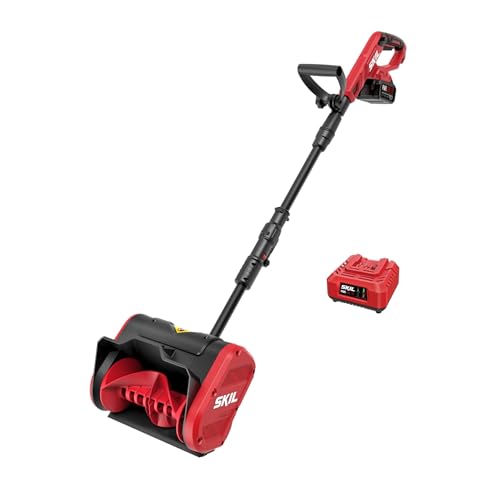 SKIL PWR CORE 20 10-in Snow Shovel Kit SNS1000B-13 The lowest-priced powered shovel we can verify that still ships with a battery and charger, and at 10 inches the narrowest | The cheapest way into a powered shovel with the battery in the box | 6.4/10 | $109.00 - View on Amazon #ad affiliate link · Price as of October 19, 2026 |
| 5 | 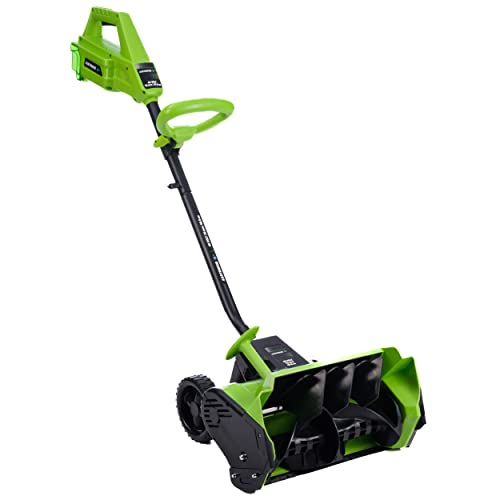 Earthwise SN74016 40V 16-in Cordless Snow Shovel Sixteen inches wide with the battery included, which is four inches more path than anything else in this class and the whole reason to choose it. Our skip-this pick | The widest powered shovel - closest thing here to a small blower | 6.5/10 | $279.99 - View on Amazon #ad affiliate link · Price as of October 19, 2026 |
| 6 |  Voltask 24V 13.2-in Cordless Snow Shovel A 13.2-inch head with a 4 Ah pack and charger included at the bottom of the market, from a brand that exists only to sell this one kind of tool | A standalone kit when you own no cordless platform at all | 6.1/10 |
The most voltage you can get in a powered shovel, with the pack included
Greenworks 80V 12-in Brushless Snow Shovel Kit
Eighty volts behind a 12-inch head, battery and charger in the box, and an 80V platform that runs more than 75 other Greenworks tools - the strongest upgrade path here.
This is the top of the powered-shovel class on the specification that actually governs how a cordless tool behaves under load, which is voltage, and it comes with a pack that holds real energy rather than a token one. Eighty volts times 2.0 amp-hours is 160 watt-hours in the box - twice what the SKIL kit ships with.
Greenworks publishes, for the tool-only version of this shovel, a 12-inch clearing path, an 8-inch clearing depth and a 25-foot throw. That 8-inch depth is the deepest bite of any powered shovel we list, and depth is what decides whether a six-inch storm is one pass or two. The LED headlights sound like a sales bullet until you have cleared a walk at six in the morning in February.
Then the honesty problem, which is the company's rather than ours: Greenworks' own listings for its 80V 12-inch shovels do not agree. One SKU page states 8 inches of depth and a 25-foot throw; others state 6 inches and 20 feet. We have cited the SKU whose page we read and said which figures came from it, and we are not going to average them into a single number no manufacturer publishes. No Greenworks page we found states a weight for any of them.
Who should buy it: someone who either owns 80V Greenworks equipment already or intends to, and who wants the deepest bite and the biggest included pack in the class. Someone clearing only a short set of steps is paying for headroom they will not use, and the SKIL kit or a corded tool will do that job for a fraction of the money. The distance and cord question is worked through on corded vs cordless.
What works
- 160 Wh included in the box - double the SKIL kit's 80 Wh and well above a 24 V pack's 96
- Eighty volts holds speed under load better than any other platform in this class
- LED headlights, which is not a gimmick on a tool used before dawn
- The 80V platform spans over 75 tools, so the pack has somewhere to go after winter
What does not
- The most expensive kit on this page by a clear margin
- Greenworks' own SKU pages contradict each other on clearing depth (6 in vs 8 in) and throw (20 ft vs 25 ft)
- No published weight anywhere we could find, on any 80V shovel SKU
- A 2.0 Ah 80V pack is physically large for a tool carried in front of you
Anyone who already owns Greenworks 24V batteries
Greenworks 24V 12-in Brushless Snow Shovel (Tool Only)
A brushless 12-inch head as a bare tool, which is the right purchase if and only if the 24V packs are already in your garage.
The case for this tool is entirely about what you already own. As a bare tool it is the cheapest 12-inch brushless head here; add a battery and a charger and the saving disappears. If there are 24V Greenworks packs on a shelf in your garage, this is the correct purchase on the page. If there are not, it is a trap dressed as a bargain.
The hardware is sound. Brushless matters more in snow than in most applications, because wet snow is a heavy, variable load and brushless motors hold their speed under it rather than bogging down. Directional vanes beat a fixed chute, since the direction you need to throw changes as you work down a walk.
Energy is the limit. Twenty-four volts times a 4.0 Ah pack is 96 watt-hours, which is a small store for a 12-inch head - EGO's 56V 2.5 Ah holds 140 Wh and its blower configurations run to 840. For a walk and a set of steps, 96 Wh is fine. For anything approaching a driveway it is not, and the honest answer there is a blower.
Greenworks publishes no weight and no clearing depth for this particular SKU, and the company's own listings for its 80V shovels disagree with each other on both depth and throw distance - 6 inches against 8, and 20 feet against 25, depending which SKU page you read. That is worth knowing before you shop this category on spec sheets.
What works
- Brushless motor, which holds speed better than a brushed one under wet snow
- Lowest price of any 12-inch brushless head here, because you supply the battery
- Greenworks 24V is a broad platform - the packs run string trimmers, blowers and hand tools
- Directional vanes rather than a fixed chute
What does not
- Bare tool: priced attractively only because there is no battery or charger in the box
- A 24 V 4.0 Ah pack holds 96 Wh, which is modest for a 12-inch head
- Greenworks publishes neither a weight nor a clearing depth for this SKU
- Buying into 24V from scratch for one seasonal tool is the mistake this page warns about
Putting DeWalt or Milwaukee packs you already own to work in winter
HeinPro 13-in Cordless Snow Shovel for DeWalt 20V Batteries (Bare Tool)
A third-party bare tool that takes DeWalt 20V packs, and the honest answer to a question tens of thousands of people ask every month - with the caveat that it is not a DeWalt and publishes almost nothing.
Skip this one
Buy it only for the reason it exists - you own DeWalt or Milwaukee packs and want winter use out of them. Judged as a tool on its merits it publishes nothing: no weight for something you carry, no depth, no throw. If you have no platform commitment, a first-party kit with real published figures is the better purchase at a similar total cost, and DeWalt's own 10-inch shovel is listed but was not shipping when we checked.
"DeWalt snow shovel" is searched thousands of times a month, and the results are mostly this: third-party tools whose only connection to DeWalt is a battery mount. Saying so plainly is the most useful thing a page can do for that search, and it is why this entry exists.
The proposition is real, though. If you own DeWalt 20V MAX packs - and a great many households do, because it is the dominant cordless platform in American garages - then a bare tool at this price is the cheapest powered shovel you can put into service, because the expensive part is already on your shelf.
What you are not getting is a DeWalt. The listing states compatibility, not licensing, and there is no DeWalt warranty or support behind it. The clearest evidence of what this product actually is: the identical 13-inch tool is listed at the same price in a Milwaukee M18 mount. One tool, several battery moldings, no brand engineering behind either.
The specification gap is the real objection. No weight, no clearing depth and no throw distance is published for it. Weight is the number that decides how a carried tool feels, and the powered shovels in our registry that do publish one range from 13.6 to 23.3 pounds. Buying blind on that spec is a genuine risk, and it is the price of the battery compatibility.
One more thing worth knowing if you came here for the brand: DeWalt now lists a first-party 10-inch cordless snow shovel of its own. When we checked, both its bare-tool and battery-kit listings showed a future availability date rather than stock, so we have not featured it - but it exists, and if you can wait, a first-party tool with a warranty is the better version of this idea.
What works
- The only route we can verify to a powered snow shovel running DeWalt 20V packs you already own
- Bare tool, so the price reflects not paying twice for batteries
- 13 in is a sensible width, wider than the budget kits and still tread-friendly
What does not
- It is not a DeWalt product and carries no DeWalt warranty, support or engineering - only the battery mount
- Publishes no weight, no depth and no throw distance: there is effectively no specification to buy on
- The identical 13-inch tool is listed at the same price in a Milwaukee M18 mount, which tells you the battery fit is a molding choice rather than a design
- Running a 20 V drill pack in a snow tool works at the bottom of the energy range: a 5.0 Ah DeWalt pack is 100 Wh
The cheapest way into a powered shovel with the battery in the box
SKIL PWR CORE 20 10-in Snow Shovel Kit SNS1000B-13
The lowest-priced powered shovel we can verify that still ships with a battery and charger, and at 10 inches the narrowest - which is the trade you are making.
This is the entry point. It is the only powered shovel we can verify that includes a battery and a charger and still lands at the bottom of the category's price range, and for someone whose job is a front walk and a set of steps it is enough tool.
The specification to understand before buying is the 10-inch clearing path. Every other kit here is 12 or 13 inches, and the Earthwise is 16. On a stair tread that narrowness is an advantage, because a 16-inch head does not fit a tread at all. On a 40-foot front walk it means more passes than a 13-inch tool needs. Match it to the surface and it is the right buy; buy it for a driveway and it will feel slow, which is the same mistake the whole category punishes.
The 80 watt-hour pack is the smallest energy store on this page. Watt-hours are volts times amp-hours, so 20 V times 4.0 Ah is 80 Wh - against 96 for a 24 V Snow Joe pack and 140 for EGO's 2.5 Ah. That is the honest ranking of how much work each battery can do, and the full comparison is on battery platforms.
What SKIL does not publish is worth stating plainly: no weight and no throw distance for this model. For a tool you carry in front of your body for an entire clear, weight is the most relevant number there is, and we will not print an estimate in place of it. If that matters to you, the Greenworks and Earthwise entries publish more.
What works
- Battery and charger included at the lowest price in the powered-shovel class
- 20 V PWR CORE packs run SKIL's wider cordless range, so the battery is not stranded on one seasonal tool
- 10 inches is genuinely narrow, which is an advantage on a stair tread
What does not
- 10 in is the narrowest clearing path here - more passes on anything wider than a walkway
- 80 Wh is the smallest pack of any kit on this page; a 24 V 4.0 Ah Snow Joe holds 96 Wh and an EGO 2.5 Ah holds 140
- SKIL publishes no weight and no throw distance for this model, so two of the three specs that matter are unavailable
- A 20 V platform is a drill-and-driver ecosystem; it was not built around outdoor power equipment
The widest powered shovel - closest thing here to a small blower
Earthwise SN74016 40V 16-in Cordless Snow Shovel
Sixteen inches wide with the battery included, which is four inches more path than anything else in this class and the whole reason to choose it.
Skip this one
A good tool on the wrong axis for this page. Sixteen inches is the widest powered shovel we can verify and genuinely useful on a long walk, but Earthwise 40V packs run almost nothing else a household already owns - so judged as a platform answer it is the weakest here. Buy it for the width if the width is what you need, and ignore the platform entirely.
Width is the whole proposition. Every other powered shovel on this page is 10 to 13 inches; this one is 16. On a long front walk or a one-car apron that difference compounds across every pass, and it is the only tool in the class that makes a driveway-ish surface a reasonable ask rather than a bad idea.
The same number is the reason not to buy it for the category's best job. A standard stair tread is about 11 inches deep. A 16-inch head does not sit on one. If your actual problem is steps and a deck, the narrow tools are not a compromise - they are the correct geometry, and decks and steps works the dimensions through.
Earthwise publishes very little for this model: no weight, no clearing depth, no throw distance. We are not going to infer them. What can be said without inventing anything is that a wider auger housing on a tool you carry in front of your body is unlikely to be lighter than the 13-to-23-pound range the rest of the class publishes, and weight is the specification that decides how a carried tool actually feels after twenty minutes.
The platform is narrow in the other sense too. Earthwise 40V packs do not run equipment most households already have, so unless you are buying into that ecosystem for other reasons you are paying for a battery and a charger to serve one seasonal tool - the pattern battery platforms argues against.
What works
- 16 in of path - a third more per pass than the 12-inch tools and 60% more than the SKIL
- Battery included, so there is no second purchase to budget
- The only powered shovel we list that gets close to a one-car apron in a sensible number of passes
What does not
- Too wide for a stair tread, which is the job this category is otherwise best at
- Earthwise publishes no weight, no depth and no throw distance for it - and a wider head on a carried tool almost certainly means more weight
- A small battery platform: the 40V packs run little else most people own
- No brushless claim on the listing
A standalone kit when you own no cordless platform at all
Voltask 24V 13.2-in Cordless Snow Shovel
A 13.2-inch head with a 4 Ah pack and charger included at the bottom of the market, from a brand that exists only to sell this one kind of tool - which is both the appeal and the risk.
This is the answer to a specific situation: you own no cordless tools, you do not want to join a platform, and you want one box that contains everything. Voltask sells essentially nothing but powered snow shovels, and this kit prices accordingly.
On width it is well judged. At 13.2 inches it takes more per pass than the 12-inch tools while staying narrow enough for most stair treads, which is the compromise this category exists for. The listing's 23-foot throw is a real figure, in the same range as tools costing twice as much.
The platform column is where it loses. A 24V Voltask pack runs a Voltask shovel and nothing else. Compare that with the Greenworks and SKIL entries, where the battery you buy for snow also runs a trimmer or a drill the rest of the year. If you expect to buy any other cordless outdoor tool in the next few years, that is a real cost you are taking on here to save money today.
No weight is published, and we will not estimate one. For a tool held in front of your body for an entire clear, the absence of that figure is the biggest gap in this listing - the four powered shovels in our registry that do publish one span 13.6 to 23.3 pounds, which is nearly a factor of two.
What works
- Complete kit - tool, 4 Ah battery and charger - at the low end of the market
- 13.2 in is a useful width: more path than a 12-inch head and still narrow enough for most treads
- A stated 23 ft throw is in line with much more expensive tools
What does not
- The 24V pack runs nothing else - there is no platform to join, only this tool
- 96 Wh is a modest energy store, the same as a Snow Joe 24V pack
- No published weight, which for a carried tool is the spec that matters most
- A single-category brand: if it fails outside warranty there is no ecosystem behind it
If you own no platform at all
Do not join one for a snow shovel. That is the mistake this whole page is arranged to prevent. A seasonal 12-inch tool is a bad reason to commit to a battery ecosystem, because the packs and charger cost more over time than the shovel does.
Buy a complete kit instead and treat the battery as part of the tool rather than as the start of a collection - the SKIL at the bottom of the market, or the Voltask if you want more width for similar money. Or buy corded and skip batteries altogether, which under about 50 feet from an outlet is genuinely the better engineering decision. That distance question is worked through properly on corded vs cordless.
And the prior question to all of this: a powered shovel is the right tool for walkways, steps, decks and short aprons, and the wrong one for a driveway. If what you actually have is a driveway, no battery platform fixes that - see are electric snow shovels any good before you spend anything.
Questions people ask
Does DeWalt make a snow shovel?
Is there a Ryobi snow shovel?
Are "compatible with DeWalt 20V" snow shovels any good?
Should I buy a bare tool or a kit?
Which battery platform is best for a snow shovel?
Can I use a drill battery in a snow shovel?
Sources
- Greenworks - 80V 12 in snow shovel, SKU 2618402 / SS80L02: 12 in path, 8 in depth, 25 ft throw, brushless, LED
- Amazon listing - Greenworks 80V 12 in kit with 2.0 Ah battery and charger
- Amazon listing - Greenworks 24V 12 in brushless, tool only
- Amazon listing - SKIL PWR CORE 20 SNS1000B-13 kit, 10 in
- Amazon listing - 13 in bare tool for DeWalt 20V MAX packs
- Amazon listing - the identical 13 in tool in a Milwaukee M18 mount, same price
- Amazon listing - Earthwise SN74016 40V 16 in, battery included
- Amazon listing - Voltask 24V 13.2 in kit, 23 ft throw
Next stage
The platform decision, in watt-hours
If you are choosing a platform rather than matching one you own, this compares 24V, 40V and 56V on stored energy and upgrade path instead of on the number printed on the box.
Keep goingAbout the author
Scooter M.
An enthusiast who is genuinely into this. I read the manuals, compile the published specs, and do the math on door clearances. No lab coat, no test bench, and nothing here is a product I have used - which is exactly why every claim carries a source.
Published by Slate Mill Group, with the Shovel Report team. Published October 18, 2026; last updated October 18, 2026. Editorial policy.
Read next
Battery Platform Guide
Cordless Snow Tool Battery Platforms Compared
Watt-hours, not volts — how to compare 24V, 40V and 56V snow tool platforms.

Corded vs Cordless
Corded vs Cordless Electric Snow Shovels
The distance rule that decides corded versus cordless, and the cord you need.

Worth It, Or Not
Are Electric Snow Shovels Any Good?
The honest case for and against the category, with the published numbers that decide it.
Best for Decks & Steps
Clearing Decks, Steps and Walkways
Narrow heads and non-marking edges for stair treads, composite decks and tight walkways.