
By Scooter M. · Last updated September 13, 2026
Shovel Report earns a commission when you buy through the links on this page, at no extra cost to you. It does not change what we recommend, and we publish a skip-this verdict on products we could otherwise earn from. Full disclosure.
Electric snow shovels are worth it for walkways, steps, decks and short aprons, and for anyone who should not be lifting snow. They are not worth it for a driveway: they are narrow, they are carried in front of your body for the whole clear, and Toro's published 300 pounds per minute is roughly a third of what a corded blower moves. Buy one for the surface it suits, not as a cheap blower.
What they are actually good at
The category exists because there is a real gap between a hand shovel and a snow blower. A blower is too wide for a stair tread, too heavy to carry up steps, and absurd for a twenty-foot path. A hand shovel requires lifting, which is the motion that causes most shoveling injuries.
A powered shovel sits precisely in that gap. It is 11 to 14 inches wide, so it fits a tread and a narrow walk. It throws rather than lifts — Toro publishes up to 20 feet, EGO up to 25 — which removes the cantilevered load that hurts people. And it weighs 13 to 17 pounds where a published figure exists, so most adults can carry it.
On that surface it is not a compromise. It is the correct tool, and nothing else does the job as well.
Where the disappointment comes from
Almost every bad review of this category is someone who bought one to clear a driveway. The arithmetic explains why that goes badly.
Published throughput, where makers state one
Roughly a third the throughput at half the width. On a set of steps that ratio is irrelevant. On a two-car driveway it means you are outside nearly three times as long, holding the tool in front of you the entire time, and the machine that would have done it properly costs about twice as much.
There is a second, quieter disappointment: no electric snow shovel has wheels. It is one of the most common searches in this category and the answer does not change. Every tool in this class is carried. If you need something that rolls, you need an electric snow blower.
How we picked
- Published clearing width and depth, which set how much the tool can physically take per pass
- Published tool weight, because every one of these is carried in front of the body for the whole clear
- Stated throughput or runtime where a maker publishes one — the only spec that converts into minutes outside
- Energy source and what it costs: cord amperage, or battery watt-hours and whether packs are included
- Honest comparison against the manual tool that costs a fraction as much and often wins
We have not physically tested these products. We do not own them, we have no lab, and we do not accept free product. Everything above is compiled from published manufacturer specifications, published manuals, published standards and live retailer data - and we tell you which is which on every claim. How we pick.
Quick picks
Ranked against the criteria below. Tap a row to jump to the full write-up; the price button goes straight to Amazon.
| # | Product | Best for | Score | Price |
|---|---|---|---|---|
| 1 |  Toro 38361 Power Shovel 12 inches, 13 pounds, 300 lb/min, 20-foot throw — Toro publishes every number, which almost nobody else here does. | Best-documented specs in the class | 7.5/10 | Check price on Amazon #ad affiliate link · no live price for this item |
| 2 |  EGO Power+ SNS1201 12-in Snow Shovel A 12-inch 56V shovel with 60 degrees of chute control, on the battery platform with the most tools to grow into. | The best cordless platform | 8.0/10 | $359.00 - View on Amazon #ad affiliate link · Price as of September 14, 2026 |
| 3 | 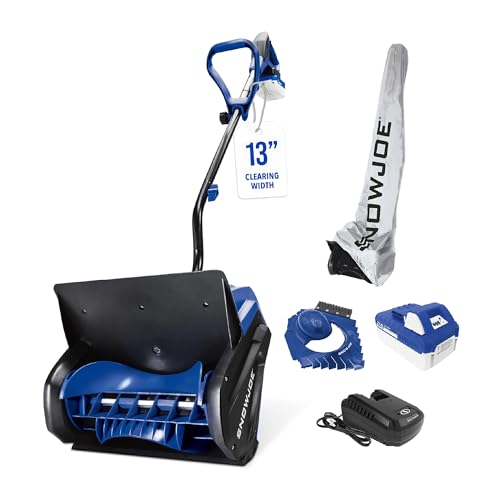 Snow Joe 24V-SS13-TV1 Cordless Snow Shovel Kit 13 inches wide, 17.2 pounds, dual-handle — the cordless shovel that publishes the number that decides whether you finish. | Lightest cordless with a published weight | 7.8/10 | $199.99 - View on Amazon #ad affiliate link · Price as of September 14, 2026 |
| 4 |  Snow Joe 323E 13-in Electric Snow Shovel A corded 10-amp, 13-inch shovel at a fraction of a cordless price — if your outlet is close enough. Our skip-this pick | Cheapest powered option | 7.4/10 | Check price on Amazon #ad affiliate link · no live price for this item |
| 5 |  The Snowplow Original Snow Pusher, 30 in A UHMW polyethylene blade that snow slides off rather than sticks to, in the width that actually changes your clearing time. Our skip-this pick | Wide, flat driveways | 8.9/10 | $64.99 - View on Amazon #ad affiliate link · Price as of September 14, 2026 |
Best-documented specs in the class
Toro 38361 Power Shovel
12 inches, 13 pounds, 300 lb/min, 20-foot throw — Toro publishes every number, which almost nobody else here does.
Toro publishes what everyone else omits: 12 inches of clearing width, up to 6 inches of depth, a 7.5-amp motor, a 20-foot throw, 300 pounds per minute of capacity, 13 pounds of tool weight, and 6 inches of telescoping handle adjustment. On a site that scores products on published specifications, that transparency counts for a lot.
The 300 lb/min figure is the one to reason from, because it lets you do arithmetic nobody usually can. A 20-by-30-foot driveway under 4 inches of fresh snow holds very roughly 1,500 to 2,500 pounds of snow depending on density. At 300 pounds a minute that is something like 5 to 8 minutes of continuous machine time, plus the walking, turning and repositioning. Compare that with the Snow Joe SJ627E's stated 840 lb/min and the size difference becomes concrete rather than vague.
At 13 pounds it is the lightest powered tool here, and for a carried tool that is the spec that determines whether you finish the job or put it down.
It is a light-snow, small-area machine and Toro says so — sidewalks, steps, decks and small driveways. Point it at a two-car driveway after eight inches of wet snow and you will be disappointed for reasons that were printed on the box.
What works
- Every spec we wanted is published on Toro's own product page, including weight and lb/min
- 13 lb is light enough to hold out in front of you for a long clear
- Telescoping handle with 6 inches of adjustment actually fits different-height users
What does not
- 7.5 amps is the least powerful motor here
- 300 lb/min is roughly a third of what a 15-amp corded blower moves
- Corded, with all the cord problems that implies
The best cordless platform
EGO Power+ SNS1201 12-in Snow Shovel
A 12-inch 56V shovel with 60 degrees of chute control, on the battery platform with the most tools to grow into.
Buying a cordless snow shovel is mostly a decision about which battery ecosystem you are joining, because the shovel is the cheap part and the batteries are not. EGO's 56V line is the strongest argument in this category: the same pack that runs this shovel runs their 21-inch two-battery snow blower, so the natural upgrade path costs you a tool and not a tool plus a battery set.
The tool itself is a 12-inch paddle auger with a directional chute the maker rates at 60 degrees of adjustment and a throw of up to 25 feet. Chute control matters more than it sounds: without it you throw snow wherever the machine points, which on a walkway means onto the part you just cleared.
Twelve inches is the honest limitation. That is a path width for steps, a deck, a walk to the mailbox, and the strip in front of a garage door. It is not a driveway machine. Point a 12-inch shovel at a two-car drive and you will be there a long time, and the battery will not last.
EGO does not publish a weight on the listing we read. For a tool you carry in front of you, that is the number we most wanted. See how the class compares to a real machine in snow shovel versus snow blower.
What works
- Directional chute control, which most electric shovels in this class do not have
- 56V EGO packs also run their blowers, mowers and the 21-inch snow blower
- Cordless removes the extension-cord problem that makes corded shovels miserable
What does not
- 12 inches is a walkway and step tool, not a driveway tool
- A 2.5 Ah battery is small for sustained snow work
- Costs more than a corded shovel with more clearing width
Lightest cordless with a published weight
Snow Joe 24V-SS13-TV1 Cordless Snow Shovel Kit
13 inches wide, 17.2 pounds, dual-handle — the cordless shovel that publishes the number that decides whether you finish.
Weight is the spec that decides whether an electric shovel gets used, because you carry it — there are no wheels on any of these. At a published 17.2 pounds this is a tool most adults can hold out in front of them for twenty minutes. That is not true of everything in the category.
The path is 13 inches wide by 6 inches deep. Read the depth carefully: six inches is the maximum bite, not the maximum storm. In a 10-inch snowfall you take two passes at different heights, which is slower but perfectly workable — and is how you should be clearing anyway.
The 24-volt platform is the compromise. It keeps the tool light and cheap, and it is the reason the machine bogs in dense, wet snow where a 56-volt tool keeps its speed. If your snow is typically wet and heavy, the extra voltage is worth paying for.
One thing no cordless snow shovel currently offers is wheels. It is a common search and the answer is honest: this class is carried, not pushed. If you need something that rolls, you need an electric snow blower, not a shovel.
What works
- 17.2 lb is published, and it is genuinely light for a powered tool
- 13-inch path is a usable step up from the 11- and 12-inch class
- Dual-handle design keeps both hands on the tool and your back straighter
- The TV1 kit includes the storage cover and scraper rather than selling them separately
What does not
- 24 V has less headroom than 40 V or 56 V systems in wet, heavy snow
- 6-inch depth means you clear twice in a real storm
- Snow Joe's 24V platform is narrower than EGO's 56V
Cheapest powered option
Snow Joe 323E 13-in Electric Snow Shovel
A corded 10-amp, 13-inch shovel at a fraction of a cordless price — if your outlet is close enough.
Skip this one
Skip any corded snow tool if your outdoor outlet is not within about 75 feet of everything you need to clear. Beyond that you are fighting voltage drop and a frozen cord, and the tool stops being worth owning.
Corded tools have one genuine advantage over battery tools and it is a big one: constant power, forever. A 10-amp motor on a 120-volt circuit does not fade at minute fifteen, and there is no charging cycle to plan around. In a category where every cordless spec sheet quotes runtime under ideal conditions, that is worth something.
The cost is the cord, and it is a real cost. You need an outdoor-rated, cold-flexible extension cord in a gauge heavy enough for the amperage — ordinary indoor cords stiffen into a coil at 20°F, and undersized cords cause voltage drop that makes the motor work harder. Then you spend the entire clear managing where the cord is relative to the auger.
The path is 13 by 6 inches, the same width as the cordless 24V-SS13. Snow Joe states a 20-foot throw, and the tool has a push-button start with a safety switch, which is the standard arrangement in this class.
The decision is geometric, not technical. Measure from your outdoor outlet to the farthest point you need to clear. Under 50 feet, corded is the value buy. Over 75, buy cordless or a blower and stop thinking about it.
What works
- Never runs out of power mid-driveway
- Cheapest way into a powered tool by a wide margin
- Adjustable handle helps fit taller and shorter users
What does not
- The cord is the whole experience — you manage it constantly
- Needs a cold-weather-rated outdoor extension cord, which is an extra cost
- Cord length caps your working radius, so it is unusable on a long driveway
Wide, flat driveways
The Snowplow Original Snow Pusher, 30 in
A UHMW polyethylene blade that snow slides off rather than sticks to, in the width that actually changes your clearing time.
Skip this one
Included deliberately as the thing to buy instead. A 30-inch manual pusher costs a fraction of any powered shovel here, never needs charging, and clears a short flat driveway faster. It is the wrong answer only if you physically cannot push — which is the single best reason to buy powered, and the one this page keeps coming back to.
UHMW — ultra-high-molecular-weight polyethylene — is the material specification that separates this from a $25 pusher. It is the same family of plastic used for conveyor wear strips and truck-bed liners, chosen for a very low coefficient of friction and high impact resistance at low temperature. The practical consequence is that snow slides off it, including the heavy wet snow that packs solid onto a cheap blade and turns pushing into scraping.
The maker states the edge self-sharpens with use and needs no maintenance, and lists the tool as usable on concrete, blacktop, pavers, decks, roofs and ice rinks. That surface list is unusually broad and is the reason we recommend it where a metal edge would be a liability.
Width is the other half of the argument. A 30-inch blade covers 67 percent more ground per pass than an 18-inch shovel. On a 20-by-30-foot driveway that is the difference between roughly 20 passes and roughly 12 — and each of those passes is a push, not a lift.
It is not a complete answer. Nothing that pushes deals with the plow berm, and on a long driveway you eventually run out of anywhere to push to. Pair it with a shovel, or with a machine.
What works
- UHMW is the reason wet snow releases instead of packing onto the blade
- 30 inches is the width where pass count drops noticeably on a two-car drive
- Rated by the maker for decking and pavers, unlike any steel-edged pusher
What does not
- Costs multiples of a hardware-store pusher
- Still cannot lift, and still cannot cut refrozen crust
- The wider the blade, the more it wanders on uneven ground
Corded or cordless, if you do buy one
This is a tape-measure decision rather than a preference. Under about 50 feet from an outdoor outlet, corded wins: constant power that never fades, no battery to buy or replace, and the lowest price in the category. Over about 75 feet, the cord becomes the dominant annoyance and cordless is worth the money.
If you go cordless, the platform matters more than the tool. You are joining a battery ecosystem, and the packs cost more than the shovel over time. Battery platforms compares 24V, 40V and 56V properly, and corded vs cordless works the distance question through.
The three people who should definitely buy one
- Anyone who should not be lifting snow. A powered shovel throws instead of lifting, which removes the loaded twist-and-lift that causes most shoveling injuries. This is the strongest case in the category — see how to shovel snow without back pain.
- Anyone clearing steps, a deck or composite boards. Narrow heads fit treads, and the paddle augers here are gentler than a steel-edged anything. Decks and steps covers the dimensional constraints.
- Anyone who clears little and often. These are grab-and-go tools with no setup. If your habit is a quick pass every few hours during a storm, that convenience is worth more than throughput.
And the two who should not
Anyone with a driveway and no physical limitation. A 30-inch manual pusher costs a fraction as much and clears a short flat drive faster, because a pusher never lifts either. The powered tool is solving a problem you do not have.
Anyone with gravel. Every paddle auger in this class contacts the ground and will pick up and throw stone. That is a safety limit rather than a preference, and it applies to every tool on this page.
The full head-to-head against the bigger machine, with the driveway sizes worked out, is in electric snow shovel vs snow blower.
Questions people ask
Are electric snow shovels any good?
Can an electric snow shovel clear a driveway?
Do electric snow shovels have wheels?
How much snow can an electric snow shovel handle?
Is an electric snow shovel better than a regular shovel?
Sources
Next stage
The head-to-head, with driveway sizes
If you are still weighing a powered shovel against a real machine, this works the throughput arithmetic through against actual driveway dimensions.
Keep goingAbout the author
Scooter M.
An enthusiast who is genuinely into this. I read the manuals, compile the published specs, and do the math on door clearances. No lab coat, no test bench, and nothing here is a product I have used - which is exactly why every claim carries a source.
Published by Slate Mill Group, with the Shovel Report team. Published September 13, 2026; last updated September 13, 2026. Editorial policy.
Read next

Powered Shovel vs Blower
Electric Snow Shovel vs Snow Blower
Published throughput and width compared, and the driveway size where the shovel stops being enough.

Corded vs Cordless
Corded vs Cordless Electric Snow Shovels
The distance rule that decides corded versus cordless, and the cord you need.
Best for Decks & Steps
Clearing Decks, Steps and Walkways
Narrow heads and non-marking edges for stair treads, composite decks and tight walkways.

Best Pusher
Best Snow Pushers
Wide pusher blades from 27 to 42 inches, and why the widest is rarely the right buy.