By Scooter M. · Last updated September 21, 2026
Shovel Report earns a commission when you buy through the links on this page, at no extra cost to you. It does not change what we recommend, and we publish a skip-this verdict on products we could otherwise earn from. Full disclosure.
Liquid ice melt is a ready-to-use brine sprayed or poured on a cleared surface, usually before snow arrives. Its job is anti-icing — stopping ice bonding to the slab — which it does better than pellets. At melting ice that has already formed, it is weaker than granular de-icer, because there is no mass to bore down and keep working.
Anti-icing and de-icing are two different jobs
This is the distinction the whole category rests on, and the labels blur it constantly.
Anti-icing happens before the storm. You put a thin film of brine on a clean, dry surface; when snow lands it cannot freeze directly to the concrete, so what accumulates sits on a slushy release layer and shovels off cleanly.
De-icing happens after. Ice has already bonded to the slab and you are trying to break that bond from above, which needs enough salt in enough concentration to work down through the layer.
Liquids are very good at the first and mediocre at the second. Pellets are the reverse: they are poor at prevention because a scattered pellet only treats the spot it lands on, and good at breaking a bond because each one bores a channel and keeps releasing salt as it dissolves.
Liquid against granular, honestly
Where each form wins
The last row in the first column is the real frustration with home-scale liquid de-icer. Three of the products we looked at publish no lowest working temperature at all, and for a de-icer that is the single most important number — what temperature ice melt stops working explains why a product below its floor does nothing but run off.
Why highway agencies use brine, and what that does and does not tell you
If you have seen dark stripes on a highway the day before a storm, that is brine, and road agencies use it because the economics are overwhelming at their scale: treating in advance uses far less salt than recovering a bonded road afterward, and a truck can cover a lot of lane miles with a tank.
Two things do not transfer to your driveway. Agencies apply calibrated rates with pumps and know their brine concentration exactly; you are pouring from a jug. And they are treating a surface that traffic keeps working — tires stir the brine into the snow, which is a mixing action a driveway never gets.
So take the principle — treat early, treat light — rather than the assumption that a home jug behaves like a highway tanker.
What to check on a liquid label
- The active chemistry. Magnesium chloride, calcium chloride, an acetate or "chloride-free" with no further detail all behave differently. A product that will not name its active ingredient is asking for trust it has not earned.
- A lowest working temperature. If there is not one, assume it is modest and plan around a granular product for your coldest nights.
- Whether it is ready to use or a concentrate. Ready-to-use is the norm at home scale; a concentrate you dilute wrongly is worse than nothing.
- The application window. "Up to two hours before snow" is a pre-treatment. "Apply before or after" claims both jobs and usually favors the first.
- What surfaces the maker names. Decking, pavers and new concrete each have their own rules, and the good labels say which they are for.
How we picked
- Whether the product names its active chemistry rather than describing a benefit
- Whether a lowest effective temperature is published — and saying so when it is not
- Anti-icing versus de-icing: what the maker's own timing instruction reveals about which job it is for
- The surfaces the maker explicitly names, quoted rather than paraphrased
- Format and size against the job: a gallon for a driveway, a small bottle for steps
- A granular product alongside for comparison, because for most households the honest answer is to own both
We have not physically tested these products. We do not own them, we have no lab, and we do not accept free product. Everything above is compiled from published manufacturer specifications, published manuals, published standards and live retailer data - and we tell you which is which on every claim. How we pick.
Quick picks
Ranked against the criteria below. Tap a row to jump to the full write-up; the price button goes straight to Amazon.
| # | Product | Best for | Score | Price |
|---|---|---|---|---|
| 1 |  Arctic Armor Liquid De-Icing Solution, 1 Gallon A ready-to-use gallon of liquid brine for anti-icing — spread before snow it stops ice bonding to the slab, which is the job granular de-icer does worst. | Pre-treating a driveway before the storm | 7.0/10 | $29.99 - View on Amazon #ad affiliate link · Price as of September 21, 2026 |
| 2 |  DeckWise Liquid Deck Ice Melt and Preventative Deicer, 1 Gallon A magnesium-chloride-based liquid formulated as a pre-treatment for wood and composite decks — sprayed before a storm to stop snow bonding to boards. Our skip-this pick | Decking and anything you will not put chloride pellets on | 7.4/10 | $24.95 - View on Amazon #ad affiliate link · Price as of September 21, 2026 |
| 3 |  REVOLVE CHEM Liquid De-Icer, 32 oz A 32-ounce pour-and-go bottle the maker states is chloride-free — the small-format liquid for steps, a landing and a path to the car. | Steps and a short path, where a gallon is too much | 6.8/10 | $26.99 - View on Amazon #ad affiliate link · Price as of September 21, 2026 |
| 4 | 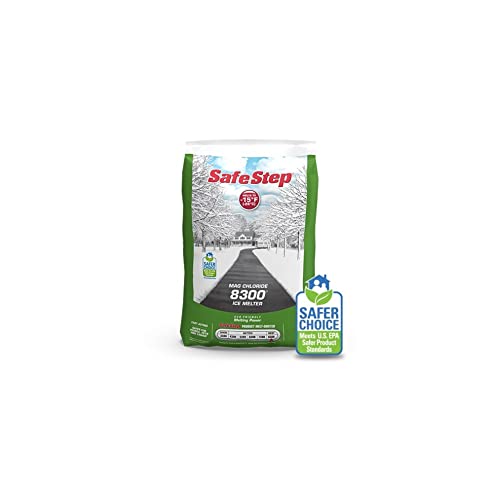 Safe Step Extreme 8300 Magnesium Chloride Ice Melter, 50 lb 100% magnesium chloride hexahydrate from Compass Minerals' Safe Step line, published to -15°F, in a 50 lb bag that costs a fraction per pound of the small pet-marketed tubs. | Magnesium chloride by the bag, at the lowest cost per pound | 8.1/10 | $49.21 - View on Amazon #ad affiliate link · Price as of September 21, 2026 |
Pre-treating a driveway before the storm
Arctic Armor Liquid De-Icing Solution, 1 Gallon
A ready-to-use gallon of liquid brine for anti-icing — spread before snow it stops ice bonding to the slab, which is the job granular de-icer does worst.
Liquid de-icer is not a more convenient version of the bag in your garage — it is a different job. Highway agencies spray brine on roads *before* a storm precisely because preventing a bond costs a fraction of breaking one, and that is what this is for at house scale.
Applied to a clean, dry slab a few hours before snow arrives, the brine dries to a film that keeps the first snow from freezing to the concrete. What falls then sits on top as loose snow, and a shovel takes it off in one pass.
Used the other way round — sprayed onto ice that has already formed — a liquid is weaker than pellets, because there is no mass to bore down and no reservoir of salt to keep working. That is the honest trade, and it is why we keep a bag as well as a jug.
The frustration with this product is what is not on the label. There is no published working temperature and no named chemistry, and for a de-icer those are the two facts that decide whether it works on your coldest night. We list it because anti-icing is genuinely useful and this is a live, ready-to-use option — not because the documentation is good. What temperature ice melt stops working explains why that number matters so much.
What works
- Anti-icing is what liquids are genuinely better at: a treated slab never lets the ice grip in the first place
- Spreads evenly instead of scattering, so you use less product per square foot than broadcasting pellets
- No white crust to track indoors the way granular chloride does
- Ready to use — no mixing, no spreader to buy
What does not
- No published lowest working temperature, which is the single most important number for a de-icer
- The chemistry is not named on the listing, so you cannot match it to your surface with any confidence
- A gallon does not go far on a driveway, and it is heavy to ship for what it covers
- "Pet safe when used as directed" is a maker's phrase, not a certification
Decking and anything you will not put chloride pellets on
DeckWise Liquid Deck Ice Melt and Preventative Deicer, 1 Gallon
A magnesium-chloride-based liquid formulated as a pre-treatment for wood and composite decks — sprayed before a storm to stop snow bonding to boards.
Skip this one
Right product, wrong page for most readers. It is formulated as a deck pre-treatment and the maker's own instruction is to apply it up to two hours before snow — so on a driveway that is already glazed it does very little. If your problem is a composite or wood deck, this is the best thing here. If it is a frozen driveway, buy a granular chloride and keep the jug for the deck.
Decks are the surface where granular de-icer is hardest to justify. Composite warranties are cautious about chlorides, pellets sit in the board gaps where they cannot be swept, and the fasteners underneath are the things you least want salted.
A sprayed liquid sidesteps most of that. There is nothing left on the boards to grind underfoot, no residue in the gaps, and the film is thin enough that what reaches the joists is a fraction of what a scattered handful delivers.
The chemistry is magnesium chloride, which the maker names — and that is more than the other liquids here manage. It is the mildest of the working chlorides, but it is a chloride, so our magnesium chloride page applies: keep it off new concrete and do not read "all-natural" as "harmless".
Treat the timing instruction as the product's real specification: applied up to two hours before snow or a freeze. This is a pre-treatment. Once the deck is glazed, your options are a plastic shovel, a chloride-free granular product, or patience — ice melt for composite decking sets those out.
What works
- Formulated for the surface most de-icers are banned from — composite and wood decking
- A sprayed film leaves nothing to sweep up off the boards, which is the real objection to pellets on a deck
- Magnesium chloride is named on the label, which the other liquids here do not do
- Pre-treatment framing is honest: the maker sells it as preventing bonding rather than melting a glaze
What does not
- The coverage claim against a 50 lb bag is the maker's, with no rate per square foot to check it against
- You need a sprayer, and the listing does not include one
- "All-natural" sits oddly on a magnesium chloride product — it is a mined salt, not an herbal remedy
- No published lowest working temperature
Steps and a short path, where a gallon is too much
REVOLVE CHEM Liquid De-Icer, 32 oz
A 32-ounce pour-and-go bottle the maker states is chloride-free — the small-format liquid for steps, a landing and a path to the car.
Most liquid de-icer is sold by the gallon because that is the unit that makes sense for a driveway. For the household whose actual problem is four concrete steps and ten feet of path, a gallon is a storage problem and a waste.
This is the small format, and the claim that makes it interesting is chloride-free. On steps that is the claim that matters most: the metal railing, the aluminum nosing strip and the door threshold are all things a chloride brine corrodes, and they are all within splash distance.
The claim is also the problem, because the listing never says what the active ingredient *is*. Chloride-free de-icers are usually acetates, formates or glycol-and-urea blends, and those behave very differently from each other in deep cold. Without a name or a temperature, you are buying a promise.
Our advice is the same as on every de-icer page here: use it as a pre-treatment on a surface you have already cleared, apply less than feels right, and if the night is genuinely cold, put grit down for traction as well. How to stop ice building up on steps and porches covers the rest of that job.
What works
- Chloride-free by the maker's statement, which removes the rebar and railing argument if it holds
- 32 ounces is the right size for the job most people actually have — a few steps and a short path
- Pours and self-distributes, so there is no spreader and no broadcasting technique to get wrong
- No crystals to track indoors onto hardwood
What does not
- No published working temperature and no named active ingredient — "chloride-free" tells you what it is not
- Costs several times per ounce what a gallon jug does
- Pouring gives you far less control over rate than a spray, and over-applying a liquid is easy
- Listed for windshields as well as pavement, which is an unusually broad claim for one formula
Magnesium chloride by the bag, at the lowest cost per pound
Safe Step Extreme 8300 Magnesium Chloride Ice Melter, 50 lb
100% magnesium chloride hexahydrate from Compass Minerals' Safe Step line, published to -15°F, in a 50 lb bag that costs a fraction per pound of the small pet-marketed tubs.
Safe Step is Compass Minerals' consumer ice melt line, and the Amazon listing sells this bag under the North American Salt name with the model number 53851. The maker describes the 8300 as 100 percent magnesium chloride hexahydrate — the ordinary hydrated crystal form of the salt, with no calcium chloride or rock salt blended in to cut the cost.
Its published working temperature is -15°F. That figure is worth a second look precisely because it is unremarkable. Texas DOT puts magnesium chloride's absolute limit, its eutectic, at about -28°F, and the Minnesota Pollution Control Agency puts its lowest practical pavement temperature at -10°F. A claim of -15°F sits between those two numbers, which is where an honest maker's figure for this chemistry should sit.
Safe Step makes one bolder claim: that the 8300 acts 75 percent faster than sodium chloride below 5°F. We have no way to check that figure and it is the maker's own. The direction of it is not controversial, though — rock salt's practical floor is around 15°F, so by 5°F it is working slowly if at all, and almost any magnesium chloride will outpace it there.
The reason to buy this bag over the small pet-marketed tubs is cost. A 50-pound bag of the same chemistry works out to a fraction of the per-pound price of a 15-pound tub, and magnesium chloride does not improve with better packaging.
The concrete claim needs the same care as the temperature one. Safe Step says the product is gentler on concrete used as directed. The Minnesota Pollution Control Agency's comparison rates magnesium chloride moderate-to-high risk to the concrete itself, citing paste deterioration from magnesium. Both can be true of light, occasional use. Neither makes it safe on a slab poured in the last twelve months — magnesium chloride ice melt lays out the evidence.
What works
- The maker states the chemistry precisely: 100% magnesium chloride hexahydrate, not a blend
- A published -15°F sits inside what the chemistry can actually do, rather than beyond it
- The 50 lb bag is the cheapest way to buy magnesium chloride that we can verify is in stock
- Crystal form, which the maker says resists scattering where you do not want it
What does not
- No published coverage rate, so you cannot budget a season from the bag
- "Gentler on concrete" is the maker's claim; the Minnesota Pollution Control Agency rates magnesium chloride higher risk to the concrete itself than calcium chloride or rock salt
- The 75%-faster-below-5°F figure is Safe Step's own and we cannot verify it
- Hygroscopic: an opened bag pulls moisture from the air and cakes unless it is sealed
How to apply it without wasting it
- Clear and dry the surface first. Brine on top of snow is diluted brine doing nothing. On a wet slab it runs off before it dries to a film.
- Treat a few hours ahead of the forecast, not during the storm. The film needs to dry onto the surface to work.
- Use a pump or battery sprayer for area, and pour only for small spots. A sprayer puts down a thin, even film; pouring puts down a puddle and a dry patch.
- Less than feels right. A liquid film that looks barely there is the correct application rate. Runoff is wasted product and salt in your soil.
- Re-treat after heavy rain or a thaw, which washes the film off.
The surfaces question does not go away
A liquid chloride is still a chloride. Spraying it rather than scattering it changes the distribution, not the chemistry, so everything our surface pages say still applies: nothing on concrete poured within the last twelve months, care around metal fixings, and attention to where the runoff drains.
Two of the liquids here make surface claims worth reading precisely. DeckWise names magnesium chloride and formulates specifically for wood and composite decking — see ice melt for composite decking for what the board makers themselves say. REVOLVE CHEM states its formula is chloride-free, which if it holds removes the corrosion argument on steps with metal railings, though the listing never names what the active ingredient actually is.
For the chemistry behind all of this — which salt works to what temperature, and what each does to concrete — start with magnesium chloride and calcium chloride vs rock salt.
Who should buy liquid, and who should not
- Buy it if you can treat before the storm, your problem surface is a deck or steps, or tracked-in white residue is the thing you hate most about de-icer.
- Buy it as well as a bag if you want the honest setup: liquid before the storm, granular for the morning a bond formed anyway.
- Do not buy it expecting it to clear a driveway that is already glazed. That is a job for calcium chloride pellets and, often, an ice chopper.
- Do not buy it as your only product in a genuinely cold climate until a maker publishes a working temperature you can plan around.
Questions people ask
Does liquid ice melt work better than salt?
When should you apply liquid de-icer?
Is liquid ice melt safe for concrete?
How much liquid de-icer do I need for a driveway?
Can you make your own brine for a driveway?
Does liquid ice melt leave residue?
Sources
- Amazon listing — Arctic Armor liquid de-icing solution, 1 gallon
- Amazon listing — DeckWise liquid deck ice melt, 1 gallon, magnesium chloride blend, apply up to 2 hours before snow
- Amazon listing — REVOLVE CHEM liquid de-icer, 32 oz, stated chloride-free
- Amazon listing — Safe Step Extreme 8300 magnesium chloride, 50 lb, -15F published
Next stage
Timing is the whole game
Liquid de-icer is an argument for treating early. This is the page that works out when early is, for every product type.
Keep goingAbout the author
Scooter M.
An enthusiast who is genuinely into this. I read the manuals, compile the published specs, and do the math on door clearances. No lab coat, no test bench, and nothing here is a product I have used - which is exactly why every claim carries a source.
Published by Slate Mill Group, with the Shovel Report team. Published September 21, 2026; last updated September 21, 2026. Editorial policy.
Read next

By Temperature
What Temperature Does Ice Melt Stop Working?
Published working temperatures by chemistry, and what to spread below them.
Best Magnesium Chloride
Magnesium Chloride Ice Melt
How cold magnesium chloride really works, what it does to concrete, and the bags we would buy.
Best for Decking
Best Ice Melt for Composite Decking
Chloride-free defaults for composite boards, and why the manufacturer's guidance is authoritative.
Timing Guide
When to Apply Ice Melt
Pre-treat, then clear, then spot-treat — the sequence that uses least product for most effect.

Best for Steps and Porches
How to Stop Ice Building Up on Steps and Porches
Why steps glaze over before anything else does, and the de-icer or heated mat that actually stops it.