By Scooter M. · Last updated September 7, 2026
Shovel Report earns a commission when you buy through the links on this page, at no extra cost to you. It does not change what we recommend, and we publish a skip-this verdict on products we could otherwise earn from. Full disclosure.
Ice builds up on steps and porches because meltwater from the roof above runs onto them and refreezes, and because a step loses heat from three sides instead of one. Apply a chloride-free de-icer before the freeze rather than after, redirect the drip that is feeding the ice, and on an entrance you use daily, a heated stair mat removes the problem instead of managing it.
Why steps ice over when the driveway does not
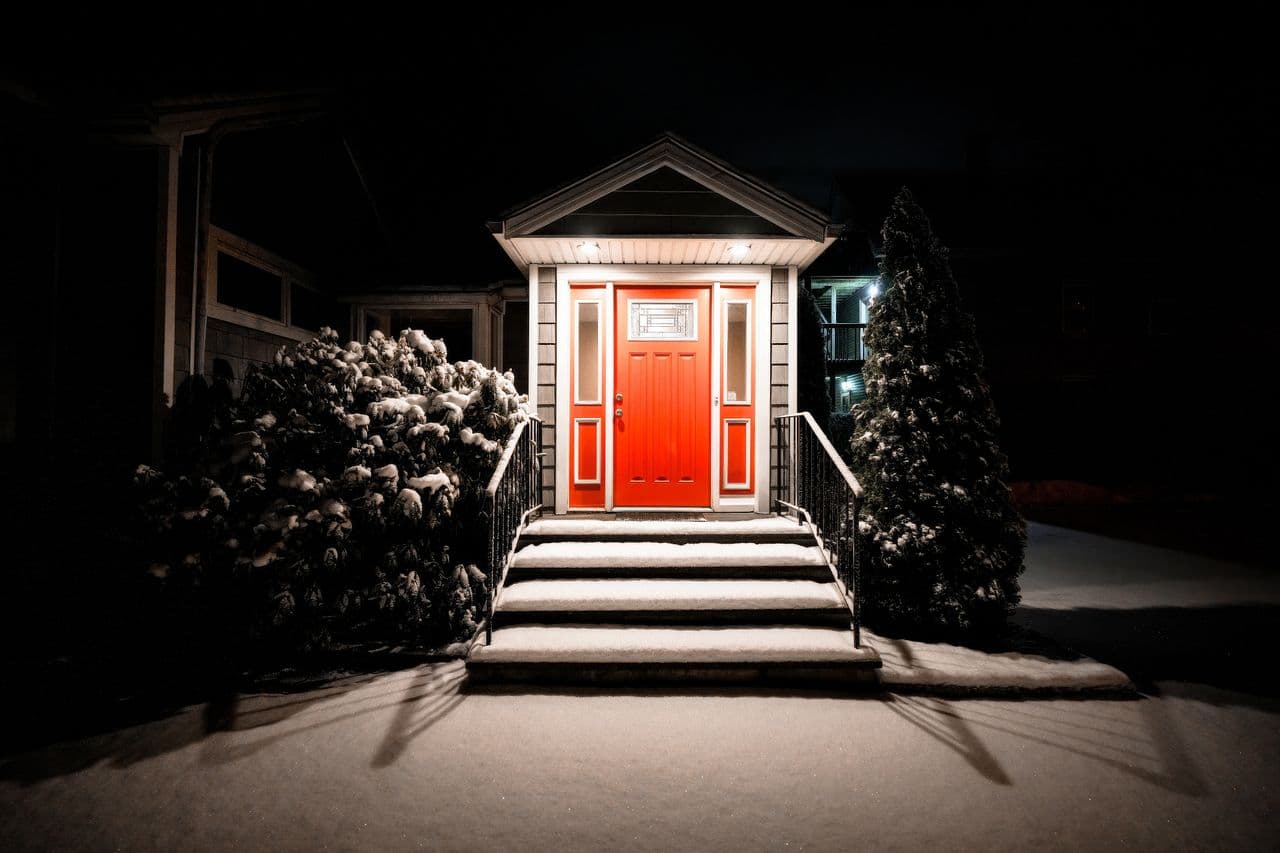
It is a common and disorienting experience: the driveway is wet, the walk is wet, and the four steps up to the front door are glass. That is not bad luck. Three things are true of a step that are not true of a slab.
A step loses heat from three faces. A driveway slab sits on ground that is warmer than the air for most of the winter, and it only radiates upward. A step has a tread on top, a riser on the front and usually air or a void underneath, so it sheds heat far faster and reaches freezing well before the flat surfaces around it. The same is true of anything cantilevered — a landing on posts, a deck, a bridge over a gap.
Water is delivered to it. Most front steps sit directly under a roof edge, a porch overhang or a gutter. Sun or attic heat melts snow up there during the day, the water runs down and arrives on the steps, and the temperature drops after dark. That is not precipitation freezing where it fell; that is a small daily irrigation system pointed at the most dangerous surface on the property. It is the same mechanism behind an ice dam, described in how to prevent ice on a driveway.
Nobody clears it properly. A driveway gets a full pass with a shovel. Steps get kicked at with a boot on the way past, which compacts the snow into the tread rather than removing it, and compacted snow is what bonds into ice. Steps are the surface most likely to have a thin, invisible, load-bearing layer of ice on them at any given moment in January.
Find the drip before you buy anything
Chemistry and heat both treat the symptom. Ten minutes with your head tilted back treats the cause, and it is free.
- Stand at the bottom of the steps and look up. Is there a gutter directly above them? A valley in the roof that funnels there? A downspout that discharges anywhere near the walk?
- Look for the drip line on the steps themselves. After a thaw, the wet stripe on the treads shows you exactly where the water lands. That stripe is where the ice will be tomorrow morning.
- Extend the downspout. If it dumps within six feet of the steps, a cheap extension that carries the water past them removes more ice than any amount of de-icer.
- Check the gutter is not blocked. A clogged gutter overflows at the low point, and the low point on an entrance porch is usually right above the door.
- Look at what the steps are sitting on. A wooden landing over open air will always freeze first. Nothing you can spread will change that; it is the case for a heated mat.
Match the de-icer to what the steps are made of
The surface question matters more on a porch than anywhere else on a property, because a porch is usually the one place where four different materials meet: concrete or stone treads, a wooden or composite deck at the top, metal railing posts and fasteners, and planting right alongside. The full material-by-material treatment is in ice melt damage by surface; here is the short version for an entrance.
De-icer choice by porch and step material
De-icer chemistry, by working temperature
Every temperature below is either published by the manufacturer of a product we link to, or labeled as a practical range. Where a maker publishes no figure, the cell says so. We have not measured any of this ourselves — here is what we did instead.
Published working temperatures are manufacturer figures for the specific products we link to, not generic chemistry constants. Two makers publish no figure at all, and those cells say so rather than borrowing a number from a competitor.
The pattern is hard to miss: chloride-free wins on a porch far more often than it wins on a driveway, because a porch has metal in it and a driveway mostly does not. The trade is temperature — Safe Paw publishes a floor of -2 degrees F against magnesium chloride's -15 — and on a cold night that gap is real. What temperature ice melt stops working covers what to do when you are below the floor of everything you own.
How we picked
- Published lowest effective temperature, because a de-icer applied below its working point does nothing at all
- Chloride content and type, which is what actually drives concrete, metal and plant risk
- Published coverage per pound where a maker states one — the only figure that lets you budget a season
- Form (pellet, flake or crystal), since pellets bore down through ice and flakes tend to sit on top
- What the manufacturer explicitly claims about surfaces, quoted rather than paraphrased
We have not physically tested these products. We do not own them, we have no lab, and we do not accept free product. Everything above is compiled from published manufacturer specifications, published manuals, published standards and live retailer data - and we tell you which is which on every claim. How we pick.
Quick picks
Ranked against the criteria below. Tap a row to jump to the full write-up; the price button goes straight to Amazon.
A porch and its steps, bought once
HeatTrak Snow Melting Mats Starter Kit
Two stair treads, a landing mat and the 120V power unit the mats cannot run without — the only configuration in this range that arrives complete.
Every other product on this page treats ice on steps as something to remove after it forms. A heated mat is the one that stops it forming, and that difference is worth understanding before you look at the price, because the two approaches fail in completely different ways.
A de-icer has to be spread, it has to be spread before the freeze rather than after, and it stops working when the pavement drops below the chemistry's published floor. A heated mat has none of those failure modes. HeatTrak publishes a melt rate of 2 inches per hour and states that the automatic power unit switches the system on below 35 degrees F, so the mat is warm at 3 a.m. when nobody is going outside with a bucket of pellets.
The reason to start with the kit rather than a single mat is a detail the individual listings make easy to miss: the mats do not plug into an outlet. They plug into a HeatTrak power unit, which carries the built-in GFCI, and that unit is a separate purchase on every standalone mat in the range. Buying one stair mat and discovering it will not run is the most common way this goes wrong. This kit is the walkway mat, two stair treads, the power unit and two extenders in one box, with a published total draw of 3.9 amps.
That 3.9 figure matters for a second reason. HeatTrak states that no more than 13 amps should sit on a single plug, so the kit uses under a third of that budget and leaves room to add treads later — a 10 x 30 tread is a published 0.7 amps and the larger 10 x 48 is 1.0. Count your steps before you buy: two stair mats covers two treads, and most front porches have three or four.
The honest limit is the outlet. If there is no outdoor receptacle within reach of the steps, none of this applies and you are back to a de-icer and a shovel — see what temperature ice melt stops working for how to choose one that survives a cold night.
What works
- Includes the power unit — every mat in this range needs one and it is otherwise a separate purchase
- Covers two treads plus the landing, which is the shape of most front entrances
- Thermostat means it runs when it is freezing and not when it is not, which is where the $0.18/hour figure comes from
- Nothing to install: it lies on the steps and plugs into an outdoor outlet
What does not
- 3.9 amps of the power unit's published 13-amp budget is gone on this kit alone
- Two stair mats covers two treads — a four-step porch needs two more
- You need a working outdoor outlet near the steps, which is the constraint that decides the whole approach
- Costs many times what a season of ice melt costs
Chloride-free, on decks and new concrete
Safe Paw Ice Melt
The one product here with no chloride in it at all — the right answer on composite decking, new concrete and around metal.
Almost every de-icer on a hardware store shelf is a chloride: sodium, calcium, magnesium or potassium. Chlorides are cheap and they work, and the chloride ion is also the thing that corrodes rebar, attacks metal fixings and gets blamed for spalled concrete. Safe Paw contains none of them.
The chemistry is a crystalline amide core carrying glycols, and the manufacturer states it is non-corrosive and effective to -2°F, with coverage of about 100 square feet per pound. That coverage figure is unusually useful: a 35-pound pail covers roughly 3,500 square feet at the stated rate, which is several storms on a normal driveway and walkway.
The -2°F floor is the honest trade. Calcium chloride keeps working far below that; this does not. On a genuinely cold night in a cold climate a chloride-free product will underperform, and pretending otherwise would be a disservice.
Where it wins outright is on surfaces where chloride is the risk rather than the temperature: composite decking, concrete poured within the last year, anything with exposed metal fasteners, and beds where salt-sensitive plants sit downhill of the runoff.
What works
- No chloride at all, which removes the entire concrete-and-metal argument
- 100 sq ft per pound is a published coverage figure you can budget from
- Traction agent included, so it does something even where it is too cold to melt
What does not
- -2°F is warmer than calcium chloride's floor — it is not the deep-cold answer
- Costs substantially more per pound than any chloride
- The glycol carrier can leave a residue that tracks indoors
Dogs, at real winter temperatures
Green Gobbler Pet Safe Ice Melt
Magnesium chloride pellets rated to -15°F — the mildest of the working chlorides, and the sensible default around pets.
Skip this one
Magnesium chloride is the mildest of the working chlorides, but it is still a chloride, and a porch is the worst place on a property to put one: the railing posts, the fasteners holding the treads, and any metal step nosing are all sitting in whatever you spread, in a puddle, all winter. On a wood or composite porch with metal hardware, go chloride-free instead.
Every de-icer works the same way: dissolve something in the thin film of water on the ice and you lower that water's freezing point, so the ice melts at a temperature it otherwise would not. The differences between products are which salt does the dissolving, how cold it keeps working, and what it does to concrete, plants and paws.
Magnesium chloride is the mild end of the working chlorides. Green Gobbler publishes an effective temperature of -15°F, which is genuinely useful — plain rock salt stops doing meaningful work somewhere around 15 to 20°F, so on a cold night rock salt is decoration and this is not.
The pet claim deserves a precise reading. Magnesium chloride is less likely to irritate paws and less likely to cause stomach upset than rock salt, which is why the maker positions it that way. It is not food, and "pet safe" is not "pet edible". Wipe paws after walks regardless of what you spread.
It is still a chloride, so it belongs in the same conversation as every other chloride when it comes to concrete: keep it off concrete poured within the last twelve months, and understand the actual damage mechanism before you decide it is safe. We explain it in does ice melt damage concrete. For a genuinely chloride-free option, see our pet-safe picks.
What works
- -15°F published working temperature is far below rock salt's practical floor
- Pellets penetrate an ice layer instead of sitting on top of it like flakes
- Magnesium chloride is the least paw-irritating of the common working chlorides
What does not
- "Pet safe" means less irritating, not edible — it is still a chloride salt
- Attracts moisture and can leave a slick residue if over-applied
- Costs several times what bulk rock salt does per pound
Wide treads, and adding steps later
HeatTrak Heated Stair Mat, 10 x 48 in
The long tread. A published 1.0 amps each, so a four-step porch is 4 amps of a 13-amp budget — but the power unit is a separate buy.
Stair mats come in two lengths and the choice is not about power, it is about how much of the tread stays uncovered. A 30-inch mat on a 42-inch staircase leaves six inches of bare concrete at each end, and bare concrete at the edge of a step is precisely where a foot lands when somebody moves to one side for the handrail.
This is the 48-inch version. HeatTrak publishes 1.0 amps per tread against 0.7 for the shorter mat, a melt rate of 2 inches per hour for both, and a 2-year warranty across the residential line. Four grommets let you secure it, which is worth using on an exposed entrance where wind gets under a mat edge.
Buy this as the add-on rather than the starting point. It has no power unit, and a heated mat with no power unit is an expensive rubber mat: the unit is what supplies the GFCI and the thermostat, and HeatTrak sells it separately from every standalone mat. If you are starting from nothing, the kit is the cheaper route to a working system; if you already have a unit and want to cover the third and fourth steps, this is the piece.
Do the arithmetic before ordering. HeatTrak states no more than 13 amps on a single plug. Four of these at 1.0 each plus a 2.5-amp walkway mat is 6.5 amps, comfortably inside it. Ten treads plus two landing mats is not, and at that point you are looking at a second circuit rather than a second mat.
One measurement decides whether this fits at all: the depth of your tread, front edge to riser. Ten inches suits a standard step. A deep porch step, a bullnose, or a stone stair with a generous run will leave the back of the tread uncovered, and ice at the back of a tread is the ice you step onto going down.
What works
- 48 inches spans a wide staircase that a 30-inch tread leaves ice at both ends of
- 1.0 amps means a four-tread run still sits well inside the published 13-amp limit
- Grommets let you tie it down, which matters on a step that gets wind
- Designed to be left out all winter rather than laid and lifted per storm
What does not
- No power unit in the box — on its own this mat will not run
- 10 inches deep does not cover a deep tread; measure before ordering
- Cord routing down a staircase is visible and has to be planned
- No published weight
The landing and the path, not the treads
HeatTrak Heated Walkway Mat, 20 x 60 in
Five feet of heated path at a published 2.5 amps — the right mat for the flat area in front of the door and the wrong one for the steps themselves.
Skip this one
If your problem is the steps, buying the landing mat first is the wrong order. A slip on a flat landing usually ends with a stumble; a slip on a tread ends with a fall down the remaining steps, and that is the injury this whole page exists to prevent. Heat the treads, then add the landing.
The flat landing at the top of a set of steps is a distinct problem from the steps. It is where people stand still — waiting for the door, setting down a bag, turning around — and standing still on ice is how a fall starts. It is also where the roof above the entrance drips, which is why it glazes over even when nothing is falling.
This mat is 20 by 60 inches at a published 2.5 amps, with the same 2-inch-per-hour melt rate as the rest of the residential range. Laid across a landing it covers the whole standing area of a typical entrance; laid along a path it clears a single-file lane.
Two numbers set the limits. Twenty inches is narrower than most concrete walks, so this heats a lane and not the walkway — fine for one person carrying groceries, less good for two people side by side. And 2.5 amps is the biggest draw in the line: HeatTrak's published ceiling is 13 amps of mats on one plug, so five of these is already the whole circuit before you have heated a single step.
The mistake to avoid is buying this instead of stair mats. Ice on a landing is unpleasant; ice on a tread is the one that hurts people, because a foot that slips on a step has nothing under it for another eight inches. If your budget covers one mat and you have steps, heat the steps.
Like every standalone mat here it needs the power unit, which is a separate purchase and is the part that supplies the GFCI and the thermostat. If you are building the system from scratch, the kit is the cheaper way to arrive at a working one.
What works
- Five feet of continuously clear path, which is the piece a stair mat cannot do
- Links to other mats on watertight connectors rather than daisy-chained extension cords
- The landing in front of a door is the highest-traffic square yard of any entrance
- Left down all season, so there is no per-storm task at all
What does not
- 2.5 amps is the heaviest draw in the residential range — five of them exceeds the 13-amp limit
- No power unit included
- 20 inches wide is narrower than most front paths, so it clears a lane rather than the whole walk
- Does nothing for the treads, which is usually where the ice that hurts people is
When a heated mat is actually the cheaper answer
A heated stair mat costs more than several winters of de-icer, so the case for one is never about money in the first season. It is about three situations where spreading a product does not work.
- Somebody in the house should not be out there salting steps at night. This is the common case. If the reason the steps are dangerous is also the reason nobody is going to treat them at 10 p.m., a de-icer that requires a person is not a solution. The related thinking is in snow shovels for seniors.
- The steps are wood, composite or a cantilevered landing. These freeze first, they are the surfaces where chlorides do the most collateral damage, and mechanical clearing marks them. Heat sidesteps all three problems.
- The ice is fed by a drip you cannot redirect. Where the roof geometry is what it is and water will keep arriving, a chemical fix has to be reapplied every time. A thermostatic mat just keeps working.
The arithmetic to do before ordering is amps, not dollars. HeatTrak publishes a limit of 13 amps of mats on a single plug, and the residential mats draw a published 0.7 amps for a 10 x 30 stair tread, 1.0 for the 10 x 48, and 2.5 for the 20 x 60 walkway mat. A four-step porch with a landing is roughly 6.5 amps — comfortable. A long flight of stairs plus a path is not, and that becomes an electrician's job rather than a shopping decision.
The other precondition is an outdoor outlet within reach. The mats do not plug into the wall; they plug into a power unit that carries the GFCI and the thermostat, and that unit needs a receptacle. No outlet near the steps means no mat, and the honest recommendation reverts to a chloride-free de-icer applied on time.
The ten minutes before a freeze
Almost everything that makes porch ice hard to deal with comes from treating it after it has formed. Ice that has bonded to a cold tread has to be melted through from the top, which takes far more product and much longer. Ice that never bonded is swept off.
- Clear the snow off the treads completely, including the back of each one. A plastic-bladed tool, or a stiff broom on a light fall. Never a metal edge on wood, composite or decorative stone.
- Get the landing dry-ish before dusk. The landing is where the water pools and then feeds the steps below it.
- Spread before the freeze, not after. A thin, even layer of a chloride-free product on a clear tread stops the next melt from bonding. Timing is the whole game and it has its own page: when to apply ice melt.
- Spread thinly. Steps are small. The instinct to empty a scoop onto a tread wastes product, leaves a slick residue, and tracks salt into the house on boots.
- Sweep the residue off in the morning. On a porch that residue is sitting against railing hardware and step fasteners for the rest of the day. Thirty seconds with a broom is the difference.
When nothing will melt: grit for traction
Below about -2 degrees F you are past the published floor of every chloride-free product, and below roughly -25 you are past calcium chloride too. At that point de-icer is decoration and the only thing that helps is traction. Coarse sand, poultry grit or non-clumping cat litter on the treads gives a boot something to bite. It melts nothing, it has to be reapplied after every fall of snow, and it needs sweeping up in spring — but it works at any temperature, which nothing chemical does. We cover the trade in full at ice melt vs sand.
One thing to avoid entirely on steps: chipping at bonded ice with a metal blade. On concrete it takes the surface off, on wood it splinters the tread edge, on composite it scars the cap layer, and on any of them it is being done while standing on ice at the top of a staircase. Treat it chemically, put grit down for now, and wait.
Questions people ask
How do I stop ice building up on my porch?
Why do my steps freeze when the driveway is clear?
What is the safest ice melt for wooden steps?
Do heated stair mats actually work?
How much does it cost to run a heated snow melting mat?
Can I use rock salt on concrete steps?
Sources
- HeatTrak — residential FAQ: 13 A per plug, 35 degrees F thermostat, $0.18 per hour, published surface list
- HeatTrak — Starter Pack contents and 3.9 A total draw
- HeatTrak — 10 x 48 in stair mat: 1.0 A per tread, 2 in per hour
- HeatTrak — 20 x 60 in walkway mat: 2.5 A, power unit required
- Safe Paw — chloride-free, -2F published, rated for wood
- Green Gobbler Pet Safe — magnesium chloride, -15F published
Next stage
Clearing steps without damaging them
Chemistry is half the job. The other half is getting the snow off a tread without taking the surface with it.
Keep goingAbout the author
Scooter M.
An enthusiast who is genuinely into this. I read the manuals, compile the published specs, and do the math on door clearances. No lab coat, no test bench, and nothing here is a product I have used - which is exactly why every claim carries a source.
Published by Slate Mill Group, with the Shovel Report team. Published September 7, 2026; last updated September 7, 2026. Editorial policy.
Read next
Timing Guide
When to Apply Ice Melt
Pre-treat, then clear, then spot-treat — the sequence that uses least product for most effect.
Best for Decking
Best Ice Melt for Composite Decking
Chloride-free defaults for composite boards, and why the manufacturer's guidance is authoritative.
Best for Decks & Steps
Clearing Decks, Steps and Walkways
Narrow heads and non-marking edges for stair treads, composite decks and tight walkways.
By Temperature
What Temperature Does Ice Melt Stop Working?
Published working temperatures by chemistry, and what to spread below them.