By Scooter M. · Last updated September 17, 2026
Shovel Report earns a commission when you buy through the links on this page, at no extra cost to you. It does not change what we recommend, and we publish a skip-this verdict on products we could otherwise earn from. Full disclosure.
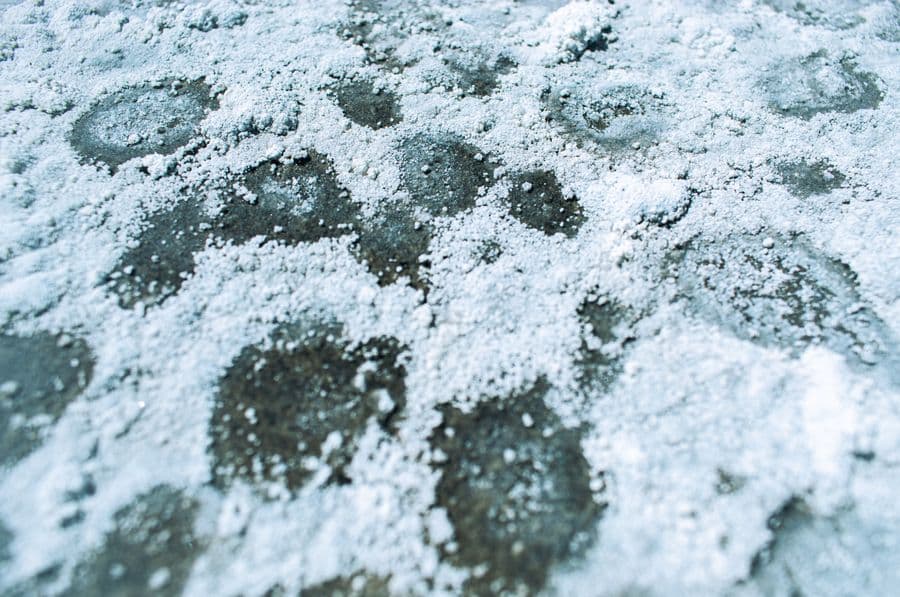
Magnesium chloride keeps melting ice well below rock salt's limit. The Minnesota Pollution Control Agency puts its lowest practical pavement temperature at -10°F, most bags publish -15°F, and Texas DOT puts its absolute limit at about -28°F. At 5°F it is still working, only more slowly. Below -10°F, reach for calcium chloride or grit.
How cold magnesium chloride actually works
Three different kinds of temperature get quoted for magnesium chloride, and most of the confusion about it comes from treating them as the same number.
The temperatures quoted for magnesium chloride, and what each one means
The eutectic is a physical limit, not a performance figure. It is the lowest temperature at which a brine of that salt can exist as a liquid, and only at one exact concentration. On a driveway the brine never holds that concentration for long: it dilutes as it melts ice, and every dilution raises the temperature at which it freezes again. That is why the useful floor sits well above the theoretical one.
The practical figure is the one that matters. The Minnesota Pollution Control Agency gives -10°F of pavement temperature for magnesium chloride, against -20°F for calcium chloride and 15°F for rock salt. Note the word pavement. A shaded slab holds cold for hours after the air warms, so if the number you are working from is an air temperature at head height, assume the surface is colder.
Why a -35°F rating is not a number to plan around
One product we list, FIREKI's pet-safe magnesium chloride, publishes a working temperature of -35°F. That is seven degrees colder than the eutectic Texas DOT gives for the chemistry, and twenty-five degrees colder than the Minnesota agency's practical floor.
We do not know how the figure was arrived at. What we can say is that a magnesium chloride brine cannot stay liquid at -35°F, so a magnesium chloride product cannot melt ice there. Earlier versions of our own pages repeated that figure as the coldest rating of anything we list. We have corrected them.
The lesson travels to any bag. When a de-icer rating looks remarkable, check it against the chemistry named on the label. The practical floor for calcium chloride is ten degrees colder than for magnesium chloride, so a magnesium chloride bag that claims to beat calcium chloride in deep cold should make you suspicious rather than excited.
Magnesium chloride vs calcium chloride
These are the two chlorides people pay more than rock salt for, and they trade off against each other more cleanly than the marketing suggests.
Magnesium chloride against calcium chloride
Read that as a clear split. Calcium chloride works about ten degrees colder in practice, and on the Minnesota agency's ratings it is the lower risk to the concrete itself. Magnesium chloride is the milder of the two on paws, which is why it is the chloride sold as pet friendly, and Texas DOT describes the magnesium chloride it uses as less harmful to the environment than calcium chloride or sodium chloride. Both corrode steel.
The common retail framing presents magnesium chloride as the concrete-friendly chloride and calcium chloride as the harsh one. On steel the agency rates them the same, and on the concrete itself it rates magnesium chloride the higher risk. If concrete is your main worry, neither chloride is the answer. Rock salt gets its own head-to-head with calcium chloride in calcium chloride vs rock salt.
Is magnesium chloride safe for concrete?
Not in the unqualified way the labels suggest. The three sources we checked do not agree, so here they are side by side.
- The Minnesota Pollution Control Agency rates magnesium chloride moderate-to-high risk to the concrete matrix — it "will exacerbate scaling" and carries a "risk of paste deterioration from magnesium" — and high risk for corrosion of reinforcing steel, adding that the evidence suggests magnesium chloride has the highest corrosion potential of the chloride products.
- Texas DOT says the magnesium chloride it uses contains a corrosion inhibitor, "making it less damaging to concrete and steel than other products". That describes an inhibited road-treatment product, not magnesium chloride in general or a bag from a hardware store.
- Safe Step says its 8300 is gentler on concrete and vegetation than conventional ice melters when used as directed. That is a manufacturer's claim, measured against conventional ice melters.
Those positions are less contradictory than they look. The agency rating describes the chemistry in general, at road scale. The Texas product has an inhibitor added. The manufacturer is comparing against conventional ice melters, used as directed. None of them says magnesium chloride is harmless to concrete, and one of them says magnesium brings a risk to the cement paste that it rates low for rock salt and calcium chloride.
In practice that comes down to three rules. Keep it, and every chloride, off concrete poured in the last twelve months. Apply it lightly to a cleared surface, because product beyond what the ice needs only leaves more brine on the slab. And sweep up whatever has not dissolved once the ice has gone. On decorative, unsealed or already-scaling concrete, use a chloride-free product instead — ice melt for concrete works through the choice by concrete age.
Pellets, flakes or crystals
Magnesium chloride is sold in all three shapes, and the shape matters for the job. Flakes are thin and dissolve quickly where they land, which suits spreading ahead of a storm to stop ice bonding in the first place. Pellets carry more mass to one spot, so they bore down through a layer that has already bonded. Crystals sit between the two, and Safe Step says the crystal shape of its 8300 resists scattering.
Texas DOT notes that although magnesium chloride is sold as flakes, road crews apply it as a liquid. The home version of that lesson is that it works through brine: it acts on the thin bonded layer left after shoveling, not on inches of loose snow. Clear first, then spread.
How we picked
- A published lowest effective temperature that is consistent with the chemistry — at or above magnesium chloride's eutectic of about -28°F — rather than beyond it
- The chemistry stated plainly on the bag, and whether the maker says what share of it is magnesium chloride
- Form: pellets for breaking a bond, flakes and crystals for preventing one
- Bag size, and what it does to the price per pound of the same chemistry
- What the maker claims about concrete and pets, set against the Minnesota Pollution Control Agency's ratings rather than taken at face value
- A calcium chloride and a chloride-free product alongside, for the two situations where magnesium chloride is the wrong bag
We have not physically tested these products. We do not own them, we have no lab, and we do not accept free product. Everything above is compiled from published manufacturer specifications, published manuals, published standards and live retailer data - and we tell you which is which on every claim. How we pick.
Quick picks
Ranked against the criteria below. Tap a row to jump to the full write-up; the price button goes straight to Amazon.
| # | Product | Best for | Score | Price |
|---|---|---|---|---|
| 1 | 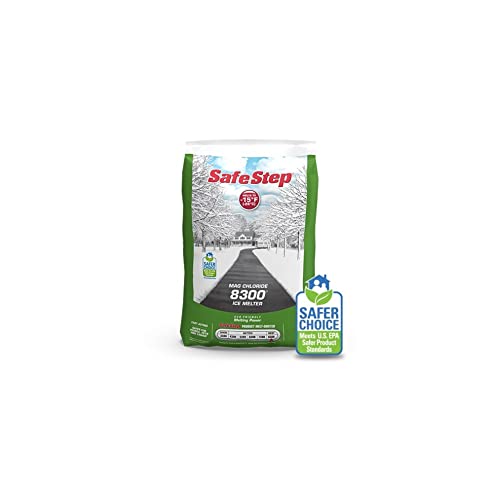 Safe Step Extreme 8300 Magnesium Chloride Ice Melter, 50 lb 100% magnesium chloride hexahydrate from Compass Minerals' Safe Step line, published to -15°F, in a 50 lb bag that costs a fraction per pound of the small pet-marketed tubs. | Magnesium chloride by the bag, at the lowest cost per pound | 8.1/10 | $49.12 - View on Amazon #ad affiliate link · Price as of September 17, 2026 |
| 2 |  Home and Country USA Dead Sea Magnesium Chloride Pellets, 50 lb Magnesium chloride in pellets rather than flakes or crystals, published to -15°F in a 50 lb bag — the shape that bores down through an ice sheet instead of sitting on top of it. | Magnesium chloride in pellet form, for ice that has already bonded | 7.7/10 | $69.99 - View on Amazon #ad affiliate link · Price as of September 17, 2026 |
| 3 |  Peladow Calcium Chloride Pellets, 50 lb OxyChem's round calcium chloride pellet at about 90% purity, working to a published -25°F and dissolving exothermically — the chemistry for ice that has already bonded. Our skip-this pick | Breaking an existing bond on a cold morning | 7.5/10 | $50.99 - View on Amazon #ad affiliate link · Price as of September 17, 2026 |
| 4 |  Safe Paw Ice Melt The one product here with no chloride in it at all — the right answer on composite decking, new concrete and around metal. | Chloride-free, on decks and new concrete | 8.2/10 | $84.95 - View on Amazon #ad affiliate link · Price as of September 17, 2026 |
| 5 |  FIREKI Pet Safe Ice Melt, Magnesium Chloride Pure magnesium chloride with no additives or dye in a 15 lb tub with a scoop — but its published -35°F is colder than magnesium chloride brine can stay liquid, so plan around the chemistry's real floor instead. Our skip-this pick | A small tub of magnesium chloride, with a scoop | 7.2/10 | $56.99 - View on Amazon #ad affiliate link · Price as of September 17, 2026 |
Magnesium chloride by the bag, at the lowest cost per pound
Safe Step Extreme 8300 Magnesium Chloride Ice Melter, 50 lb
100% magnesium chloride hexahydrate from Compass Minerals' Safe Step line, published to -15°F, in a 50 lb bag that costs a fraction per pound of the small pet-marketed tubs.
Safe Step is Compass Minerals' consumer ice melt line, and the Amazon listing sells this bag under the North American Salt name with the model number 53851. The maker describes the 8300 as 100 percent magnesium chloride hexahydrate — the ordinary hydrated crystal form of the salt, with no calcium chloride or rock salt blended in to cut the cost.
Its published working temperature is -15°F. That figure is worth a second look precisely because it is unremarkable. Texas DOT puts magnesium chloride's absolute limit, its eutectic, at about -28°F, and the Minnesota Pollution Control Agency puts its lowest practical pavement temperature at -10°F. A claim of -15°F sits between those two numbers, which is where an honest maker's figure for this chemistry should sit.
Safe Step makes one bolder claim: that the 8300 acts 75 percent faster than sodium chloride below 5°F. We have no way to check that figure and it is the maker's own. The direction of it is not controversial, though — rock salt's practical floor is around 15°F, so by 5°F it is working slowly if at all, and almost any magnesium chloride will outpace it there.
The reason to buy this bag over the small pet-marketed tubs is cost. A 50-pound bag of the same chemistry works out to a fraction of the per-pound price of a 15-pound tub, and magnesium chloride does not improve with better packaging.
The concrete claim needs the same care as the temperature one. Safe Step says the product is gentler on concrete used as directed. The Minnesota Pollution Control Agency's comparison rates magnesium chloride moderate-to-high risk to the concrete itself, citing paste deterioration from magnesium. Both can be true of light, occasional use. Neither makes it safe on a slab poured in the last twelve months — magnesium chloride ice melt lays out the evidence.
What works
- The maker states the chemistry precisely: 100% magnesium chloride hexahydrate, not a blend
- A published -15°F sits inside what the chemistry can actually do, rather than beyond it
- The 50 lb bag is the cheapest way to buy magnesium chloride that we can verify is in stock
- Crystal form, which the maker says resists scattering where you do not want it
What does not
- No published coverage rate, so you cannot budget a season from the bag
- "Gentler on concrete" is the maker's claim; the Minnesota Pollution Control Agency rates magnesium chloride higher risk to the concrete itself than calcium chloride or rock salt
- The 75%-faster-below-5°F figure is Safe Step's own and we cannot verify it
- Hygroscopic: an opened bag pulls moisture from the air and cakes unless it is sealed
Magnesium chloride in pellet form, for ice that has already bonded
Home and Country USA Dead Sea Magnesium Chloride Pellets, 50 lb
Magnesium chloride in pellets rather than flakes or crystals, published to -15°F in a 50 lb bag — the shape that bores down through an ice sheet instead of sitting on top of it.
Most magnesium chloride sold for driveways comes as flakes or irregular crystals. This bag is pellets, and for one job that difference matters more than the chemistry does: breaking a layer of ice that has already bonded to the pavement.
A pellet has enough mass to sit in one place and bore downward as it dissolves, cutting a channel to the pavement that lets brine spread sideways underneath the ice and break its grip. A flake dissolves at the surface and spreads out from where it landed. Flakes are fine for preventing a bond; pellets are better at breaking one.
Home and Country USA publishes a working temperature of -15°F and describes the salt as sourced from the Dead Sea. That temperature sits sensibly between magnesium chloride's practical pavement floor of -10°F, as the Minnesota Pollution Control Agency gives it, and its eutectic of about -28°F per Texas DOT. The listing does not say what share of each pellet is magnesium chloride, and we would like it to.
Two of the listing's claims need reading carefully. "Naturally pet friendly" means magnesium chloride is less irritating to paws than rock salt, which is fair; it does not mean edible, and paws still need wiping. "Less corrosive on metal surfaces and concrete" is harder to support. The Minnesota Pollution Control Agency rates magnesium chloride high for corrosion of reinforcing steel and moderate-to-high risk to the concrete itself — higher than calcium chloride or rock salt on the second point.
None of that rules it out on a mature driveway at a light application rate. It does mean the reason to buy it is the pellet form, not a promise about your concrete. On concrete you are genuinely worried about, the chloride-free answer is on ice melt for concrete.
What works
- Pellets carry enough mass to bore down through a bonded ice layer, where flakes spread at the surface
- A published -15°F is consistent with what the chemistry can do
- 50 lb bag, so a season's supply in one purchase
What does not
- The listing does not state what share of the pellet is magnesium chloride
- "Less corrosive" to concrete is the seller's claim, and the Minnesota Pollution Control Agency's ratings do not support it for the concrete itself
- Costs noticeably more per pound than the Safe Step 8300 bag
- No published coverage rate
Breaking an existing bond on a cold morning
Peladow Calcium Chloride Pellets, 50 lb
OxyChem's round calcium chloride pellet at about 90% purity, working to a published -25°F and dissolving exothermically — the chemistry for ice that has already bonded.
Skip this one
Do not use calcium chloride on concrete poured within the last twelve months, on pavers, on composite decking, or where runoff drains straight into planting beds. It is the right chemistry for breaking a bond that has already formed and the wrong one for a new driveway.
The Green Gobbler calcium chloride we used to list here is no longer available. Peladow is the closest comparable product we can verify is in stock, and it is the reference calcium chloride pellet that most of the category is measured against: made by OxyChem, at about 90% calcium chloride.
The reason to reach for calcium chloride is its mechanism. It dissolves exothermically — it releases heat as it goes into solution — so it starts working the moment it lands rather than depending on sunlight or ambient warmth. OxyChem also points to the round pellet shape, which penetrates an ice layer and attacks the bond with the pavement instead of sitting on top.
Be precise about the temperature. OxyChem publishes an effective temperature of -25°F. That is very cold, and it is consistent with the chemistry: the Minnesota Pollution Control Agency puts calcium chloride's lowest practical pavement temperature at -20°F, ten degrees colder than magnesium chloride's. Calcium chloride wins on both counts that matter in deep cold — it works colder, and it starts faster on an existing bond.
The cost is what it does to surfaces. Calcium chloride drives the most freeze-thaw cycling of any common de-icer, which is the mechanism that damages concrete, and its brine washes jointing sand out of pavers. Use it to rescue a driveway that has already iced — how to get ice off a driveway — not as routine pre-treatment.
What works
- Exothermic: it generates heat as it dissolves, so it starts working on contact rather than waiting for sun
- Round pellets bore down through an ice layer instead of sitting on top of it
- Published compliance with the ASTM and AASHTO calcium chloride standards
- 50 lb bag is the economical way to buy the coldest-working chloride
What does not
- Rated high risk for corrosion of reinforcing steel and for vegetation by the Minnesota Pollution Control Agency, like the other chlorides
- Hardest on paws of anything we list
- The maker's "up to 3x faster" claim is theirs, not a figure we can verify
- 50 pounds is a heavy bag, and calcium chloride absorbs moisture and cakes if stored open
Chloride-free, on decks and new concrete
Safe Paw Ice Melt
The one product here with no chloride in it at all — the right answer on composite decking, new concrete and around metal.
Almost every de-icer on a hardware store shelf is a chloride: sodium, calcium, magnesium or potassium. Chlorides are cheap and they work, and the chloride ion is also the thing that corrodes rebar, attacks metal fixings and gets blamed for spalled concrete. Safe Paw contains none of them.
The chemistry is a crystalline amide core carrying glycols, and the manufacturer states it is non-corrosive and effective to -2°F, with coverage of about 100 square feet per pound. That coverage figure is unusually useful: a 35-pound pail covers roughly 3,500 square feet at the stated rate, which is several storms on a normal driveway and walkway.
The -2°F floor is the honest trade. Calcium chloride keeps working far below that; this does not. On a genuinely cold night in a cold climate a chloride-free product will underperform, and pretending otherwise would be a disservice.
Where it wins outright is on surfaces where chloride is the risk rather than the temperature: composite decking, concrete poured within the last year, anything with exposed metal fasteners, and beds where salt-sensitive plants sit downhill of the runoff.
What works
- No chloride at all, which removes the entire concrete-and-metal argument
- 100 sq ft per pound is a published coverage figure you can budget from
- Traction agent included, so it does something even where it is too cold to melt
What does not
- -2°F is warmer than calcium chloride's floor — it is not the deep-cold answer
- Costs substantially more per pound than any chloride
- The glycol carrier can leave a residue that tracks indoors
A small tub of magnesium chloride, with a scoop
FIREKI Pet Safe Ice Melt, Magnesium Chloride
Pure magnesium chloride with no additives or dye in a 15 lb tub with a scoop — but its published -35°F is colder than magnesium chloride brine can stay liquid, so plan around the chemistry's real floor instead.
Skip this one
Two reasons we can verify. Its published -35°F is colder than the about -28°F that Texas DOT gives as the limit for any magnesium chloride, so the headline number on the tub is not one to plan around. And a 15-pound tub costs several times as much per pound as the 50-pound bags above, for the same chemistry. If a small tub with a scoop is genuinely what a set of steps needs, it is still magnesium chloride — plan around -10°F, like everything else on this page.
The Green Gobbler Pet Safe ice melt we used to list here is no longer available, and the brand's ice melt line has gone from the retailer we link to. This is the closest comparable product we can verify is in stock: pure magnesium chloride, in the same 15-pound size.
Every de-icer works the same way: it dissolves into the thin film of water on the ice and lowers that water's freezing point. What differs is which salt does the dissolving, how cold it keeps working, and what it does to concrete, plants and paws. Magnesium chloride sits at the mild end of the working chlorides.
FIREKI states the product is pure magnesium chloride with no additives and no coloring, and publishes a working temperature of -35°F. That temperature is the figure to discount. Texas DOT gives magnesium chloride's eutectic — the coldest point at which its brine can stay liquid at all — as about -28°F, and the Minnesota Pollution Control Agency puts its lowest practical pavement temperature at -10°F. A claim of -35°F sits below both, so plan around -10°F as you would for any magnesium chloride, and switch to calcium chloride or grit below it. magnesium chloride ice melt explains the numbers.
The pet claim deserves a precise reading. Magnesium chloride is less likely to irritate paws than rock salt, which is why it is sold this way. It is not food, and "pet safe" is not "pet edible". Wipe paws after walks regardless. It is also still a chloride, so keep it off concrete poured within the last twelve months — does ice melt damage concrete explains why, and pet-safe ice melt covers the chloride-free alternative.
What works
- No dye, so nothing to stain decking seams or track indoors as color
- Magnesium chloride is the least paw-irritating of the common working chlorides
- Scoop included for measured application
What does not
- "Pet safe" means less irritating, not edible — it is still a chloride salt
- The published -35°F is colder than magnesium chloride's eutectic of about -28°F (Texas DOT) and far below the -10°F practical pavement floor the Minnesota Pollution Control Agency gives, so it is not a figure to plan around
- Costs several times as much per pound as a 50 lb bag of the same chemistry
- No published coverage rate, so you cannot budget a season from the bag
- Attracts moisture and can leave a slick residue if over-applied
How to use it
- Clear the surface first. Shovel or blow the snow off. De-icer is for the bonded layer underneath, not for melting the storm.
- Spread thinly and evenly. Hand-broadcasting routinely puts down far more than the ice needs, because white product on a white surface is hard to see. A handheld spreader fixes that — ice melt spreaders compares them.
- Give it time in the cold. Near its practical floor, magnesium chloride is slow. Treat in the evening for a surface you need in the morning, and judge it then.
- Sweep up and seal the bag. Brush leftover product off the slab once the ice has gone. Magnesium chloride pulls moisture from the air, so an open bag cakes; Safe Step describes this hygroscopic action as part of how it melts.
When to buy something else
- Pavement regularly below -10°F. That is past magnesium chloride's practical floor. Calcium chloride's is -20°F, and below that grit for traction is the only thing that works — what temperature ice melt stops working sets out every chemistry's floor.
- New, decorative or damaged concrete. Use a chloride-free product such as Safe Paw, which publishes -2°F, and accept that it stops working sooner.
- Mild winters. If your pavement rarely drops below 15°F, rock salt does the melting for less money, at the cost of being harsher on paws.
- Pets are the whole reason you are here. Magnesium chloride is the milder chloride, not a non-chloride. Pet-safe ice melt covers the chloride-free options.
Questions people ask
What temperature does magnesium chloride ice melt work to?
Does magnesium chloride work at 5°F?
Is magnesium chloride better than calcium chloride?
Is magnesium chloride safe for concrete?
Is magnesium chloride ice melt safe for dogs?
Can magnesium chloride ice melt really work to -35°F?
Sources
- Minnesota Pollution Control Agency — deicing chemicals: lowest practical temperatures (MgCl2 -10F, CaCl2 -20F, NaCl 15F), concrete and corrosion ratings
- Texas DOT — magnesium chloride: eutectic about -28F at 21.6%, corrosion inhibitor, environmental comparison
- Safe Step — Mag Chloride 8300: 100% magnesium chloride hexahydrate, -15F, 75% faster than NaCl below 5F
- Amazon listing — North American Salt Extreme 8300 magnesium chloride, 50 lb
- Amazon listing — Home and Country USA magnesium chloride pellets, -15F
- FIREKI Pet Safe — magnesium chloride, -35F published
- Peladow calcium chloride pellets — about 90%, -25F published
- Safe Paw — chloride-free, -2F published
Next stage
Every chemistry's floor
Magnesium chloride stops being the right bag at about -10°F of pavement. Here is where every other chemistry stops, and what to spread below all of them.
Keep goingAbout the author
Scooter M.
An enthusiast who is genuinely into this. I read the manuals, compile the published specs, and do the math on door clearances. No lab coat, no test bench, and nothing here is a product I have used - which is exactly why every claim carries a source.
Published by Slate Mill Group, with the Shovel Report team. Published September 17, 2026; last updated September 17, 2026. Editorial policy.
Read next

By Temperature
What Temperature Does Ice Melt Stop Working?
Published working temperatures by chemistry, and what to spread below them.
Chloride Comparison
Calcium Chloride vs Rock Salt
Working temperature, melting speed and surface risk across the common chloride chemistries.

Best Pet Safe
Best Pet Safe Ice Melt
What "pet safe" means on a label, and the products that genuinely contain no chloride.
Best for Concrete
Best Ice Melt for Concrete
Chloride type against concrete age and condition, with the real damage mechanism explained.
Concrete Damage Explained
Does Ice Melt Damage Concrete?
Freeze-thaw cycling, not dissolution — the mechanism, the risk cases, and what protects a slab.