
By Scooter M. · Last updated September 13, 2026
Shovel Report earns a commission when you buy through the links on this page, at no extra cost to you. It does not change what we recommend, and we publish a skip-this verdict on products we could otherwise earn from. Full disclosure.
Match the spreader to the surface: a 64-ounce hand shaker for steps and a short path, a 5-pound dial spreader for a typical driveway, and a cranked broadcast spreader if you need to reach the edges of a wide drive. A spreader pays for itself not in time but in product — a thin even layer melts more ice than a heavy uneven one.
Why thrown-by-hand fails
Spread by hand, de-icer lands in clumps. That feels thorough and it is the opposite. A clump does not melt faster than an even layer — it melts a hole directly beneath itself and leaves the ice around it intact, because melting is a surface reaction between the product and the thin film of water on top of the ice.
The chemistry is worth understanding because it changes how much you buy. A de-icer works by dissolving into that surface film and lowering its freezing point. Once the film is saturated, additional product does nothing at all — it sits there, then runs off into your soil when it thaws. There is a maximum useful application rate, and most people exceed it substantially.
So the spreader is not a convenience purchase. It is the thing that keeps you at a sensible rate across the whole surface, which makes a bag last a season instead of a month and keeps the chloride load off your planting. The mechanism in full is in does ice melt damage concrete.
Capacity is the spec that decides whether you enjoy it
Capacity sounds like a boring number and it is the one that determines whether the tool is pleasant. Too small and you refill four times, losing the walking rhythm that makes coverage even in the first place. Too large and you are carrying five pounds of salt at arm's length, which gets heavy faster than anyone expects.
Published capacity against the surface it suits
Shaker, crank or broadcast
The three mechanisms are genuinely different tools and the choice is mostly about the width of what you are treating.
- Shaker. No mechanism — you shake it and material falls in a narrow band under your hand. Cheapest, most precise in tight spaces, least even over distance. Ideal on steps, where a wide pattern would throw chloride into the planting and against railing posts.
- Hand crank with a gate. A crank drives an impeller and a separate gate meters the flow. Rate and throw are controlled independently, which is why the Chapin 8705A lays down the most consistent thin film here.
- Broadcast. A cranked impeller throwing a wide arc — Scotts publishes a 5-foot spread for the Whirl. Far fewer passes on a driveway, and badly wasteful on anything narrower than the pattern.
How we picked
- Published hopper capacity, because it decides how many times you stop and refill on your actual surface
- Whether rate is genuinely adjustable or just open and shut — a dial or gate is what makes a thin layer repeatable
- Published spread width, since a pattern wider than your walkway throws product into the planting
- Mechanism — shaker, hand crank or broadcast — matched to the width of the surface rather than ranked against each other
- What the maker actually lists as compatible materials, quoted rather than assumed: one of these does not name ice melt
We have not physically tested these products. We do not own them, we have no lab, and we do not accept free product. Everything above is compiled from published manufacturer specifications, published manuals, published standards and live retailer data - and we tell you which is which on every claim. How we pick.
Quick picks
Ranked against the criteria below. Tap a row to jump to the full write-up; the price button goes straight to Amazon.
| # | Product | Best for | Score | Price |
|---|---|---|---|---|
| 1 | 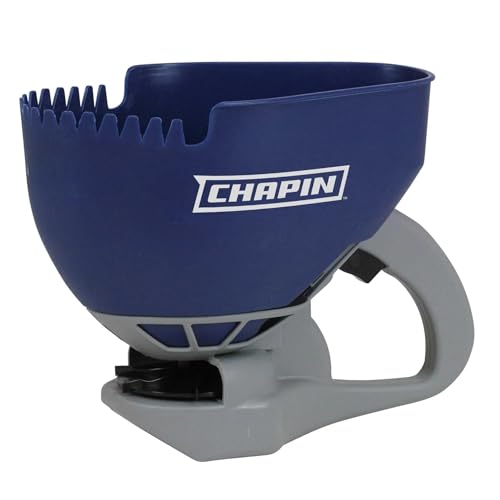 Chapin 8705A SaltPro Hand Crank Spreader A hand-cranked impeller with a thumb-controlled gate — the one here that lets you meter the rate and the direction at the same time. | Even coverage without a broadcast arc | 8.3/10 | $24.99 - View on Amazon #ad affiliate link · Price as of September 14, 2026 |
| 2 |  Snow Joe SJSPD1 Handheld Spreader, 5 lb An 84.5-ounce hopper holding five pounds with a dial flow control — the largest handheld capacity here, from a brand already on this site. | Covering a driveway without refilling | 8.1/10 | |
| 3 |  Scotts Whirl Hand-Powered Spreader A cranked broadcast spreader with an arm support and a stated 5-foot spread — the widest pattern here, and the one that reaches the edges. | A wide, even throw on open ground | 7.9/10 | |
| 4 |  Chapin 84700A TurfPro Handheld Bag Spreader, 25 lb Carries the bag itself rather than a hopper — 25 pounds at a time, which is the only handheld option here that will finish a long drive without stopping. Our skip-this pick | A long driveway, in one load | 7.5/10 | $31.97 - View on Amazon #ad affiliate link · Price as of September 14, 2026 |
| 5 |  Chapin 8740A All-Season Hand Shaker, 64 oz A 64-ounce shaker for the price of a bag of ice melt — no crank, no dial, and exactly right for a set of steps. | Steps, and spending almost nothing | 7.2/10 |
Even coverage without a broadcast arc
Chapin 8705A SaltPro Hand Crank Spreader
A hand-cranked impeller with a thumb-controlled gate — the one here that lets you meter the rate and the direction at the same time.
The reason to own a spreader at all is not speed, it is that a spreader stops you wasting product. Thrown by hand, de-icer lands in clumps: too much in the middle of the path, nothing at the edges, and a scatter of pellets in the flower bed. A clump does not melt faster than an even layer — it melts a hole and leaves the ice around it. Even beats heavy every time.
This is the most controllable of the handheld options. A hand crank drives an impeller that throws the material, and a separate thumb-operated gate sets how much reaches the impeller. Those being independent is the point: you can walk a narrow walkway at a low gate setting and a steady crank and lay down a genuinely thin, even film.
The hopper is small — Chapin states 0.3 gallons on the listing we link to — and on a walkway that is deliberate rather than limiting. You cannot dump half a bag onto twenty feet of path with a hopper this size, which is the single most common way people damage concrete and kill the grass along the edge.
One honesty note on the specification. Different retailers list this model at 1.6 liters and at 3 liters, which cannot both be right. We quote the figure from the listing we actually link to and are not going to pick a side on the rest.
Match it to the chemistry rather than the other way round. If you are spreading on concrete under a year old, no spreader saves you — read does ice melt damage concrete first, because the answer there is to use nothing at all.
What works
- Crank plus gate means you control rate and throw independently — nothing else here does both
- The toothed scoop edge fills it from the bag without a second container
- Small hopper is a feature on a walkway: you physically cannot over-apply a whole bag
- Made in the USA with a simple mechanism and little to fail
What does not
- 0.3 gallons is a few minutes of work — expect to refill on anything driveway-sized
- Cranking occupies one hand permanently
- Retailers list conflicting capacity figures for this model (1.6 L against 3 L); we quote the listing we link to and nothing else
- No published weight
Covering a driveway without refilling
Snow Joe SJSPD1 Handheld Spreader, 5 lb
An 84.5-ounce hopper holding five pounds with a dial flow control — the largest handheld capacity here, from a brand already on this site.
Capacity is the specification that decides whether a handheld spreader is pleasant or infuriating, and it is the one most listings bury. A one-pound shaker is perfect for a set of steps and maddening on a driveway, because you refill it four times and lose the rhythm that makes spreading even in the first place.
Snow Joe publishes an 84.5-ounce hopper holding up to five pounds, which is the largest handheld figure in this group. On a typical two-car driveway that is one fill for the whole job at a sensible application rate.
Rate is set by a dial rather than a simple open-shut gate, and that distinction matters more than it sounds. A gate gives you on and off and a lot of guesswork; a dial lets you find a setting, walk the whole surface at it, and get a consistent film. Consistency is what makes a bag of de-icer last the season.
The shaker mechanism is the trade against the hand-cranked option. A crank-driven impeller throws material in a controlled arc and covers a wider, more even swath; a shaker drops it in a narrower band under your hand. For a driveway walked in overlapping passes that is fine. For a wide open area it is slower.
The warning that comes with a big hopper is over-application. Five pounds is enough to seriously overdose a small area, and more de-icer does not melt more ice once the surface film is saturated — it just runs off into your soil. When to apply ice melt covers the timing that makes a thin layer work better than a thick one.
What works
- Five pounds is roughly double the small hand shakers — a whole driveway on one fill
- The dial is a genuine rate control, not just open or closed
- All-season use means it earns storage space rather than sitting idle until December
- Snow Joe parts and support are easy to find, which is not true of the no-name shakers
What does not
- Five pounds of salt held out at arm's length gets heavy faster than you expect
- Shaker action gives a narrower, less even pattern than a cranked impeller
- No published weight for the tool itself
- A big hopper makes over-application easy — the opposite failure from the small ones
A wide, even throw on open ground
Scotts Whirl Hand-Powered Spreader
A cranked broadcast spreader with an arm support and a stated 5-foot spread — the widest pattern here, and the one that reaches the edges.
Broadcast spreaders solve the problem the shakers do not: reaching the edges. Ice forms first along the margins of a driveway, where meltwater runs and where the sun does not reach, and a tool that drops product in a narrow band under your hand is exactly the wrong shape for treating a margin.
The Whirl throws a stated five-foot pattern from a hand crank. On a sixteen-foot-wide driveway that is three or four passes instead of a dozen, and because the pattern overlaps you get a genuinely even film rather than stripes.
The arm support is the feature worth noticing. Anything you crank while holding it out in front of you loads your wrist and forearm, and that — not the walking — is what makes people stop halfway and start flinging handfuls. Scotts brackets the weight against your forearm instead.
Two honest caveats. The first is the specification itself: retailers list this model's capacity at figures as far apart as 1.15 pounds and 8 pounds, which cannot both describe the same hopper. The listing we link to states coverage rather than weight — enough product for up to 1,500 square feet — so that is the figure we quote, and we are not going to pretend to know the rest.
The second is a matter of fit. A five-foot spread is wrong for a four-foot walkway: you would be putting a third of every scoop into the lawn and the beds. Chlorides are hard on planting, and the case is set out in ice melt damage by surface. Use this on the drive and something narrower on the path.
What works
- A 5-foot pattern covers a driveway in far fewer passes than a shaker
- Arm support takes the load off your wrist, which is the thing that ends long sessions
- Broadcast throw reaches the edges of a drive, where ice actually forms first
- Genuinely dual-season, so it is in use in spring as well
What does not
- Five feet of throw is too wide for walkways, steps or anything near planting
- Retailer capacity listings for this model conflict badly (1.15 lb against 8 lb); we do not know which is right and will not guess
- Broadcast spreaders waste product at the edge of any surface narrower than the pattern
- No published tool weight
A long driveway, in one load
Chapin 84700A TurfPro Handheld Bag Spreader, 25 lb
Carries the bag itself rather than a hopper — 25 pounds at a time, which is the only handheld option here that will finish a long drive without stopping.
Skip this one
Skip the 25-pound bag spreader unless your driveway is genuinely long. Carrying and cranking that much weight is a real physical task, and for most of the people this site is written for — anyone with a bad back, anyone buying for a parent — it is the wrong tool no matter how good the coverage is. It also happens to be the one here that Chapin does not name ice melt among its materials.
There is a length of driveway past which handheld spreaders stop making sense, and it arrives sooner than people expect. At a sensible application rate a five-pound hopper treats a couple of hundred square feet. A 200-foot rural drive is several thousand. You are not spreading at that point, you are refilling.
This is the handheld answer to that. Rather than a hopper you decant into, the material bag mounts to the tool itself, so you carry 25 pounds and you are not standing over a sack with a scoop in the dark.
Read the maker's claim carefully, because we are extending it. Chapin markets the TurfPro for grass seed and fertilizer. The mechanism is the same one their salt spreaders use and there is no reason it will not spread a pelletized de-icer, but ice melt is not among the materials Chapin names on this listing, and we would rather tell you that than quote a claim they did not make.
The physical cost is real. Twenty-five pounds carried and cranked is a workout, and for a lot of the people this site is written for — anyone shovelling with a bad back, anyone buying for a parent — it is simply the wrong tool. Snow shovels for seniors makes the same argument about load in a different category.
Where it fits: a long or rural drive on the kind of property that also gets fertilized in May. If your drive is a two-car apron, buy one of the small ones and enjoy the change.
What works
- 25 pounds is five times the biggest hopper here — a long driveway in a single load
- Bag-mounted design means no decanting from sack to hopper and no spillage
- The same tool does the spring fertilizer round, so it is not a single-season purchase
- Chapin build quality, from a brand that has made spreaders for a very long time
What does not
- Chapin markets it for seed and fertilizer; ice melt is our extension of the mechanism, not a maker's claim
- 25 pounds hanging off one shoulder is genuinely heavy and rules it out for many buyers
- Overkill on anything smaller than a long drive or a commercial walk
- Most expensive option here, and no published tool weight
Steps, and spending almost nothing
Chapin 8740A All-Season Hand Shaker, 64 oz
A 64-ounce shaker for the price of a bag of ice melt — no crank, no dial, and exactly right for a set of steps.
Not every property needs a mechanism. If what you are treating is a front path, a porch and four steps, a 64-ounce shaker does the whole job in one fill and costs less than the de-icer you put in it.
The case for it is precision in a small space rather than coverage. A shaker puts material in a narrow band directly under your hand, which on a set of steps is exactly what you want — the alternative is a broadcast spreader flinging chloride into the shrubs either side and against the railing posts.
What you give up is evenness over distance. There is no crank metering the flow, so the rate is whatever your arm is doing, and arms get tired and inconsistent. Over twenty feet that does not matter. Over a driveway it produces stripes, which means bare ice between the treated bands.
Chapin does not publish an adjustable rate control for this model on the listing we read, so treat it as a fixed-rate tool and control the dose by walking speed instead. Walk faster for less, slower for more.
The genuine reason to buy the cheapest option here: for a small property it is not a compromise at all. Put the money you saved into the right chemistry for your surface instead — pet-safe ice melt and ice melt for pavers are where the decision actually matters.
What works
- Costs a fraction of everything else here and does the one job it claims
- 64 ounces is the right amount for a porch, a set of steps and a short path
- Nothing mechanical to seize up after a summer in the garage
- Narrow pattern keeps product off planting and out of board seams
What does not
- No crank, so coverage is only as even as your shaking rhythm
- 64 oz means constant refilling on anything driveway-sized
- No published adjustable rate control on the listing we read
- A shaker is the easiest tool to accidentally over-apply with in one spot
Using it so the bag lasts
- Spread before the freeze, not after. A thin layer on clear pavement stops ice bonding. Breaking a bond that already formed takes several times the product. The timing is the whole game — when to apply ice melt.
- Clear the snow first. De-icer spread on top of snow has to melt through the snow before it reaches the ice, which wastes most of it.
- Set the rate low and walk slowly. Almost everyone applies too much. You want a scatter you can still see pavement through, not a white coating.
- Overlap your passes. Stripes of treated and untreated surface are how a driveway ends up with ice ribbons between clear bands.
- Sweep up the residue in spring. What is left on the surface in March goes into the soil and the storm drain. On pavers it also sits in the joints.
- Rinse the spreader and dry it. Salt is corrosive and will seize a crank mechanism over the summer. This is the reason most spreaders die.
One last honest note: for a small property, the cheapest shaker on this page is not a compromise. Sixty-four ounces genuinely does a porch and a path, and the money is far better spent on the right chemistry for your surface than on a mechanism you do not need.
Questions people ask
Do I need a spreader for ice melt?
What size spreader do I need for a driveway?
Can you use a fertilizer spreader for salt?
How much ice melt should I spread?
What is the best spreader for steps and a small path?
Sources
Next stage
Timing beats equipment
The best spreader in the world applied after the ice has bonded is doing the expensive version of the job. Here is the sequence that is not.
Keep goingAbout the author
Scooter M.
An enthusiast who is genuinely into this. I read the manuals, compile the published specs, and do the math on door clearances. No lab coat, no test bench, and nothing here is a product I have used - which is exactly why every claim carries a source.
Published by Slate Mill Group, with the Shovel Report team. Published September 13, 2026; last updated September 13, 2026. Editorial policy.
Read next

Timing Guide
When to Apply Ice Melt
Pre-treat, then clear, then spot-treat — the sequence that uses least product for most effect.

Best Pet Safe
Best Pet Safe Ice Melt
What "pet safe" means on a label, and the products that genuinely contain no chloride.

By Temperature
What Temperature Does Ice Melt Stop Working?
Published working temperatures by chemistry, and what to spread below them.
Concrete Damage Explained
Does Ice Melt Damage Concrete?
Freeze-thaw cycling, not dissolution — the mechanism, the risk cases, and what protects a slab.