By Scooter M. · Last updated August 25, 2026
Shovel Report earns a commission when you buy through the links on this page, at no extra cost to you. It does not change what we recommend, and we publish a skip-this verdict on products we could otherwise earn from. Full disclosure.
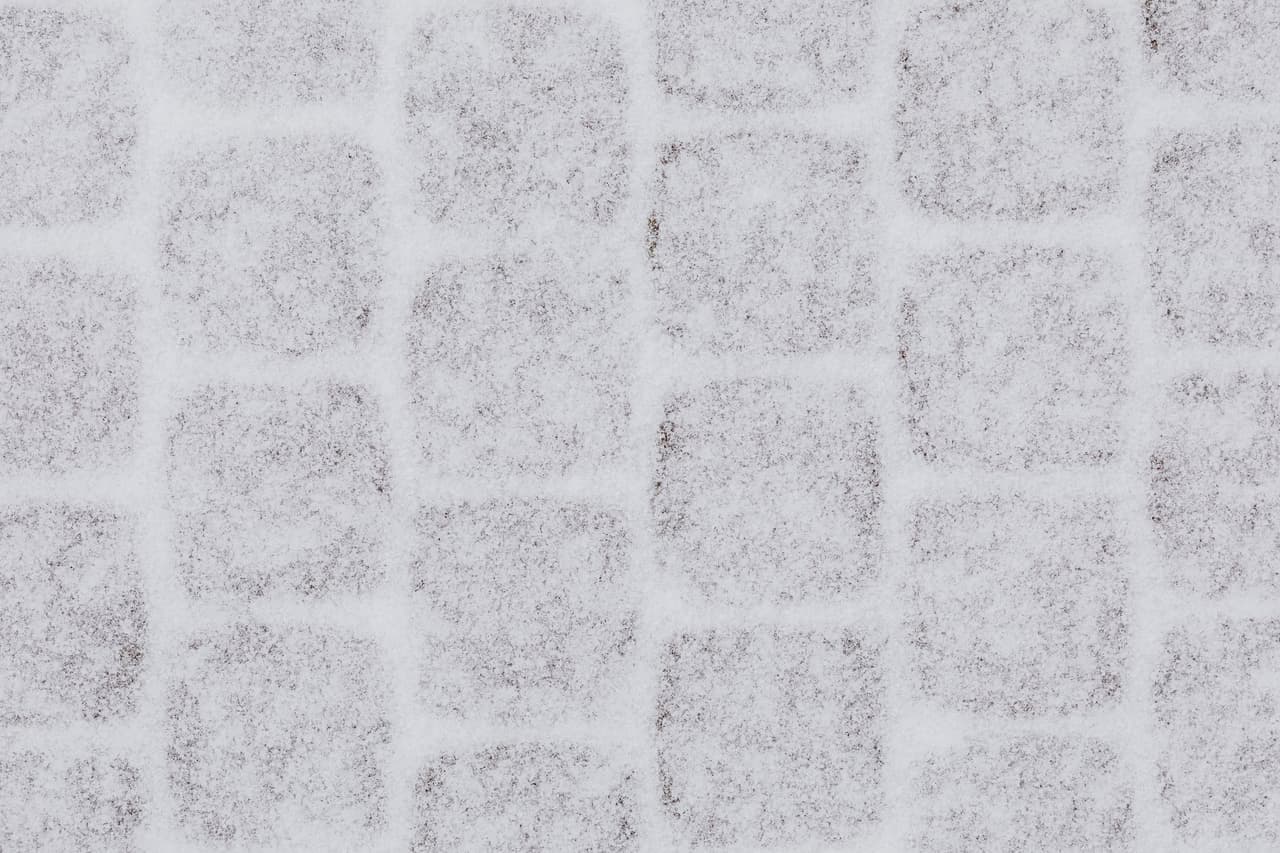
On pavers the concern is not the units themselves but the joints between them and the surface finish. Concentrated brine washes jointing sand out and can pull salts to the surface as efflorescence. Chloride-free products and controlled application rates are the sensible defaults, and polymeric sand plus sealing does more than any product choice.
Three separate risks, only one of them the paver
Jointing sand erosion. An interlocking paver surface works because the joints are packed with sand that locks the units together. Meltwater carrying dissolved salt runs into those joints and washes sand out. Lose enough and the units start to shift, which is a structural problem rather than a cosmetic one.
Efflorescence. The white haze that appears on concrete pavers is soluble salts migrating to the surface and crystallizing as water evaporates. Adding salt to the surface gives that process more material to work with. It is cosmetic and it is stubborn.
Surface scaling on the units. Concrete pavers are a cementitious product, so the freeze-thaw mechanism that scales a concrete driveway applies to them too — though quality pavers are manufactured denser than poured driveway concrete and are correspondingly more resistant.
Notice that the first two are about the system rather than the material. That is why the guidance for pavers differs from the guidance for a poured concrete slab.
How we picked
- Published lowest effective temperature, because a de-icer applied below its working point does nothing at all
- Chloride content and type, which is what actually drives concrete, metal and plant risk
- Published coverage per pound where a maker states one — the only figure that lets you budget a season
- Form (pellet, flake or crystal), since pellets bore down through ice and flakes tend to sit on top
- What the manufacturer explicitly claims about surfaces, quoted rather than paraphrased
We have not physically tested these products. We do not own them, we have no lab, and we do not accept free product. Everything above is compiled from published manufacturer specifications, published manuals, published standards and live retailer data - and we tell you which is which on every claim. How we pick.
Quick picks
Ranked against the criteria below. Tap a row to jump to the full write-up; the price button goes straight to Amazon.
| # | Product | Best for | Score | Price |
|---|---|---|---|---|
| 1 |  Safe Paw Ice Melt The one product here with no chloride in it at all — the right answer on composite decking, new concrete and around metal. | Chloride-free, on decks and new concrete | 8.2/10 | $84.95 - View on Amazon #ad affiliate link · Price as of October 16, 2026 |
| 2 |  Snow Joe AZ-50-EB Premium Enviro Blend Green-coated crystals carrying calcium magnesium acetate for corrosion inhibition — the compromise blend when you cannot use one chemistry everywhere. | Mixed surfaces on one bag | 7.9/10 | $34.97 - View on Amazon #ad affiliate link · Price as of October 16, 2026 |
| 3 |  FIREKI Pet Safe Ice Melt, Magnesium Chloride Pure magnesium chloride with no additives or dye in a 15 lb tub with a scoop — but its published -35°F is colder than magnesium chloride brine can stay liquid, so plan around the chemistry's real floor instead. | A small tub of magnesium chloride, with a scoop | 7.2/10 | $56.99 - View on Amazon #ad affiliate link · Price as of October 16, 2026 |
| 4 |  Peladow Calcium Chloride Pellets, 50 lb OxyChem's round calcium chloride pellet at about 90% purity, working to a published -25°F and dissolving exothermically — the chemistry for ice that has already bonded. Our skip-this pick | Breaking an existing bond on a cold morning | 7.5/10 | $50.99 - View on Amazon #ad affiliate link · Price as of October 16, 2026 |
Chloride-free, on decks and new concrete
Safe Paw Ice Melt
The one product here with no chloride in it at all — the right answer on composite decking, new concrete and around metal.
Almost every de-icer on a hardware store shelf is a chloride: sodium, calcium, magnesium or potassium. Chlorides are cheap and they work, and the chloride ion is also the thing that corrodes rebar, attacks metal fixings and gets blamed for spalled concrete. Safe Paw contains none of them.
The chemistry is a crystalline amide core carrying glycols, and the manufacturer states it is non-corrosive and effective to -2°F, with coverage of about 100 square feet per pound. That coverage figure is unusually useful: a 35-pound pail covers roughly 3,500 square feet at the stated rate, which is several storms on a normal driveway and walkway.
The -2°F floor is the honest trade. Calcium chloride keeps working far below that; this does not. On a genuinely cold night in a cold climate a chloride-free product will underperform, and pretending otherwise would be a disservice.
Where it wins outright is on surfaces where chloride is the risk rather than the temperature: composite decking, concrete poured within the last year, anything with exposed metal fasteners, and beds where salt-sensitive plants sit downhill of the runoff.
What works
- No chloride at all, which removes the entire concrete-and-metal argument
- 100 sq ft per pound is a published coverage figure you can budget from
- Traction agent included, so it does something even where it is too cold to melt
What does not
- -2°F is warmer than calcium chloride's floor — it is not the deep-cold answer
- Costs substantially more per pound than any chloride
- The glycol carrier can leave a residue that tracks indoors
Mixed surfaces on one bag
Snow Joe AZ-50-EB Premium Enviro Blend
Green-coated crystals carrying calcium magnesium acetate for corrosion inhibition — the compromise blend when you cannot use one chemistry everywhere.
Calcium magnesium acetate — CMA — is not a chloride, and that is the entire point of it. It is used by transport agencies specifically where chloride corrosion of steel is unacceptable, and its inclusion here is why Snow Joe positions this blend as safer for concrete and metals.
The green coating is a better idea than it looks. Ice melt is almost always over-applied, because you cannot see white crystals on white snow and so you keep spreading. A colored product shows your coverage, and coverage discipline is what keeps chloride out of your soil and product in the bag.
The missing figure is the working temperature, which the listing we read does not publish. Acetate-based and blended products generally give up some cold performance in exchange for gentleness, so treat this as a moderate-cold product until the maker publishes a number.
It is a sensible default for the common real-world case: a driveway with a lawn edge, a metal railing and a concrete walk, where you want one bag rather than three. If it is genuinely cold, reach for calcium chloride instead.
What works
- Calcium magnesium acetate is a recognized corrosion inhibitor, not marketing language
- The green coating shows you where you have already spread — which is how you avoid over-applying
- Positioned for mixed surfaces where one chemistry will not do
What does not
- No published lowest effective temperature on the listing we read
- The colorant can track indoors on boots and paws
- Blends always trade some cold-temperature performance for gentleness
A small tub of magnesium chloride, with a scoop
FIREKI Pet Safe Ice Melt, Magnesium Chloride
Pure magnesium chloride with no additives or dye in a 15 lb tub with a scoop — but its published -35°F is colder than magnesium chloride brine can stay liquid, so plan around the chemistry's real floor instead.
The Green Gobbler Pet Safe ice melt we used to list here is no longer available, and the brand's ice melt line has gone from the retailer we link to. This is the closest comparable product we can verify is in stock: pure magnesium chloride, in the same 15-pound size.
Every de-icer works the same way: it dissolves into the thin film of water on the ice and lowers that water's freezing point. What differs is which salt does the dissolving, how cold it keeps working, and what it does to concrete, plants and paws. Magnesium chloride sits at the mild end of the working chlorides.
FIREKI states the product is pure magnesium chloride with no additives and no coloring, and publishes a working temperature of -35°F. That temperature is the figure to discount. Texas DOT gives magnesium chloride's eutectic — the coldest point at which its brine can stay liquid at all — as about -28°F, and the Minnesota Pollution Control Agency puts its lowest practical pavement temperature at -10°F. A claim of -35°F sits below both, so plan around -10°F as you would for any magnesium chloride, and switch to calcium chloride or grit below it. magnesium chloride ice melt explains the numbers.
The pet claim deserves a precise reading. Magnesium chloride is less likely to irritate paws than rock salt, which is why it is sold this way. It is not food, and "pet safe" is not "pet edible". Wipe paws after walks regardless. It is also still a chloride, so keep it off concrete poured within the last twelve months — does ice melt damage concrete explains why, and pet-safe ice melt covers the chloride-free alternative.
What works
- No dye, so nothing to stain decking seams or track indoors as color
- Magnesium chloride is the least paw-irritating of the common working chlorides
- Scoop included for measured application
What does not
- "Pet safe" means less irritating, not edible — it is still a chloride salt
- The published -35°F is colder than magnesium chloride's eutectic of about -28°F (Texas DOT) and far below the -10°F practical pavement floor the Minnesota Pollution Control Agency gives, so it is not a figure to plan around
- Costs several times as much per pound as a 50 lb bag of the same chemistry
- No published coverage rate, so you cannot budget a season from the bag
- Attracts moisture and can leave a slick residue if over-applied
Breaking an existing bond on a cold morning
Peladow Calcium Chloride Pellets, 50 lb
OxyChem's round calcium chloride pellet at about 90% purity, working to a published -25°F and dissolving exothermically — the chemistry for ice that has already bonded.
Skip this one
Concentrated calcium chloride brine running into paver joints is the fastest way to wash out jointing sand and to pull salts to the surface as efflorescence. It is the right chemistry for deep cold on a poured surface and the wrong one on a jointed one.
The Green Gobbler calcium chloride we used to list here is no longer available. Peladow is the closest comparable product we can verify is in stock, and it is the reference calcium chloride pellet that most of the category is measured against: made by OxyChem, at about 90% calcium chloride.
The reason to reach for calcium chloride is its mechanism. It dissolves exothermically — it releases heat as it goes into solution — so it starts working the moment it lands rather than depending on sunlight or ambient warmth. OxyChem also points to the round pellet shape, which penetrates an ice layer and attacks the bond with the pavement instead of sitting on top.
Be precise about the temperature. OxyChem publishes an effective temperature of -25°F. That is very cold, and it is consistent with the chemistry: the Minnesota Pollution Control Agency puts calcium chloride's lowest practical pavement temperature at -20°F, ten degrees colder than magnesium chloride's. Calcium chloride wins on both counts that matter in deep cold — it works colder, and it starts faster on an existing bond.
The cost is what it does to surfaces. Calcium chloride drives the most freeze-thaw cycling of any common de-icer, which is the mechanism that damages concrete, and its brine washes jointing sand out of pavers. Use it to rescue a driveway that has already iced — how to get ice off a driveway — not as routine pre-treatment.
What works
- Exothermic: it generates heat as it dissolves, so it starts working on contact rather than waiting for sun
- Round pellets bore down through an ice layer instead of sitting on top of it
- Published compliance with the ASTM and AASHTO calcium chloride standards
- 50 lb bag is the economical way to buy the coldest-working chloride
What does not
- Rated high risk for corrosion of reinforcing steel and for vegetation by the Minnesota Pollution Control Agency, like the other chlorides
- Hardest on paws of anything we list
- The maker's "up to 3x faster" claim is theirs, not a figure we can verify
- 50 pounds is a heavy bag, and calcium chloride absorbs moisture and cakes if stored open
What actually protects a paver driveway
- Polymeric jointing sand. It binds when wetted and resists washout far better than plain sand. This does more to protect an interlocking surface than any de-icer decision.
- Sealing. A paver sealer reduces water absorption, which reduces both freeze-thaw scaling and efflorescence. It also makes the surface easier to clear.
- Controlled application. Less product means less brine running into joints. Use a spreader.
- Clear mechanically first. De-icer should be treating a thin bonded layer, not melting six inches of snow into brine that flows across your joints.
- Direct the meltwater. Where the drive slopes, the low end takes the concentrated runoff. That is where joint erosion shows up first.
The clearing half of the problem
Pavers are also the surface where clearing tools cause the most avoidable damage, because paver surfaces are rarely perfectly level. Frost heave and settlement leave lips between units, and a rigid edge catches on them.
The rules that follow: no steel shovel edges. Poly or UHMW blades only — the makers of the better pushers explicitly rate them for pavers. And if you use a snow blower, set the skid shoes high so the scraper is not riding on the units, and prefer a two-stage machine whose auger is held off the surface entirely.
The complete paver setup, tools and chemistry together, is on our paver driveway page.
Sealed versus unsealed changes the answer
A sealed paver surface absorbs much less water, which reduces both the scaling risk and the efflorescence risk substantially. On a well-sealed drive with polymeric joints, a magnesium chloride product at a controlled rate is a reasonable choice.
On an unsealed surface with plain sand joints — which describes a lot of older installations — the conservative approach is chloride-free chemistry or mechanical clearing plus grit. Efflorescence in particular is much easier to avoid than to remove.
Questions people ask
Is ice melt safe on pavers?
What causes white haze on pavers in winter?
Will ice melt wash out my paver joints?
Can I use a snow blower on a paver driveway?
Sources
Next stage
The whole paver driveway
Chemistry plus the right blade edge plus the right skid height. On pavers all three have to agree or the joints pay for it.
Keep goingAbout the author
Scooter M.
An enthusiast who is genuinely into this. I read the manuals, compile the published specs, and do the math on door clearances. No lab coat, no test bench, and nothing here is a product I have used - which is exactly why every claim carries a source.
Published by Slate Mill Group, with the Shovel Report team. Published August 17, 2026; last updated August 25, 2026. Editorial policy.
Read next
Best for Pavers
Paver Driveway Snow Removal
Soft-edged tools, high skid settings and joint-safe chemistry for interlocking surfaces.
Best for Concrete
Best Ice Melt for Concrete
Chloride type against concrete age and condition, with the real damage mechanism explained.
Blade Material Guide
Snow Shovel Blade Materials, Compared
Poly, aluminum-edged, UHMW and steel blades ranked on snow release, durability and surface safety.
Best for Decking
Best Ice Melt for Composite Decking
Chloride-free defaults for composite boards, and why the manufacturer's guidance is authoritative.