By Scooter M. · Last updated October 18, 2026
Shovel Report earns a commission when you buy through the links on this page, at no extra cost to you. It does not change what we recommend, and we publish a skip-this verdict on products we could otherwise earn from. Full disclosure.
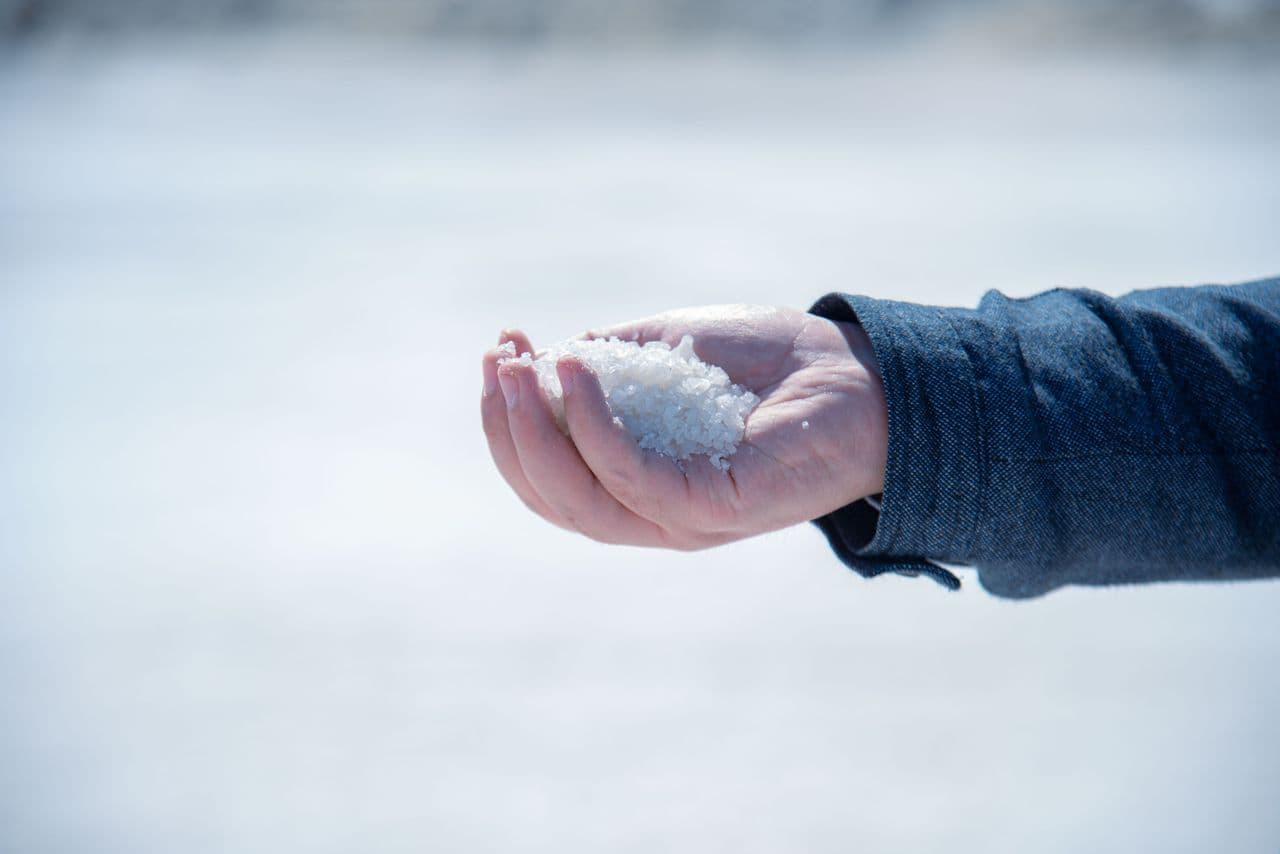
Use less than four pounds of ice melt per 1,000 square feet - that is Minnesota Pollution Control Agency guidance, and one pound is roughly a heaping 12-ounce coffee mug. A single-car driveway of about 300 square feet therefore needs a bit over a mug per application, not a scoop from the bag. More does not melt faster; it leaves the surplus on dry pavement, which the MPCA says means it is no longer working. A 50-pound bag, used at that rate, is about twelve treatments of a two-car driveway.
The published rate, and who published it
This category is full of guesses, so it is worth being precise about where the number comes from. Minnesota's Pollution Control Agency runs a winter-maintenance certification program and publishes a homeowner-facing sheet, Smart Salter. Its application guidance is three sentences long and it is the most useful thing written about de-icer quantity:
- "More salt does not melt ice faster."
- "Use less than four pounds of salt per 1,000 square feet" - and the sheet adds the useful scale that an average parking space is about 150 square feet.
- "One pound of salt is approximately a heaping 12-ounce coffee mug."
That last line is the one that changes behavior, because it converts an abstract rate into something you can see. Four pounds per 1,000 square feet is four coffee mugs across an area the size of about seven parking spaces. Almost nobody applies that little by hand, which is the whole point of the sheet.
Your driveway, in mugs
This site uses roughly 300 square feet for a single-car driveway - about 10 feet by 30. Here is the MPCA ceiling applied to real areas, with the mug conversion carried through:
Maximum per application at under 4 lb per 1,000 sq ft
How many bags is a winter?
This is the question behind most searches here, and with the rate established it is simple division. A 760-square-foot property - driveway, walk and steps - takes about 3 pounds per application:
Applications per bag, at 3 lb per treatment of a 760 sq ft property
So one 50-pound bag is a season for most households, which is considerably less than the two or three bags people commonly buy. If you are getting through four bags a winter on a normal driveway, the problem is almost certainly rate rather than weather.
Rates differ by chemistry - and some makers publish theirs
The four-pound figure is for salt. Other chemistries work at different strengths, and where a maker publishes a rate it beats any general guidance. Two of the products we rank do:
Published coverage and rate figures, by product
Note the direction of the CMA figure. The maker of the 100% product states 5 to 15 pounds per 1,000 square feet, which is between 1.25 and nearly 4 times the salt ceiling. That is not a mistake on their part - an acetate is a weaker melter per pound than a chloride, so you need more of it. It is also why CMA costs so much more per treatment than its price per pound suggests, and the full case for and against it is on CMA, urea and potassium chloride.
The practical buying lesson: a bag that publishes a coverage rate is worth more than a bag that does not, because it is the only figure that lets you budget a season or compare two products on cost per treatment rather than cost per pound.
Four things that cut the amount you need
1. Clear the snow first. The MPCA puts this first too: the more snow and ice you shovel or blow, the less de-icer you need and the more effective it can be. De-icer applied onto six inches of snow is being spent melting snow, which a shovel does for free. The sheet goes as far as saying you may decide de-icer is not needed at all.
2. Treat before, not after. Preventing a bond costs a fraction of breaking one. This is why highway crews spray brine ahead of a storm rather than salting after it, and the residential version is on when to apply ice melt and liquid ice melt and de-icer.
3. Use a spreader. A hand-scattered pass is wildly uneven and heavy by default; a spreader meters it. This is the single piece of equipment that makes the rates on this page achievable rather than theoretical, and the models are on best handheld salt spreaders.
4. Sweep up the surplus and reuse it. The MPCA is blunt about this: if you see salt or sand on dry pavement, it is no longer working - save it to use somewhere else. Free product, and it stays out of the storm drain.
The rate cannot fix the wrong temperature
One failure mode no quantity solves. The MPCA notes most salts stop working at 15 degrees Fahrenheit. Below a product's working floor, applying more of it achieves nothing whatsoever - the chemistry has stopped, and the pile on your driveway is inert.
If your pavement is colder than the bag's published floor, the answer is either a colder-working chemistry or sand for traction, not a heavier hand. Which chemistry works to which temperature is on what temperature does ice melt stop working, and the traction-instead-of-melting route is on ice melt vs sand.
How we picked
- Whether the maker publishes a coverage rate or an application rate - the only figure that lets you budget a season
- Published lowest effective temperature, because below it no quantity works at all
- Bag or pail size against a realistic season's use, rather than cost per pound in isolation
- Whether the product helps you see your own rate - a visible granule or a dye makes over-application obvious
- For the spreader: whether it meters a consistent rate, which is what makes a published figure achievable by hand
We have not physically tested these products. We do not own them, we have no lab, and we do not accept free product. Everything above is compiled from published manufacturer specifications, published manuals, published standards and live retailer data - and we tell you which is which on every claim. How we pick.
Quick picks
Ranked against the criteria below. Tap a row to jump to the full write-up; the price button goes straight to Amazon.
| # | Product | Best for | Score | Price |
|---|---|---|---|---|
| 1 |  Safe Paw Ice Melt The one product here with no chloride in it at all — the right answer on composite decking, new concrete and around metal. | Chloride-free, on decks and new concrete | 8.2/10 | $84.95 - View on Amazon #ad affiliate link · Price as of October 18, 2026 |
| 2 | 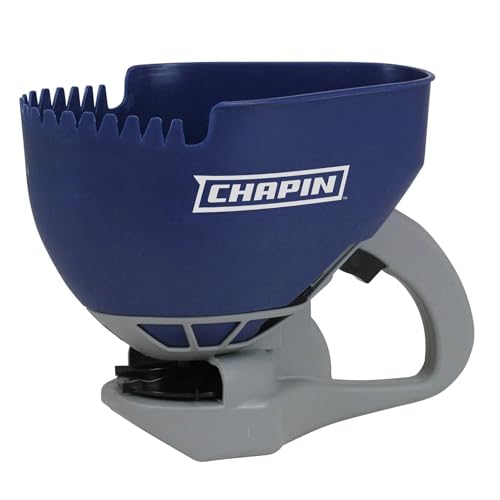 Chapin 8705A SaltPro Hand Crank Spreader A hand-cranked impeller with a thumb-controlled gate — the one here that lets you meter the rate and the direction at the same time. Our skip-this pick | Even coverage without a broadcast arc | 8.3/10 | $24.99 - View on Amazon #ad affiliate link · Price as of October 18, 2026 |
| 3 |  Snow Joe AZ-50-EB Premium Enviro Blend Green-coated crystals carrying calcium magnesium acetate for corrosion inhibition — the compromise blend when you cannot use one chemistry everywhere. | Mixed surfaces on one bag | 7.9/10 | $34.97 - View on Amazon #ad affiliate link · Price as of October 18, 2026 |
| 4 | 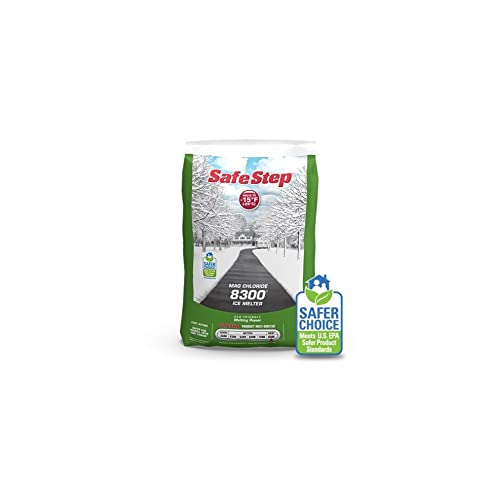 Safe Step Extreme 8300 Magnesium Chloride Ice Melter, 50 lb 100% magnesium chloride hexahydrate from Compass Minerals' Safe Step line, published to -15°F, in a 50 lb bag that costs a fraction per pound of the small pet-marketed tubs. | Magnesium chloride by the bag, at the lowest cost per pound | 8.1/10 | $49.73 - View on Amazon #ad affiliate link · Price as of October 18, 2026 |
Chloride-free, on decks and new concrete
Safe Paw Ice Melt
The one product here with no chloride in it at all — the right answer on composite decking, new concrete and around metal.
Almost every de-icer on a hardware store shelf is a chloride: sodium, calcium, magnesium or potassium. Chlorides are cheap and they work, and the chloride ion is also the thing that corrodes rebar, attacks metal fixings and gets blamed for spalled concrete. Safe Paw contains none of them.
The chemistry is a crystalline amide core carrying glycols, and the manufacturer states it is non-corrosive and effective to -2°F, with coverage of about 100 square feet per pound. That coverage figure is unusually useful: a 35-pound pail covers roughly 3,500 square feet at the stated rate, which is several storms on a normal driveway and walkway.
The -2°F floor is the honest trade. Calcium chloride keeps working far below that; this does not. On a genuinely cold night in a cold climate a chloride-free product will underperform, and pretending otherwise would be a disservice.
Where it wins outright is on surfaces where chloride is the risk rather than the temperature: composite decking, concrete poured within the last year, anything with exposed metal fasteners, and beds where salt-sensitive plants sit downhill of the runoff.
What works
- No chloride at all, which removes the entire concrete-and-metal argument
- 100 sq ft per pound is a published coverage figure you can budget from
- Traction agent included, so it does something even where it is too cold to melt
What does not
- -2°F is warmer than calcium chloride's floor — it is not the deep-cold answer
- Costs substantially more per pound than any chloride
- The glycol carrier can leave a residue that tracks indoors
Even coverage without a broadcast arc
Chapin 8705A SaltPro Hand Crank Spreader
A hand-cranked impeller with a thumb-controlled gate — the one here that lets you meter the rate and the direction at the same time.
Skip this one
Not a de-icer, and included deliberately because a spreader is what actually fixes over-application - a hand-scattered pass puts down several times what a calibrated spreader does. The skip-this note is this: do not buy a spreader to solve the wrong problem. If you are using a product with no published coverage rate, a spreader just distributes your guesswork more evenly.
The reason to own a spreader at all is not speed, it is that a spreader stops you wasting product. Thrown by hand, de-icer lands in clumps: too much in the middle of the path, nothing at the edges, and a scatter of pellets in the flower bed. A clump does not melt faster than an even layer — it melts a hole and leaves the ice around it. Even beats heavy every time.
This is the most controllable of the handheld options. A hand crank drives an impeller that throws the material, and a separate thumb-operated gate sets how much reaches the impeller. Those being independent is the point: you can walk a narrow walkway at a low gate setting and a steady crank and lay down a genuinely thin, even film.
The hopper is small — Chapin states 0.3 gallons on the listing we link to — and on a walkway that is deliberate rather than limiting. You cannot dump half a bag onto twenty feet of path with a hopper this size, which is the single most common way people damage concrete and kill the grass along the edge.
One honesty note on the specification. Different retailers list this model at 1.6 liters and at 3 liters, which cannot both be right. We quote the figure from the listing we actually link to and are not going to pick a side on the rest.
Match it to the chemistry rather than the other way round. If you are spreading on concrete under a year old, no spreader saves you — read does ice melt damage concrete first, because the answer there is to use nothing at all.
What works
- Crank plus gate means you control rate and throw independently — nothing else here does both
- The toothed scoop edge fills it from the bag without a second container
- Small hopper is a feature on a walkway: you physically cannot over-apply a whole bag
- Made in the USA with a simple mechanism and little to fail
What does not
- 0.3 gallons is a few minutes of work — expect to refill on anything driveway-sized
- Cranking occupies one hand permanently
- Retailers list conflicting capacity figures for this model (1.6 L against 3 L); we quote the listing we link to and nothing else
- No published weight
Mixed surfaces on one bag
Snow Joe AZ-50-EB Premium Enviro Blend
Green-coated crystals carrying calcium magnesium acetate for corrosion inhibition — the compromise blend when you cannot use one chemistry everywhere.
Calcium magnesium acetate — CMA — is not a chloride, and that is the entire point of it. It is used by transport agencies specifically where chloride corrosion of steel is unacceptable, and its inclusion here is why Snow Joe positions this blend as safer for concrete and metals.
The green coating is a better idea than it looks. Ice melt is almost always over-applied, because you cannot see white crystals on white snow and so you keep spreading. A colored product shows your coverage, and coverage discipline is what keeps chloride out of your soil and product in the bag.
The missing figure is the working temperature, which the listing we read does not publish. Acetate-based and blended products generally give up some cold performance in exchange for gentleness, so treat this as a moderate-cold product until the maker publishes a number.
It is a sensible default for the common real-world case: a driveway with a lawn edge, a metal railing and a concrete walk, where you want one bag rather than three. If it is genuinely cold, reach for calcium chloride instead.
What works
- Calcium magnesium acetate is a recognized corrosion inhibitor, not marketing language
- The green coating shows you where you have already spread — which is how you avoid over-applying
- Positioned for mixed surfaces where one chemistry will not do
What does not
- No published lowest effective temperature on the listing we read
- The colorant can track indoors on boots and paws
- Blends always trade some cold-temperature performance for gentleness
Magnesium chloride by the bag, at the lowest cost per pound
Safe Step Extreme 8300 Magnesium Chloride Ice Melter, 50 lb
100% magnesium chloride hexahydrate from Compass Minerals' Safe Step line, published to -15°F, in a 50 lb bag that costs a fraction per pound of the small pet-marketed tubs.
Safe Step is Compass Minerals' consumer ice melt line, and the Amazon listing sells this bag under the North American Salt name with the model number 53851. The maker describes the 8300 as 100 percent magnesium chloride hexahydrate — the ordinary hydrated crystal form of the salt, with no calcium chloride or rock salt blended in to cut the cost.
Its published working temperature is -15°F. That figure is worth a second look precisely because it is unremarkable. Texas DOT puts magnesium chloride's absolute limit, its eutectic, at about -28°F, and the Minnesota Pollution Control Agency puts its lowest practical pavement temperature at -10°F. A claim of -15°F sits between those two numbers, which is where an honest maker's figure for this chemistry should sit.
Safe Step makes one bolder claim: that the 8300 acts 75 percent faster than sodium chloride below 5°F. We have no way to check that figure and it is the maker's own. The direction of it is not controversial, though — rock salt's practical floor is around 15°F, so by 5°F it is working slowly if at all, and almost any magnesium chloride will outpace it there.
The reason to buy this bag over the small pet-marketed tubs is cost. A 50-pound bag of the same chemistry works out to a fraction of the per-pound price of a 15-pound tub, and magnesium chloride does not improve with better packaging.
The concrete claim needs the same care as the temperature one. Safe Step says the product is gentler on concrete used as directed. The Minnesota Pollution Control Agency's comparison rates magnesium chloride moderate-to-high risk to the concrete itself, citing paste deterioration from magnesium. Both can be true of light, occasional use. Neither makes it safe on a slab poured in the last twelve months — magnesium chloride ice melt lays out the evidence.
What works
- The maker states the chemistry precisely: 100% magnesium chloride hexahydrate, not a blend
- A published -15°F sits inside what the chemistry can actually do, rather than beyond it
- The 50 lb bag is the cheapest way to buy magnesium chloride that we can verify is in stock
- Crystal form, which the maker says resists scattering where you do not want it
What does not
- No published coverage rate, so you cannot budget a season from the bag
- "Gentler on concrete" is the maker's claim; the Minnesota Pollution Control Agency rates magnesium chloride higher risk to the concrete itself than calcium chloride or rock salt
- The 75%-faster-below-5°F figure is Safe Step's own and we cannot verify it
- Hygroscopic: an opened bag pulls moisture from the air and cakes unless it is sealed
The short version
- Shovel first. Every pound of snow you remove mechanically is de-icer you do not buy.
- Measure once, by mug. Under four pounds per 1,000 square feet; one pound is a heaping 12-ounce mug. Three mugs does a typical driveway, walk and steps.
- Spread it, do not fling it. A handheld spreader is the difference between the rate on this page and five times it.
- Check the temperature against the bag. Below the published floor, nothing you apply works.
- Sweep up what is sitting on dry pavement and use it next time.
Buy one bag of something that publishes its figures, buy a spreader once, and a normal property is a single 50-pound bag a winter. If you want the surface-by-surface version of which product to put on what, that is ice melt damage by surface.
Questions people ask
How much ice melt do I need for my driveway?
How many bags of ice melt do I need for a winter?
How much ice melt per square foot?
Does more ice melt work faster?
How much does a bag of ice melt cover?
Why is my ice melt not working even though I used a lot?
Do I need a spreader for ice melt?
Sources
- Minnesota Pollution Control Agency, Smart Salter (p-tr1-45) - under four pounds per 1,000 sq ft, one pound is approximately a heaping 12-ounce coffee mug, most salts stop working at 15 degrees, sweep up and reuse surplus
- SIMA product listing - Natural Alternative 100% CMA: application rate 5-15 lb per 1,000 sq ft
- Safe Paw - manufacturer site: 100 square feet per pound, chloride-free, -2 F
Next stage
The tool that makes these rates achievable
Hand-scattering puts down several times what a metered pass does. A handheld spreader is the difference between the figures above and five times them.
Keep goingAbout the author
Scooter M.
An enthusiast who is genuinely into this. I read the manuals, compile the published specs, and do the math on door clearances. No lab coat, no test bench, and nothing here is a product I have used - which is exactly why every claim carries a source.
Published by Slate Mill Group, with the Shovel Report team. Published October 18, 2026; last updated October 18, 2026. Editorial policy.
Read next
Best Spreader
Best Handheld Salt Spreaders
Capacity, spread width and rate control — matched to the size of the surface you actually treat.
Timing Guide
When to Apply Ice Melt
Pre-treat, then clear, then spot-treat — the sequence that uses least product for most effect.

By Temperature
What Temperature Does Ice Melt Stop Working?
Published working temperatures by chemistry, and what to spread below them.
Low-Corrosion Options
CMA, Urea and Potassium Chloride Ice Melt
CMA is purchasable and useful; urea and potassium chloride mostly are not. The published figures, and why none is for deep cold.