By Scooter M. · Last updated September 21, 2026
Shovel Report earns a commission when you buy through the links on this page, at no extra cost to you. It does not change what we recommend, and we publish a skip-this verdict on products we could otherwise earn from. Full disclosure.
A snow pusher slides snow off the surface instead of lifting it, which removes the motion that causes most shoveling injuries. Buy 27 to 32 inches for a residential driveway. Wider blades only pay off on genuinely flat, open surfaces — on uneven ground they bridge dips and catch on high spots.
Why pushers are underrated
Almost every article about reducing shoveling strain talks about handle geometry. Very few mention the tool that removes the strain-producing motion altogether, probably because it is cheap and unglamorous. If you are still working out which shape you need at all, the seven types of snow shovel lays them out side by side.
The mechanics are unarguable. Lifting a loaded shovel is what loads your lumbar spine and what spikes cardiac demand. A pusher never lifts: the blade stays on the ground and you walk the snow to the edge of the drive. There is no throw, no twist and no cantilevered load.
It also covers ground faster. A 30-inch blade clears 67 percent more per pass than an 18-inch shovel, so on a 20-by-30-foot driveway you make roughly 12 passes instead of roughly 20 — and each of those passes is a push rather than a lift.
What a pusher cannot do
Two things, and they are the reason a pusher is a second tool rather than the only one.
It cannot lift. The windrow you accumulate at the edge of the drive has to go somewhere, and past a certain height you are picking it up. Keep a light scoop for that.
It cannot chop. The compacted, refrozen ridge the municipal plow leaves across the end of your driveway will stop a pusher dead — it simply rides over the top. That is a steel-edge job. See blade materials. It is also a ground tool only — the roof and the car need their own tools, covered in roof rakes and car snow tools.
It also has a range limit. On a long driveway you eventually run out of anywhere to push to, which is the point at which the honest recommendation becomes a machine.
How we picked
- Published tare weight, because it is added to every one of the several hundred lifts in a driveway clear
- Blade width against that weight — the load-per-stroke trade nobody puts on the box
- Assembled length against user height, since a short shaft forces a stoop no handle design can undo
- Wear edge material, which decides both durability and which surfaces the tool is safe on
- Grip geometry: whether a second hand can take the load off the lower back
We have not physically tested these products. We do not own them, we have no lab, and we do not accept free product. Everything above is compiled from published manufacturer specifications, published manuals, published standards and live retailer data - and we tell you which is which on every claim. How we pick.
Quick picks
Ranked against the criteria below. Tap a row to jump to the full write-up; the price button goes straight to Amazon.
| # | Product | Best for | Score | Price |
|---|---|---|---|---|
| 1 |  The Snowplow Original Snow Pusher, 30 in A UHMW polyethylene blade that snow slides off rather than sticks to, in the width that actually changes your clearing time. | Wide, flat driveways | 8.9/10 | $69.99 - View on Amazon #ad affiliate link · Price as of October 15, 2026 |
| 2 | 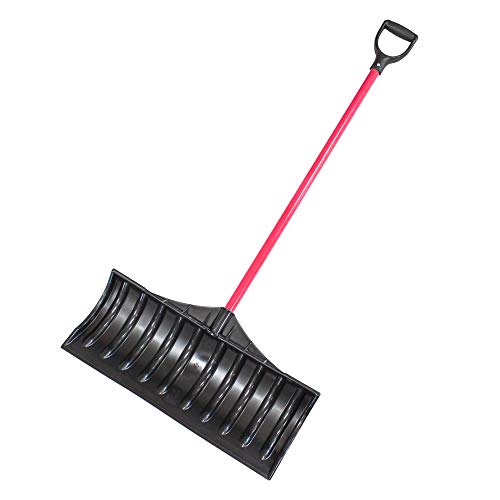 Bully Tools 92813 27-in Poly Snow Pusher A 27-inch poly scoop on a fiberglass D-grip handle — wide enough to matter, soft enough for pavers and decking. | A pusher that will not mark a surface | 8.2/10 | $51.94 - View on Amazon #ad affiliate link · Price as of October 15, 2026 |
| 3 |  Manplow PRO32 Snow Pusher, 32 in The PRO line's EZ Glide Edge at 32 inches — the width most driveways can actually use, on the edge Manplow rates for aggregate and decking. | A residential-width Manplow | 8.4/10 | $105.67 - View on Amazon #ad affiliate link · Price as of October 15, 2026 |
| 4 |  Manplow PRO 42 with Power U Handle The EZ Glide Edge is the only manual pusher edge here the maker specifically rates for aggregate, broken concrete and gravel. | Uneven and aggregate surfaces | 8.3/10 | $125.67 - View on Amazon #ad affiliate link · Price as of October 15, 2026 |
| 5 |  The Snowplow Original Snow Pusher, 36 in The same UHMW blade six inches wider — genuinely faster on open, flat concrete, and unwieldy anywhere else. Our skip-this pick | The widest sensible manual blade | 8.0/10 | $79.99 - View on Amazon #ad affiliate link · Price as of October 15, 2026 |
Wide, flat driveways
The Snowplow Original Snow Pusher, 30 in
A UHMW polyethylene blade that snow slides off rather than sticks to, in the width that actually changes your clearing time.
UHMW — ultra-high-molecular-weight polyethylene — is the material specification that separates this from a $25 pusher. It is the same family of plastic used for conveyor wear strips and truck-bed liners, chosen for a very low coefficient of friction and high impact resistance at low temperature. The practical consequence is that snow slides off it, including the heavy wet snow that packs solid onto a cheap blade and turns pushing into scraping.
The maker states the edge self-sharpens with use and needs no maintenance, and lists the tool as usable on concrete, blacktop, pavers, decks, roofs and ice rinks. That surface list is unusually broad and is the reason we recommend it where a metal edge would be a liability.
Width is the other half of the argument. A 30-inch blade covers 67 percent more ground per pass than an 18-inch shovel. On a 20-by-30-foot driveway that is the difference between roughly 20 passes and roughly 12 — and each of those passes is a push, not a lift.
It is not a complete answer. Nothing that pushes deals with the plow berm, and on a long driveway you eventually run out of anywhere to push to. Pair it with a shovel, or with a machine.
What works
- UHMW is the reason wet snow releases instead of packing onto the blade
- 30 inches is the width where pass count drops noticeably on a two-car drive
- Rated by the maker for decking and pavers, unlike any steel-edged pusher
What does not
- Costs multiples of a hardware-store pusher
- Still cannot lift, and still cannot cut refrozen crust
- The wider the blade, the more it wanders on uneven ground
A pusher that will not mark a surface
Bully Tools 92813 27-in Poly Snow Pusher
A 27-inch poly scoop on a fiberglass D-grip handle — wide enough to matter, soft enough for pavers and decking.
The single largest reduction in shoveling effort available to a homeowner is not an ergonomic handle. It is not lifting at all. A pusher slides the snow off the surface instead of picking it up, which removes the entire lift-and-throw motion that hurts people.
The constraint is that pushing only works while the snow is loose and while you have somewhere to push it to. On a 60-foot driveway you are moving snow 30 feet, and at some point the windrow in front of the blade is bigger than the blade. The technique is to push at an angle across the drive, peeling snow to the side in strips, not to bulldoze the whole length.
Poly is the right material here specifically because it is soft. Nothing on this tool can scratch a paver or a composite board, which is why it is our default recommendation on paver driveways and on decks.
It cannot chop. When the plow berm freezes you will need a steel edge or an ice chisel — the pusher will ride over the top of it.
What works
- No metal edge means no scratches on pavers, sealed asphalt or composite decking
- 27 inches clears a two-car driveway in far fewer passes than an 18-inch shovel
- Fiberglass handle survives the leverage a wide pusher generates
What does not
- A pusher does not lift — you still need a shovel for the plow ridge
- Poly will not cut refrozen crust
- Wide blades wander on an uneven surface
A residential-width Manplow
Manplow PRO32 Snow Pusher, 32 in
The PRO line's EZ Glide Edge at 32 inches — the width most driveways can actually use, on the edge Manplow rates for aggregate and decking.
The PRO32 is the model most homeowners looking at Manplow should actually be looking at. The 42-inch PRO is built for commercial crews clearing loading docks; 32 inches fits between a garage door and a shrub bed.
Manplow's design idea across the range is the same: a wide blade on a two-handed handle that keeps your spine vertical while you push, rather than a shovel handle that pulls you into a stoop. That geometry is the entire reason to buy a purpose-built pusher over a combination shovel.
What makes this the better of the two residential Manplows is the edge. The PRO line carries the patented EZ Glide Edge, and Manplow's claim for it is unusually specific: it clears aggregate, broken concrete and gravel, and it will not scratch or gouge wood or composite decking the way a steel edge will. That is the documented option if edge material matters to your surface — and on pavers it does.
The edge is a consumable. Manplow publishes 300 to 350 shoveling hours before it needs replacing, which is several seasons for a homeowner and a running cost for anyone clearing commercially. No weight is published for the tool, and we are not going to fill that gap with an assumption.
Like every pusher here, it moves loose snow and nothing else. Keep a shovel for the end of the driveway.
What works
- 32 inches is a usable residential width, unlike the 42-inch PRO
- Carries the same edge Manplow rates for aggregate, broken concrete and gravel
- Explicitly stated not to scratch or gouge wood or composite decking
- Replaceable wear edge with a published service life and a 24-month warranty
What does not
- Manplow publishes no weight for it, which on a two-handed tool is the number you want
- The consumable edge is an ongoing cost once you pass the stated 300-350 hours
- Two-handed U-handle changes the technique — it is a plow, not a shovel
- As with all pushers, useless against the frozen plow berm
Uneven and aggregate surfaces
Manplow PRO 42 with Power U Handle
The EZ Glide Edge is the only manual pusher edge here the maker specifically rates for aggregate, broken concrete and gravel.
Manplow makes a specific and unusual claim about this edge: that it clears uneven surfaces including aggregate, broken concrete and gravel, and that unlike a steel edge it will not scratch or gouge wood or composite decking. That is exactly the gap in the manual-tool market, and it is why this appears on our gravel and paver pages.
Understand what "gravel" means here. A flexible glide edge riding over loose stone is not the same as a rigid steel scraper digging into it — but no manual pusher makes gravel easy, and on a gravel drive you will still move some stone. The realistic use is a gravel drive that has frozen hard, or a mixed surface with an aggregate apron.
The published edge life — 300 to 350 shoveling hours before replacement — is the kind of number nobody else in this category publishes, and it is genuinely useful. At a generous 40 hours of shoveling a winter, that is seven or eight seasons.
The width is the catch. At 42 inches this is a commercial tool. For a normal two-car driveway the 30-inch UHMW pusher is the more sensible buy, and for a gravel drive that needs real clearing a two-stage machine with adjustable skid shoes is the honest answer.
What works
- The only edge here the maker rates for aggregate, broken concrete and gravel
- Explicitly stated not to scratch or gouge wood or composite decking
- Replaceable wear edge with a published service life
What does not
- 42 inches is a commercial width and too much blade for most homes
- Two-handed U-handle changes the technique — it is a plow, not a shovel
- Consumable edge is an ongoing cost
The widest sensible manual blade
The Snowplow Original Snow Pusher, 36 in
The same UHMW blade six inches wider — genuinely faster on open, flat concrete, and unwieldy anywhere else.
Skip this one
Thirty-six inches is too wide for a normal residential drive. A rigid edge that long only contacts the high points of an uneven surface, so it bridges dips and skips ground, and the snow load in front of it in wet conditions is more than most people can steer. Buy the 30-inch.
Wider is not automatically better, and this is the product that proves it. A 36-inch blade is 20 percent wider than the 30-inch, which sounds like a straightforward gain until you consider two things: the mass of snow in front of the blade, and the flatness of what you are pushing across.
Snow load scales with width. Push a 36-inch blade through six inches of wet snow for 30 feet and you are moving a windrow that will stop you before the end of the run. The 30-inch version leaves you a load you can still steer.
Flatness is the bigger issue. A wide, rigid edge only makes contact where the surface is highest. On a poured concrete apron that is fine. On a residential drive with frost heave, settled sections and a slope to the street, a 36-inch edge rides on the high points and skips the dips, so you end up going over the same ground twice.
Buy the 30-inch unless you have specifically looked at your driveway and concluded it is flat. If it is gravel, buy neither — see gravel driveways.
What works
- Fewest passes of any manual tool here on a big, flat surface
- Same low-friction UHMW blade as the 30-inch model
- Genuinely fast on a smooth commercial-style apron
What does not
- Too wide for an uneven residential drive — it will catch
- The load in front of a 36-inch blade in wet snow is a lot to push
- Awkward to store and to steer around obstacles
How wide is too wide
The intuition that a wider blade is a faster blade breaks down for two independent reasons.
Load. The snow in front of the blade scales with width. A 42-inch commercial blade pushing six inches of wet snow for thirty feet accumulates a windrow that will stop an average adult before the end of the run. Commercial crews use those widths on dry, frequently cleared surfaces.
Flatness. A rigid edge only contacts the surface where the surface is highest. On a poured, level apron that is everywhere. On a residential drive with frost heave, settled sections and a crown, a 36- or 42-inch edge rides on the high points and skips the low ones, so you cover the same ground twice.
Choosing a pusher width
Technique: strips, not bulldozing
The mistake with a pusher is treating it like a plow and driving the full length of the driveway. The windrow builds until you are moving more snow than the blade can hold, and the last ten feet are miserable.
Push at an angle instead, peeling snow to one side in strips across the width of the drive. Each pass sheds its load off the edge as you go, so the blade never accumulates more than it can carry. It is the same technique a plow driver uses and it takes about a minute to learn.
On a driveway with a slope, push downhill. Pushing a loaded blade uphill is the one way to make a pusher harder work than a shovel.
A pusher with wheels under it is a different tool again: the blade never leaves the ground, so you steer rather than lift. The good ones weigh about the same as a conventional pusher and the bad ones weigh three times as much — wheeled snow shovels sorts them by published weight.
Questions people ask
Is a snow pusher better than a snow shovel?
What width snow pusher should I buy?
Can you use a snow pusher on gravel?
Will a snow pusher scratch my pavers or deck?
Sources
Next stage
The short-driveway answer
On a driveway under about 40 feet, a good pusher beats a small machine on both cost and time. Here is the complete short-driveway setup, including the de-icer.
Keep goingAbout the author
Scooter M.
An enthusiast who is genuinely into this. I read the manuals, compile the published specs, and do the math on door clearances. No lab coat, no test bench, and nothing here is a product I have used - which is exactly why every claim carries a source.
Published by Slate Mill Group, with the Shovel Report team. Published August 17, 2026; last updated September 21, 2026. Editorial policy.
Read next
Which Type You Need
Types of Snow Shovels
The seven shapes sold as snow shovels, the mechanism behind each, and which one your surface and your back actually call for.

Best for a Bad Back
Best Snow Shovels for a Bad Back
Strain-reducing shovels ranked on published weight, leverage geometry and shaft length.
Blade Material Guide
Snow Shovel Blade Materials, Compared
Poly, aluminum-edged, UHMW and steel blades ranked on snow release, durability and surface safety.

Best for Short Drives
Short Driveway? Buy Less.
Why a pusher beats a machine under about forty feet, and the modest option if you want one anyway.

Shovel vs Blower
Snow Shovel vs Snow Blower
The throughput arithmetic that decides whether a machine earns its price on your driveway.

Pusher vs Shovel
Snow Pusher vs Snow Shovel
Sliding versus lifting — when each wins, and why most driveways need both tools.