
By Scooter M. · Last updated September 13, 2026
Shovel Report earns a commission when you buy through the links on this page, at no extra cost to you. It does not change what we recommend, and we publish a skip-this verdict on products we could otherwise earn from. Full disclosure.
For most homes the right buy is a HeatTrak entrance mat, because the power unit is included and a doorway is where the ice actually hurts people. Plan around amps rather than size: HeatTrak states no more than 13 amps of mats on one plug, and a single 40x60 entrance mat is 5.3 of them. You also need an outdoor receptacle within reach, which is the constraint that rules this category out for a lot of properties.
Two completely different products share this name
Before anything else: "snow melting mat" covers two things that have almost nothing in common, and buying the wrong one is an expensive mistake.
Portable mats are heated rubber you put out in November, plug into an outdoor outlet through a thermostatic power unit, and roll up in March. Everything HeatTrak makes for homes is this kind. The roofline equivalent is roof heat cable, which follows the same plug-in-and-forget logic at the eave.
Embedded systems are heating cable in a mat format that goes underneath your paving, permanently, and typically run on 240V. The WarmlyYours PowerMat here is one: the maker states it embeds in asphalt, in concrete, or in mortar beneath pavers. There is exactly one moment when installing that is reasonable, and it is while the surface is being laid.
If you want help this winter, you want a portable mat. If you are already repaving and have fought the same ice for a decade, the embedded system is the permanent answer and an electrician is part of the price.
Amps, not square feet, is the number to plan with
HeatTrak publishes a hard ceiling: no more than 13 amps of mats on a single plug. Every mat in the range has a published draw, and once you total them the plan either fits or it does not.
Published draw for every HeatTrak piece we carry
Read that table before the first purchase rather than after the third. A large entrance mat plus a walkway kit is 12.8 amps — technically inside the ceiling and with nothing left for a single stair tread. Most disappointments in this category are arithmetic rather than product failures.
What they actually do, in the maker's own numbers
HeatTrak publishes a melt rate of 2 inches of snow per hour and states that the automatic power unit switches the system on below 35 degrees F. Running cost is given as roughly $0.18 per hour, or about $1 a day in use. The residential range carries a 2-year manufacturer's warranty.
We have not tested any of this, and those are all the manufacturer's figures rather than our findings. What we can say is which ones matter: the thermostat is the reason the running cost stays modest, because the system is not heating your porch in October. And 2 inches per hour is a melt rate, not a blizzard rating — in a heavy storm the mat keeps a usable path rather than staying bare.
The published surface list is worth quoting too, because it is more restrictive than people assume: concrete, grass, turf, wood, and gravel, composite or stamped concrete with a barrier beneath the mat. Asphalt is not on it. If your path is blacktop, that is a question for HeatTrak rather than an assumption for us.
How we picked
- Published amp draw, because the 13-amp per-plug ceiling decides what you can add later
- Whether the power unit — which carries the GFCI and the thermostat — is included or a separate purchase
- Coverage in one piece versus linked mats, since a seam between mats is a strip that does not melt
- The maker's published surface list, quoted rather than paraphrased
- Whether the product is portable or requires permanent installation, which is the difference between a purchase and a construction project
We have not physically tested these products. We do not own them, we have no lab, and we do not accept free product. Everything above is compiled from published manufacturer specifications, published manuals, published standards and live retailer data - and we tell you which is which on every claim. How we pick.
Quick picks
Ranked against the criteria below. Tap a row to jump to the full write-up; the price button goes straight to Amazon.
| # | Product | Best for | Score | Price |
|---|---|---|---|---|
| 1 |  HeatTrak Entrance Mat, 24 x 36 in The smallest entrance mat, at a published 1.9 amps — and the cheapest way into the range that arrives with the power unit already included. | One doorway, complete in the box | 8.3/10 | $299.95 - View on Amazon #ad affiliate link · Price as of September 14, 2026 |
| 2 |  HeatTrak Walkway Kit, 3 Mats + Power Unit Three 20-by-60 walkway mats and the power unit to run them — fifteen linear feet of path in one purchase, at a published 7.5 amps. | Fifteen feet of continuous clear path | 8.2/10 | $689.99 - View on Amazon #ad affiliate link · Price as of September 14, 2026 |
| 3 |  HeatTrak Snow Melting Mats Starter Kit Two stair treads, a landing mat and the 120V power unit the mats cannot run without — the only configuration in this range that arrives complete. | A porch and its steps, bought once | 8.6/10 | $499.95 - View on Amazon #ad affiliate link · Price as of September 14, 2026 |
| 4 |  HeatTrak Entrance Mat, 40 x 60 in Nearly 17 square feet of heated ground at a published 5.3 amps, power unit included — the largest single lay-down mat HeatTrak makes for a home. | A wide entrance or a double door | 8.1/10 | |
| 5 | 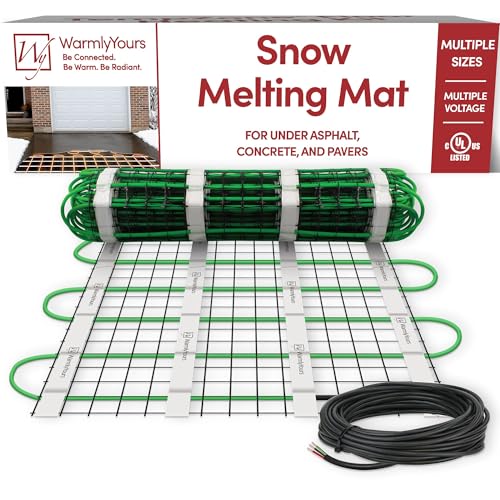 WarmlyYours PowerMat Snow Melting Mat, 2 x 30 ft Not a lay-down mat at all — 60 square feet of 240V embedded heating cable at 50 W per square foot, installed into the paving itself. Our skip-this pick | A permanent installation, done properly | 7.6/10 |
One doorway, complete in the box
HeatTrak Entrance Mat, 24 x 36 in
The smallest entrance mat, at a published 1.9 amps — and the cheapest way into the range that arrives with the power unit already included.
Most people who look at heated mats want one thing: the bit of ground immediately outside the door to stop being a hazard. Not the walk, not the drive — the square yard where you stand while finding keys, where the roofline drips, and where a fall happens with your hands full.
This is that product at its smallest. HeatTrak publishes 1.9 amps for the 24-by-36 entrance mat and the same 2-inch-per-hour melt rate as the rest of the residential line, with the thermostatic power unit switching the system on below 35 degrees F.
The specification that matters most is not on the size chart: the power unit is included. Every standalone walkway and stair mat in this range needs a separate power unit to run at all, and buying a mat without one is the most common mistake in this category. The entrance mats ship complete.
1.9 amps is also strategically small. HeatTrak's ceiling is 13 amps of mats on a single plug, so starting here leaves room to add stair treads or a walkway mat to the same unit next winter without rewiring anything.
Be clear-eyed about scale before buying. Two feet by three is a doormat. If the problem is the path or the steps rather than the doorway, this is the wrong item in the range — how to stop ice building up on steps and porches works through which shape fits which problem.
What works
- Power unit is in the box — the single most common way a mat purchase goes wrong is solved
- 1.9 amps leaves most of the 13-amp per-plug budget free to add mats later
- Doormat footprint covers the square of ground where people actually stand and turn
- No installation of any kind: lay it down and plug it in
What does not
- Two by three feet is a doorway, not a path — it will not get you to the car
- Costs many times an ordinary mat, and it is only doing anything below freezing
- Still needs an outdoor receptacle within reach
- No published weight
Fifteen feet of continuous clear path
HeatTrak Walkway Kit, 3 Mats + Power Unit
Three 20-by-60 walkway mats and the power unit to run them — fifteen linear feet of path in one purchase, at a published 7.5 amps.
The walkway mats are the pieces people end up buying three of, one winter at a time, and doing it that way is both more expensive and more annoying — each standalone mat needs a power unit it does not come with, and by the third one you are checking whether your first unit has the headroom.
This kit collapses that into a single decision: three 20-by-60 mats and the power unit, covering fifteen linear feet. HeatTrak publishes 2.5 amps per walkway mat, so the kit draws 7.5 of the 13 amps allowed on one plug.
That number sets the ceiling on what comes next. With 7.5 gone you can still add several stair treads at a published 0.7 or 1.0 amps each. You cannot add a second walkway kit, and you cannot add a large entrance mat at 5.3. If your eventual plan is path plus steps plus doorway, this kit plus treads is the combination that fits; anything more is a second circuit.
Twenty inches is the honest limitation. It is a lane, not a walkway — fine for one person carrying groceries, and noticeably narrow if two people walk out together. The mats also link with seams between them, and a seam is a strip that does not get heated.
The reason to buy the whole run at once is not really money, it is that a partially heated path is a worse product than no heated path. People stop watching their footing on the heated section and then hit the untreated gap. Either cover the route or treat it chemically — when to apply ice melt is the cheaper discipline.
What works
- Fifteen continuous feet is a real path rather than a heated patch
- Power unit included, and the mats link on watertight connectors rather than extension cords
- Cheaper per square foot than buying three walkway mats and a unit separately
- Buys you the whole run in one decision instead of three winters of adding mats
What does not
- 7.5 amps of a 13-amp ceiling — you can add stair treads but not another walkway kit
- Twenty inches is single-file; two people cannot walk it abreast
- The most expensive item in the residential range by a clear margin
- Three mats means two seams, and a seam does not melt
A porch and its steps, bought once
HeatTrak Snow Melting Mats Starter Kit
Two stair treads, a landing mat and the 120V power unit the mats cannot run without — the only configuration in this range that arrives complete.
Every other product on this page treats ice on steps as something to remove after it forms. A heated mat is the one that stops it forming, and that difference is worth understanding before you look at the price, because the two approaches fail in completely different ways.
A de-icer has to be spread, it has to be spread before the freeze rather than after, and it stops working when the pavement drops below the chemistry's published floor. A heated mat has none of those failure modes. HeatTrak publishes a melt rate of 2 inches per hour and states that the automatic power unit switches the system on below 35 degrees F, so the mat is warm at 3 a.m. when nobody is going outside with a bucket of pellets.
The reason to start with the kit rather than a single mat is a detail the individual listings make easy to miss: the mats do not plug into an outlet. They plug into a HeatTrak power unit, which carries the built-in GFCI, and that unit is a separate purchase on every standalone mat in the range. Buying one stair mat and discovering it will not run is the most common way this goes wrong. This kit is the walkway mat, two stair treads, the power unit and two extenders in one box, with a published total draw of 3.9 amps.
That 3.9 figure matters for a second reason. HeatTrak states that no more than 13 amps should sit on a single plug, so the kit uses under a third of that budget and leaves room to add treads later — a 10 x 30 tread is a published 0.7 amps and the larger 10 x 48 is 1.0. Count your steps before you buy: two stair mats covers two treads, and most front porches have three or four.
The honest limit is the outlet. If there is no outdoor receptacle within reach of the steps, none of this applies and you are back to a de-icer and a shovel — see what temperature ice melt stops working for how to choose one that survives a cold night.
What works
- Includes the power unit — every mat in this range needs one and it is otherwise a separate purchase
- Covers two treads plus the landing, which is the shape of most front entrances
- Thermostat means it runs when it is freezing and not when it is not, which is where the $0.18/hour figure comes from
- Nothing to install: it lies on the steps and plugs into an outdoor outlet
What does not
- 3.9 amps of the power unit's published 13-amp budget is gone on this kit alone
- Two stair mats covers two treads — a four-step porch needs two more
- You need a working outdoor outlet near the steps, which is the constraint that decides the whole approach
- Costs many times what a season of ice melt costs
A wide entrance or a double door
HeatTrak Entrance Mat, 40 x 60 in
Nearly 17 square feet of heated ground at a published 5.3 amps, power unit included — the largest single lay-down mat HeatTrak makes for a home.
A wide entrance is a different problem from a doorway. Double doors, a generous stoop, a landing people cross at an angle rather than head-on — cover part of that and you have simply moved the ice to the part you did not cover, which is arguably worse because now it is unexpected.
This is HeatTrak's answer at close to seventeen square feet in one piece. The advantage over linking three smaller mats is that there are no cold seams: a joint between two mats is a strip that does not melt, and a strip of ice across a mat is a trip hazard with a lip on it.
The number to plan around is 5.3 amps. HeatTrak's published ceiling is 13 amps of mats on a single plug, so this one mat consumes over 40% of that budget. Adding a walkway mat at 2.5 and a pair of stair treads at 0.7 each takes you to 9.2 — still inside, but the headroom is gone. If a whole-entrance system is the eventual plan, count amps before the first purchase, not after the third.
As with the smaller entrance mat, the power unit with its built-in GFCI is included, which is the difference between this and the standalone walkway and stair mats that need one bought separately.
Running cost scales with size, and HeatTrak's roughly $0.18 per hour figure is for a system rather than a mat — a bigger mat is a bigger share of that. It is thermostatic, so it is not running in October. But at this size it is a genuine line on a winter electricity bill, and anyone who would rather not carry that should be reading what temperature ice melt stops working and spreading a de-icer instead.
What works
- Covers a double doorway or a wide stoop in one piece, with no cold seams between mats
- Power unit included, so it runs out of the box
- One mat and one cord run instead of three mats linked together
- Same thermostatic control as the rest of the line — it runs only when it is freezing
What does not
- 5.3 amps is over 40% of the 13-amp per-plug budget in a single mat
- The most expensive single lay-down mat in the residential range
- Big enough that storing it in summer is an actual consideration
- No published weight
A permanent installation, done properly
WarmlyYours PowerMat Snow Melting Mat, 2 x 30 ft
Not a lay-down mat at all — 60 square feet of 240V embedded heating cable at 50 W per square foot, installed into the paving itself.
Skip this one
Skip this unless you are actively repaving. It is not a portable mat despite sharing the name — it embeds in asphalt, in a concrete pour or in the mortar under pavers, and it needs a dedicated 240V circuit. Buying it to help this winter would mean tearing up your driveway to install it. It belongs on a build schedule, not a shopping list.
Everything else in this category is a rubber mat you put out in November and roll up in March. This is a different product wearing the same words, and buying it by mistake would be an expensive surprise: it is heating cable in a mat format that goes underneath your paving, permanently.
WarmlyYours publishes 60 square feet of coverage from a 2-by-30-foot mat, running on 240V at 12.5 amps for 3,000 watts — 50 watts per square foot. That output is in a different class from the portable mats, and it needs to be, because it is heating through a layer of concrete or asphalt rather than sitting on top of the ice.
The installation is the entire decision. The mat embeds in asphalt, in a concrete pour, or in the mortar bed under pavers, which means there is exactly one moment in your property's life when installing it is reasonable: when that surface is being laid or replaced. Retrofitting is not a matter of lifting a mat, it is a matter of removing a driveway.
It also needs a dedicated 240V circuit. That is a licensed electrician and a panel that has room, and we are not going to put a number on either — it varies enormously by property and by region, and a made-up figure would be worse than none.
So the honest guidance is narrow. If you are already repaving and you have been fighting the same ice every winter for a decade, this is the moment and this is the product. If you are looking for something to help this winter, it is categorically the wrong item — buy a portable mat or read how to get ice off a driveway instead.
What works
- Permanent and invisible — nothing to lay out in November or lift in March
- 50 W per square foot is a genuine snow-melting output, not a mat that keeps pace with a flurry
- The only product here rated to go under a driveway surface
- Manufacturer states CSA certification for outdoor use in the US and Canada
What does not
- Requires a dedicated 240V circuit — this is an electrician's job, not a purchase
- Can only be installed while the surface is being laid or replaced; retrofitting means tearing it up
- 12.5 amps at 240V is a serious continuous load and a serious running cost
- Installation cost will exceed the price of the mat, and we cannot estimate it for your property
Before you buy any of them, check the outlet
Every portable mat here needs a working outdoor receptacle within reach of the area you want heated, on a circuit with the headroom for it. No outlet near the steps means no mat, and the honest fallback is a chloride-free de-icer applied on time.
That is not a small caveat. A great many houses have exactly one outdoor outlet, on the wrong side of the building. Pricing an electrician to add one is a legitimate part of this decision and we cannot estimate it for your property.
Where a mat genuinely beats chemistry
- Nobody in the house should be out salting at 10pm. If the reason the surface is dangerous is also the reason nobody will treat it, a product that needs a person is not a solution.
- Wood, composite or a cantilevered landing. These freeze first, chlorides do collateral damage to the fasteners beneath, and mechanical clearing marks them. Heat avoids all three.
- A drip you cannot redirect. Where roof geometry keeps delivering meltwater, a chemical fix has to be reapplied every time and a thermostatic mat just keeps working.
If the specific problem is your front steps rather than the doorway or the path, the shapes and the trade-offs are worked through in how to stop ice building up on steps and porches, which is the page for treads specifically.
Questions people ask
Do snow melting mats actually work?
How much does it cost to run a snow melting mat?
Can you leave snow melting mats out all winter?
Can you put a snow melting mat on asphalt?
How many snow melting mats can I run on one outlet?
Are heated driveway mats worth it?
Sources
Next stage
If the problem is the steps specifically
Treads are a different shape of problem from a doorway or a path, and they are where a fall actually does damage.
Keep goingAbout the author
Scooter M.
An enthusiast who is genuinely into this. I read the manuals, compile the published specs, and do the math on door clearances. No lab coat, no test bench, and nothing here is a product I have used - which is exactly why every claim carries a source.
Published by Slate Mill Group, with the Shovel Report team. Published September 13, 2026; last updated September 13, 2026. Editorial policy.
Read next
Best for Ice Dams
Roof Heat Cable for Ice Dams
Watts per foot, self-regulating versus constant wattage, and the amp arithmetic that decides whether you can simply plug it in.

Best for Steps and Porches
How to Stop Ice Building Up on Steps and Porches
Why steps glaze over before anything else does, and the de-icer or heated mat that actually stops it.

Ice Prevention
How to Prevent Ice on a Driveway
Drainage, clearing habits and pre-treatment — reducing how much ice forms at all.

By Temperature
What Temperature Does Ice Melt Stop Working?
Published working temperatures by chemistry, and what to spread below them.

Best for Decking
Best Ice Melt for Composite Decking
Chloride-free defaults for composite boards, and why the manufacturer's guidance is authoritative.