By Scooter M. · Last updated September 21, 2026
Most driveway ice is not frozen precipitation. It is meltwater that ran across the surface and refroze, usually at a low point or a shaded strip. Clear snow completely so there is less to melt, direct the water away from where it collects, and pre-treat before storms so what does form cannot bond.
Where the ice actually comes from
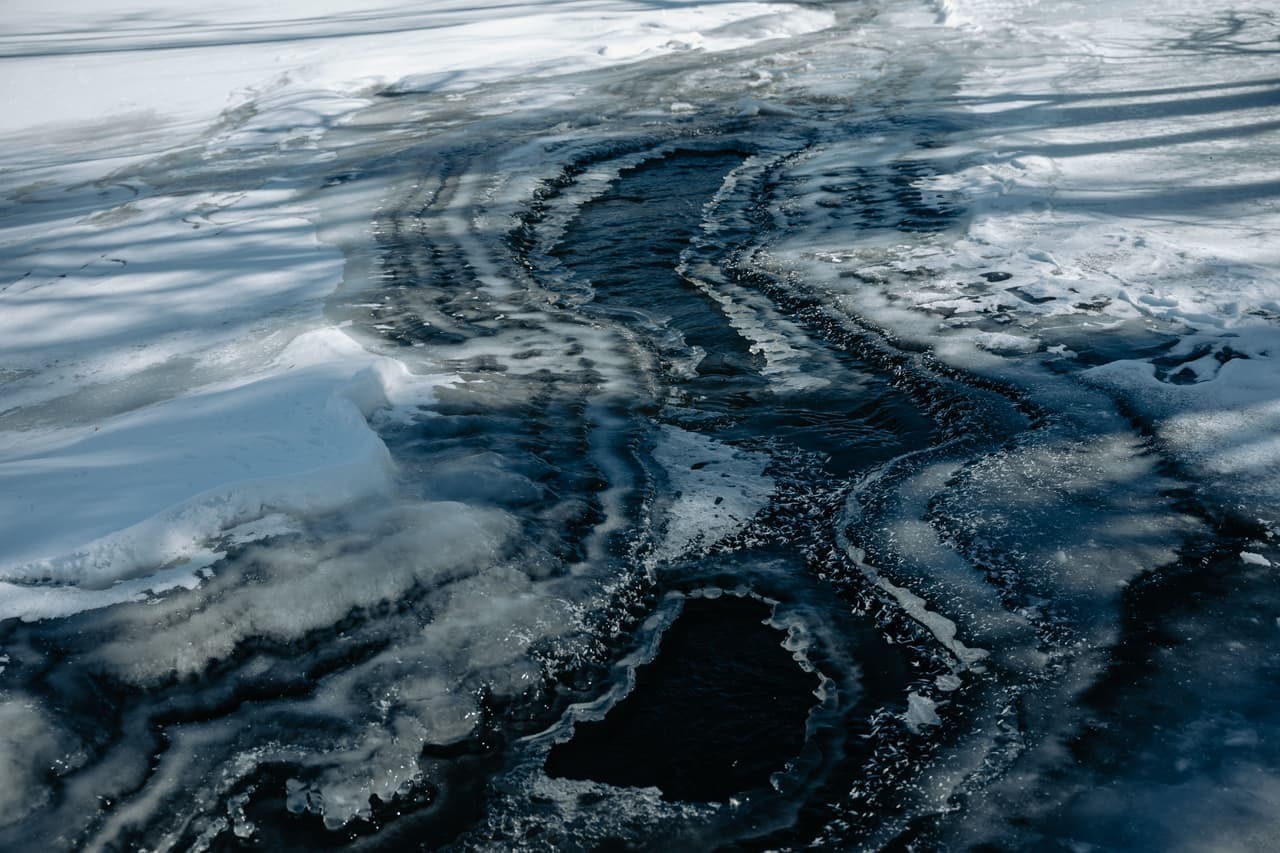
Walk a driveway that has iced and you will usually find the ice is not spread evenly. It is at the bottom of the slope, along one edge, in the shade of the garage, or in a shallow depression. That pattern is the clue: it is meltwater that moved and then froze, not snow that fell and stayed.
Three sources dominate. Snow left on the drive melts in afternoon sun and refreezes overnight. Snow piled at the sides melts and runs across the surface. And roof runoff, particularly from a downspout that discharges onto or above the drive, delivers water to exactly the wrong place.
Each of those is fixable without chemistry, which is why prevention is cheaper than treatment.
Clear completely, not mostly
A thin layer of snow left behind is a reservoir. It melts in the sun, runs to the low point, and freezes there overnight — and by morning you have ice in a place that did not have snow.
This is one of the strongest arguments for a single-stage machine on a hard surface: it scrapes to bare pavement, which means there is nothing left to melt. On gravel and pavers you cannot do that, which is part of why those surfaces need more attention to drainage.
A dark asphalt driveway helps here, because it absorbs solar radiation well and dries itself after a thorough clear. See asphalt driveways.
Where you put the snow matters
- Pile downhill of the driveway, not uphill. An uphill pile drains straight across the surface every sunny afternoon.
- Keep piles off the sun side where practical, so they melt slowly rather than in a rush.
- Do not pile against the garage — meltwater runs to the door threshold and freezes there, which is where people fall.
- Throw further out early in the season. By February you will not have anywhere to put March's snow, and the banks will start draining across the drive.
- Watch your downspouts. A downspout discharging onto or above the drive is a reliable ice factory. Extending or redirecting it is a one-afternoon fix with a large payoff.
Quick picks
Ranked against the criteria below. Tap a row to jump to the full write-up; the price button goes straight to Amazon.
| # | Product | Best for | Score | Price |
|---|---|---|---|---|
| 1 |  FIREKI Pet Safe Ice Melt, Magnesium Chloride Pure magnesium chloride with no additives or dye in a 15 lb tub with a scoop — but its published -35°F is colder than magnesium chloride brine can stay liquid, so plan around the chemistry's real floor instead. | A small tub of magnesium chloride, with a scoop | 7.2/10 | $56.99 - View on Amazon #ad affiliate link · Price as of October 16, 2026 |
| 2 |  Safe Paw Ice Melt The one product here with no chloride in it at all — the right answer on composite decking, new concrete and around metal. | Chloride-free, on decks and new concrete | 8.2/10 | $84.95 - View on Amazon #ad affiliate link · Price as of October 16, 2026 |
| 3 |  The Snowplow Original Snow Pusher, 30 in A UHMW polyethylene blade that snow slides off rather than sticks to, in the width that actually changes your clearing time. Our skip-this pick | Wide, flat driveways | 8.9/10 | $69.99 - View on Amazon #ad affiliate link · Price as of October 16, 2026 |
A small tub of magnesium chloride, with a scoop
FIREKI Pet Safe Ice Melt, Magnesium Chloride
Pure magnesium chloride with no additives or dye in a 15 lb tub with a scoop — but its published -35°F is colder than magnesium chloride brine can stay liquid, so plan around the chemistry's real floor instead.
The Green Gobbler Pet Safe ice melt we used to list here is no longer available, and the brand's ice melt line has gone from the retailer we link to. This is the closest comparable product we can verify is in stock: pure magnesium chloride, in the same 15-pound size.
Every de-icer works the same way: it dissolves into the thin film of water on the ice and lowers that water's freezing point. What differs is which salt does the dissolving, how cold it keeps working, and what it does to concrete, plants and paws. Magnesium chloride sits at the mild end of the working chlorides.
FIREKI states the product is pure magnesium chloride with no additives and no coloring, and publishes a working temperature of -35°F. That temperature is the figure to discount. Texas DOT gives magnesium chloride's eutectic — the coldest point at which its brine can stay liquid at all — as about -28°F, and the Minnesota Pollution Control Agency puts its lowest practical pavement temperature at -10°F. A claim of -35°F sits below both, so plan around -10°F as you would for any magnesium chloride, and switch to calcium chloride or grit below it. magnesium chloride ice melt explains the numbers.
The pet claim deserves a precise reading. Magnesium chloride is less likely to irritate paws than rock salt, which is why it is sold this way. It is not food, and "pet safe" is not "pet edible". Wipe paws after walks regardless. It is also still a chloride, so keep it off concrete poured within the last twelve months — does ice melt damage concrete explains why, and pet-safe ice melt covers the chloride-free alternative.
What works
- No dye, so nothing to stain decking seams or track indoors as color
- Magnesium chloride is the least paw-irritating of the common working chlorides
- Scoop included for measured application
What does not
- "Pet safe" means less irritating, not edible — it is still a chloride salt
- The published -35°F is colder than magnesium chloride's eutectic of about -28°F (Texas DOT) and far below the -10°F practical pavement floor the Minnesota Pollution Control Agency gives, so it is not a figure to plan around
- Costs several times as much per pound as a 50 lb bag of the same chemistry
- No published coverage rate, so you cannot budget a season from the bag
- Attracts moisture and can leave a slick residue if over-applied
Chloride-free, on decks and new concrete
Safe Paw Ice Melt
The one product here with no chloride in it at all — the right answer on composite decking, new concrete and around metal.
Almost every de-icer on a hardware store shelf is a chloride: sodium, calcium, magnesium or potassium. Chlorides are cheap and they work, and the chloride ion is also the thing that corrodes rebar, attacks metal fixings and gets blamed for spalled concrete. Safe Paw contains none of them.
The chemistry is a crystalline amide core carrying glycols, and the manufacturer states it is non-corrosive and effective to -2°F, with coverage of about 100 square feet per pound. That coverage figure is unusually useful: a 35-pound pail covers roughly 3,500 square feet at the stated rate, which is several storms on a normal driveway and walkway.
The -2°F floor is the honest trade. Calcium chloride keeps working far below that; this does not. On a genuinely cold night in a cold climate a chloride-free product will underperform, and pretending otherwise would be a disservice.
Where it wins outright is on surfaces where chloride is the risk rather than the temperature: composite decking, concrete poured within the last year, anything with exposed metal fasteners, and beds where salt-sensitive plants sit downhill of the runoff.
What works
- No chloride at all, which removes the entire concrete-and-metal argument
- 100 sq ft per pound is a published coverage figure you can budget from
- Traction agent included, so it does something even where it is too cold to melt
What does not
- -2°F is warmer than calcium chloride's floor — it is not the deep-cold answer
- Costs substantially more per pound than any chloride
- The glycol carrier can leave a residue that tracks indoors
Wide, flat driveways
The Snowplow Original Snow Pusher, 30 in
A UHMW polyethylene blade that snow slides off rather than sticks to, in the width that actually changes your clearing time.
Skip this one
A pusher prevents ice by removing the snow that would melt and refreeze, which is genuinely the mechanism — but it is not an ice tool. Once ice has formed, a UHMW blade rides over it. Prevention is its job; removal is not.
UHMW — ultra-high-molecular-weight polyethylene — is the material specification that separates this from a $25 pusher. It is the same family of plastic used for conveyor wear strips and truck-bed liners, chosen for a very low coefficient of friction and high impact resistance at low temperature. The practical consequence is that snow slides off it, including the heavy wet snow that packs solid onto a cheap blade and turns pushing into scraping.
The maker states the edge self-sharpens with use and needs no maintenance, and lists the tool as usable on concrete, blacktop, pavers, decks, roofs and ice rinks. That surface list is unusually broad and is the reason we recommend it where a metal edge would be a liability.
Width is the other half of the argument. A 30-inch blade covers 67 percent more ground per pass than an 18-inch shovel. On a 20-by-30-foot driveway that is the difference between roughly 20 passes and roughly 12 — and each of those passes is a push, not a lift.
It is not a complete answer. Nothing that pushes deals with the plow berm, and on a long driveway you eventually run out of anywhere to push to. Pair it with a shovel, or with a machine.
What works
- UHMW is the reason wet snow releases instead of packing onto the blade
- 30 inches is the width where pass count drops noticeably on a two-car drive
- Rated by the maker for decking and pavers, unlike any steel-edged pusher
What does not
- Costs multiples of a hardware-store pusher
- Still cannot lift, and still cannot cut refrozen crust
- The wider the blade, the more it wanders on uneven ground
Pre-treatment, properly used
A light application of de-icer on a clean, dry surface before a storm leaves a brine film that prevents ice bonding to the pavement. Because you are preventing a bond rather than breaking one, it uses a fraction of the product.
The conditions are that the surface must be clean and dry, and rain must not be forecast before the snow — rain washes a pre-treatment straight off. The full timing sequence is in when to apply ice melt.
Choose the chemistry for the temperature, and choose it for your surface: chloride-free on new concrete and decking, magnesium chloride or a blend on mature sealed concrete. Our ice melt hub has the compatibility table.
The non-chemical options, honestly
Sand or grit provides traction instantly, at any temperature, and melts nothing. Where it is too cold for chemistry to work, this is the honest answer rather than spreading a product that will not do anything. See ice melt versus sand.
Surface preparation. Sealing concrete reduces water absorption; sealing asphalt cracks stops water freezing inside them. Both are autumn jobs with winter payoffs.
Drainage. If one part of your driveway ices every single year, it is almost certainly collecting water. A regrade or a drain is a real cost and a permanent fix, and for some driveways it is the only thing that actually works.
Heated driveway systems and snow-melting mats also exist. They are a genuine option for a short problem area such as a set of steps, and a substantial installation for a whole driveway. Steps are the place where that math actually works, and we go through the amps and the preconditions in how to stop ice building up on steps and porches.
Questions people ask
How do I stop my driveway from icing over?
How do I prevent ice without salt?
Why does the same spot on my driveway always ice up?
Does pre-treating a driveway actually work?
Sources
Next stage
Match the chemistry to your surface
Prevention reduces how much you need. Here is the compatibility table for what to spread when you do need something.
Keep goingAbout the author
Scooter M.
An enthusiast who is genuinely into this. I read the manuals, compile the published specs, and do the math on door clearances. No lab coat, no test bench, and nothing here is a product I have used - which is exactly why every claim carries a source.
Published by Slate Mill Group, with the Shovel Report team. Published August 18, 2026; last updated September 21, 2026. Editorial policy.
Read next
Best Windshield Snow Cover
Best Windshield Snow Covers
Covers judged on fabric weight, published size and how many ways they attach.
Ice Already Formed
How to Get Ice Off a Driveway
The sequence for ice that has already bonded — and why doing it in the wrong order costs you hours.
Timing Guide
When to Apply Ice Melt
Pre-treat, then clear, then spot-treat — the sequence that uses least product for most effect.
Melt vs Traction
Ice Melt vs Sand
Melting versus traction, the temperature where sand wins, and why using both is common.
Best for Concrete
Concrete Driveway Snow Removal
Clear to bare pavement safely, and pick the de-icer by the age and condition of the slab.
Best for Steep Drives
Steep Driveway Snow Removal
Traction, self-propulsion and pre-treatment timing — the slope changes every priority.
Best for Steps and Porches
How to Stop Ice Building Up on Steps and Porches
Why steps glaze over before anything else does, and the de-icer or heated mat that actually stops it.
Claim Check
Electromagnetic Snow Removal Claims
What the electromagnetic snow removal ads claim, why the physics fails, and what works instead.