By Scooter M. · Last updated September 21, 2026
Shovel Report earns a commission when you buy through the links on this page, at no extra cost to you. It does not change what we recommend, and we publish a skip-this verdict on products we could otherwise earn from. Full disclosure.
In heavy wet snow, buy for intake depth, a steel auger and stated throughput — in that order — and prefer two stages if the snow regularly exceeds about a foot. Clearing width is the least important of the four, because a wide machine that chokes is slower than a narrow one that does not.
Why wet snow is a different problem
Density. Fresh dry powder is mostly air; wet snow falling near freezing can be several times denser. A machine rated at a given throughput on light snow is doing far more work per cubic foot in wet conditions, which shows up as a bogging motor, a clogging chute and a shorter runtime on battery.
Wet snow also sticks. It packs into the auger housing and the chute rather than flowing through, which is the single most common frustration with an under-specified machine in these conditions.
And it refreezes. Wet snow that thaws in the afternoon and freezes overnight leaves a crust bonded to the pavement — a job a rubber-edged auger will ride straight over.
How we picked
- Stage — single or two — because it decides which surfaces the machine can be used on at all
- Published clearing width and intake depth, which set pass count and whether a deep storm needs two passes
- Stated throughput in lb/min or tons/hour where a maker publishes it: the only spec that converts to minutes
- Energy available: cord amperage for corded machines, watt-hours (volts x amp-hours) for battery ones
- Auger material and skid-shoe adjustment, which together decide surface risk and ground clearance
We have not physically tested these products. We do not own them, we have no lab, and we do not accept free product. Everything above is compiled from published manufacturer specifications, published manuals, published standards and live retailer data - and we tell you which is which on every claim. How we pick.
Quick picks
Ranked against the criteria below. Tap a row to jump to the full write-up; the price button goes straight to Amazon.
| # | Product | Best for | Score | Price |
|---|---|---|---|---|
| 1 |  Snow Joe SJ627E 22-in Corded Snow Blower 840 pounds of snow a minute from a wall socket, at 35 pounds and a fraction of a cordless machine's price. | Most snow moved per dollar | 8.6/10 | $249.99 - View on Amazon #ad affiliate link · Price as of October 15, 2026 |
| 2 |  EGO Power+ SNT2400 24-in Two-Stage A true two-stage, self-propelled 24-inch machine — the only configuration in this build that belongs on a gravel driveway. | Gravel, and everything else hard | 8.8/10 | $1,178.99 - View on Amazon #ad affiliate link · Price as of October 15, 2026 |
| 3 |  EGO Power+ SNT2112 21-in Snow Blower A steel-auger 21-inch machine on two 56V packs, with a 40-foot stated throw and a warranty that says EGO expects it to last. | Best cordless blower overall | 8.5/10 | $749.00 - View on Amazon #ad affiliate link · Price as of October 15, 2026 |
| 4 | 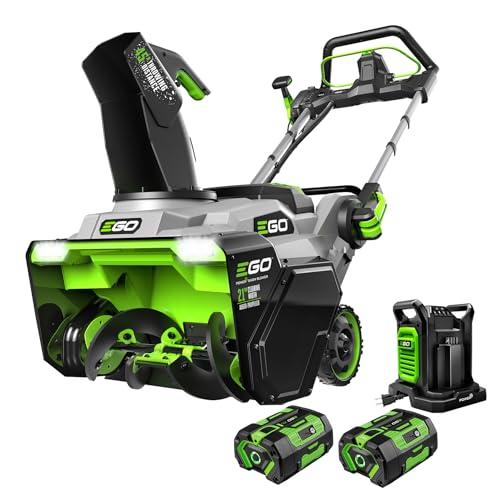 EGO Power+ SNT2125AP 21-in Auger-Propelled Two 7.5 Ah packs instead of two 5.0 Ah — 50% more stored energy, which is the whole answer on a long driveway. | Long driveways on battery | 8.3/10 | |
| 5 |  EGO Power+ SNT2122 21-in Snow Blower EGO's current single-stage 21-inch kit: steel auger, a published 42-foot throw and 13-inch intake — shipped with two 4.0 Ah packs rather than the 5.0 Ah pair on the SNT2112. Our skip-this pick | EGO's current 21-inch kit, on smaller packs | 7.9/10 | $749.00 - View on Amazon #ad affiliate link · Price as of October 15, 2026 |
Most snow moved per dollar
Snow Joe SJ627E 22-in Corded Snow Blower
840 pounds of snow a minute from a wall socket, at 35 pounds and a fraction of a cordless machine's price.
This machine exists to make a point about arithmetic. Snow Joe states it moves up to 840 pounds of snow per minute through a 22-inch by 13-inch intake. The best-documented electric shovel in this build, the Toro Power Shovel, is rated at 300 pounds per minute through a 12-by-6-inch path. That is not a small difference in degree; it is a different job.
Work through a driveway with it. A 20-by-40-foot drive under 6 inches of fresh snow contains very roughly two to four thousand pounds of snow depending on density. At the stated 840 lb/min that is a few minutes of actual throughput — the clock is dominated by walking and turning, not by the machine.
The 13-inch intake depth is the underrated spec. Most single-stage machines in this price class top out around 8 to 10 inches, which means a foot of snow needs layered passes. Thirteen inches takes most storms in one.
The cord is the price. Fifteen amps over a long, thin extension cord is a voltage-drop problem, so you need a heavy-gauge, cold-flexible outdoor cord, and you spend the whole clear aware of where it is. Measure your outlet-to-far-corner distance before you buy — beyond about 100 feet, go cordless.
What works
- 840 lb/min is roughly triple what the best electric shovel here moves
- 13 inches of intake depth handles a real storm in one pass
- 35 lb published weight makes it manageable to turn and store
What does not
- Corded, so your working radius is a cord length
- 15 amps needs a properly rated cold-weather extension cord
- Single-stage: no gravel, and limited on steep grades
Gravel, and everything else hard
EGO Power+ SNT2400 24-in Two-Stage
A true two-stage, self-propelled 24-inch machine — the only configuration in this build that belongs on a gravel driveway.
The single most useful thing to understand about snow blowers is the difference between one stage and two, because it decides which surfaces you can use the machine on at all.
A single-stage machine has one auger that both picks the snow up and throws it, and it does that by contacting the surface. That is why it clears down to bare pavement — and why it will pick up gravel and fling it at your garage door. A two-stage machine has a serrated auger that gathers snow and a separate impeller that throws it, and the whole assembly rides on adjustable skid shoes with the auger held above the ground. That gap is the entire reason two-stage machines work on gravel.
So on a gravel driveway this is not a preference, it is the requirement. Set the skid shoes so the auger clears the stone by roughly an inch, accept that you will leave a thin layer of packed snow, and stop expecting bare-surface results.
The catch is that it ships as a bare tool. EGO sells it without batteries or charger, and on a 56V two-stage machine you want large packs — so budget for them. See single-stage versus two-stage for the full decision.
What works
- Two-stage design keeps the auger off the ground, which is the requirement on gravel
- 24 inches is a genuine two-car-driveway width
- Self-propelled, so the machine's weight stops being your problem
What does not
- Sold as a bare tool — batteries and charger are a substantial extra
- Two-stage machines are heavy and take real storage space
- Overkill for a short concrete drive
Best cordless blower overall
EGO Power+ SNT2112 21-in Snow Blower
A steel-auger 21-inch machine on two 56V packs, with a 40-foot stated throw and a warranty that says EGO expects it to last.
The steel auger is the reason this model exists. EGO's own comparison is against the SNT2102, which uses a rubber-edged auger, and they state the steel version cuts through ice and snow 50 percent faster. That is a manufacturer claim, but the underlying engineering is uncontroversial: a rigid steel edge bites crusted snow that a flexible one rides over.
It also changes where you can use it. A steel single-stage auger touches the ground — that is how single-stage machines clear to the surface — so on gravel it becomes a stone thrower, and on pavers or a sealed asphalt apron you want the highest skid setting and a slow walking pace.
EGO states up to 8 inches of snow on a 12-car driveway from two 5.0 Ah packs on one charge, and a throw distance up to 40 feet. Both are best-case figures on the maker's terms, and both are in the right order of magnitude for a two-battery 56V machine.
The warranty is the quiet signal. Five years on the tool and three on the batteries is longer than most of this category offers, and battery life is where cordless outdoor equipment usually disappoints. If your driveway is gravel, stop here and read that page instead — this is the wrong machine for it, whatever else it does well.
What works
- Steel auger, which EGO states cuts 50% faster than the rubber-edged SNT2102
- 40-foot stated throw is genuinely long for a battery machine
- 5-year tool and 3-year battery warranty
What does not
- Single-stage, so it is not a gravel machine and never will be
- Two 5.0 Ah packs are a significant share of the price
- 21 inches will feel narrow on a three-car driveway
Long driveways on battery
EGO Power+ SNT2125AP 21-in Auger-Propelled
Two 7.5 Ah packs instead of two 5.0 Ah — 50% more stored energy, which is the whole answer on a long driveway.
On a long driveway the question is not how fast a machine clears, it is whether it finishes. Battery capacity is the constraint, and it is one you can compute rather than guess: watt-hours equal volts times amp-hours. Two 56 V 7.5 Ah packs give 840 Wh nominal. Two 5.0 Ah packs give 560 Wh. That is 50 percent more work available before you are standing in the snow waiting for a charger.
What that converts to in driveway length depends on snow density, depth and how fast you walk, and no honest source can give you a single number. But the ratio is real: if a 5.0 Ah kit gets you three quarters of the way down your drive, the 7.5 Ah kit finishes it.
Auger propulsion is the second difference. Instead of a separate wheel drive, the auger's contact with the ground pulls the machine forward. It is simpler and lighter than a wheel drive and works well on pavement. It also means propulsion disappears when the auger is not biting.
Everything else follows the 21-inch EGO pattern, including the surface limits. Gravel is still out; see gravel driveways for what actually works there.
What works
- 840 Wh of nominal stored energy is 50% more than the 5.0 Ah kits' 560 Wh
- Auger propulsion pulls the machine forward so you steer rather than push
- Same 56V platform, so the packs run every other EGO tool
What does not
- Auger propulsion only works while the auger is engaged with the surface
- The largest packs are the most expensive part of the machine
- Still single-stage, still not for gravel
EGO's current 21-inch kit, on smaller packs
EGO Power+ SNT2122 21-in Snow Blower
EGO's current single-stage 21-inch kit: steel auger, a published 42-foot throw and 13-inch intake — shipped with two 4.0 Ah packs rather than the 5.0 Ah pair on the SNT2112.
Skip this one
Wet, heavy snow is the fastest way to drain a battery, and this is the smallest battery configuration here: two 4.0 Ah packs at a nominal 448 Wh, against 560 Wh on the SNT2112. The steel auger is right for crust; the packs are the constraint in exactly the conditions this page is about.
EGO retired the SNT2102 we used to list here, and the SNT2122 is the current kit in the same slot: a 21-inch single-stage machine sold with batteries and a charger. It is not a like-for-like swap, and the differences cut both ways, so they are worth stating plainly.
The machine itself is better. EGO publishes a 6-inch steel auger on a brushless motor, a 13-inch intake height and a throw of up to 42 feet, with variable auger speed, a 180-degree chute and adjustable skid shoes. The old model had a rubber-edged auger, and crusted snow is exactly where a flexible edge rides over instead of biting.
The kit is smaller. The SNT2122 ships with two 4.0 Ah packs where the SNT2112 ships with two 5.0 Ah. Multiply volts by amp-hours and that is a nominal 448 watt-hours against 560 — roughly a fifth less stored energy for a tool that is priced close to its sibling. On a long driveway in heavy snow, that is the number that decides whether you finish on one charge.
So the honest read is that you are buying EGO's better auger with less fuel in the tank. If your driveway is short, that trade is fine. If it is long, or your snow is wet, compare the watt-hours before the sticker price — battery snow blowers works that arithmetic through.
What works
- Steel auger and a brushless motor — the specification that bites into crust
- A published 42-foot throw is the longest of any walk-behind on this site
- 13-inch intake height means fewer two-layer passes in a deep storm
- Variable auger speed lets you place snow rather than just fling it
What does not
- Two 4.0 Ah packs store a nominal 448 Wh — about 20% less than the SNT2112's pair of 5.0 Ah packs
- Several times the price of a corded machine once the batteries are counted
- No published weight
- Peak Power draws from both packs at once, so one flat pack stops the machine
The four specs, in priority order
- Intake depth. How deep a bite the machine takes in one pass. The Snow Joe SJ627E publishes 13 inches, which handles most residential storms without layering. Many machines publish 8 to 10, and some publish nothing.
- Auger material. Steel bites crusted snow; a rubber edge rides over it. EGO's own figure — 50 percent faster through ice and snow for the steel version — is the clearest statement of that difference anyone in the category publishes.
- Stated throughput. Where a maker publishes lb/min or tons/hour, that is the number that converts to minutes in your driveway. Snow Joe's 840 lb/min on the SJ627E is the highest published figure in this build.
- Stage. Above about a foot, or on any surface the auger might catch, a two-stage machine's separate impeller and raised housing earn their price.
Clearing width is deliberately not on that list. A 24-inch machine that chokes in wet snow clears less per hour than a 21-inch one that keeps moving.
Corded holds up better than battery in the wet
This is worth stating plainly because it runs against the general trend. Dense snow makes the motor draw more current; a battery pack under high current sags in voltage and depletes faster, so both power and runtime fall at once. A corded machine on a 15-amp circuit does not sag and does not deplete.
If wet, heavy snow is your normal condition and your driveway is within reach of an outlet, a corded machine is genuinely the more capable choice — which is not the conclusion the price would lead you to expect. The cord constraint is covered in corded versus cordless.
Technique that stops the chute clogging
- Clear in layers. Take the top half of a deep fall first. Two passes at half depth are faster than one pass fighting a clog.
- Slow down. Feed rate is what clogs a chute. Walking slower into wet snow is the whole fix.
- Keep the impeller loaded, not stuffed. A partial-width pass in very wet snow moves more per minute than a full-width one that stalls.
- Clear before it refreezes. Wet snow left overnight becomes a crust job, and that is a different, worse machine requirement.
- Never clear a clog by hand. Use the clean-out tool, every time, even with the machine off.
Questions people ask
What snow blower is best for wet heavy snow?
Why does my snow blower keep clogging?
Is intake depth more important than clearing width?
Do I need a two-stage blower for heavy snow?
Sources
Next stage
What the bigger machine costs to own
Buying up for wet snow raises the purchase price and the running cost. Here is the full ownership ledger before you commit.
Keep goingAbout the author
Scooter M.
An enthusiast who is genuinely into this. I read the manuals, compile the published specs, and do the math on door clearances. No lab coat, no test bench, and nothing here is a product I have used - which is exactly why every claim carries a source.
Published by Slate Mill Group, with the Shovel Report team. Published August 23, 2026; last updated September 21, 2026. Editorial policy.
Read next
Best Snow Blower Tire Chains
Snow Blower Tire Chains
Chains judged on pattern, published link gauge and how clearly the listing states fitment.
Best Shear Pin Kit
Snow Blower Shear Pins
How to identify the right shear pin, and why the cheap upgrade to a stronger bolt is a mistake.
Single vs Two-Stage
Single-Stage vs Two-Stage Snow Blowers
Auger clearance is the whole decision: what each type can clear, and what it will destroy.

Best for Wet Snow
Best Snow Shovels for Heavy, Wet Snow
Wet, dense snow changes the math — smaller blades, stiffer shafts, harder edges.
Best Electric Blower
Best Electric Snow Blowers
Corded and battery machines compared on stated throughput, intake depth and surface fit.

Best for Long Drives
Best Snow Removal for a Long Driveway
Capacity, not width — sizing battery watt-hours and throughput to distance rather than to price.