
By Scooter M. · Last updated September 21, 2026
Shovel Report earns a commission when you buy through the links on this page, at no extra cost to you. It does not change what we recommend, and we publish a skip-this verdict on products we could otherwise earn from. Full disclosure.
In heavy wet snow, buy a narrower blade, a stiffer shaft and a harder edge — and do not fill the blade. Wet snow can be several times denser than powder, so the same shovel that is comfortable in January becomes an injury risk in March. Clearing in shallow layers matters more than any product choice.
The density problem
Snow is not one material. Fresh dry powder is mostly air — commonly cited at around 5 to 8 percent water content — while wet snow falling near freezing can be three to five times denser. Old settled snowpack is denser still.
That range is the whole story of this page. An 18-inch blade filled with powder is a pleasant lift; the same blade filled with wet coastal snow is a load that belongs in a gym, repeated for the length of your driveway. Nothing about the shovel changes between those two days. Only the snow does.
So the correct response to heavy snow is counterintuitive: buy less blade, not more. A 15- or 16-inch scoop that you can fill is more useful than a 22-inch one you must consciously under-fill, because nobody under-fills consistently at minute thirty.
How we picked
- Published tare weight, because it is added to every one of the several hundred lifts in a driveway clear
- Blade width against that weight — the load-per-stroke trade nobody puts on the box
- Assembled length against user height, since a short shaft forces a stoop no handle design can undo
- Wear edge material, which decides both durability and which surfaces the tool is safe on
- Grip geometry: whether a second hand can take the load off the lower back
We have not physically tested these products. We do not own them, we have no lab, and we do not accept free product. Everything above is compiled from published manufacturer specifications, published manuals, published standards and live retailer data - and we tell you which is which on every claim. How we pick.
Quick picks
Ranked against the criteria below. Tap a row to jump to the full write-up; the price button goes straight to Amazon.
| # | Product | Best for | Score | Price |
|---|---|---|---|---|
| 1 |  Hathoro 18-in Steel Blade Snow Shovel An 18-inch steel blade on a 37-inch wooden D-grip handle — the cheap, honest way to own the one tool that can chop a refrozen plow ridge. | Cutting the frozen plow ridge | 7.0/10 | $39.50 - View on Amazon #ad affiliate link · Price as of October 14, 2026 |
| 2 | 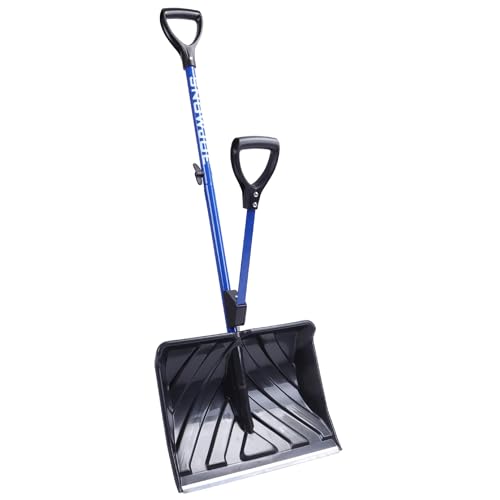 Snow Joe Shovelution SJ-SHLV01 A spring-assisted second handle moves the lifting load down the shaft, and at 3.5 lb the shovel itself adds almost nothing to what you lift. | Backs that already hurt | 8.6/10 | $39.97 - View on Amazon #ad affiliate link · Price as of October 14, 2026 |
| 3 |  McKraftis Ergonomic Snow Shovel with Assist Grip An ergonomic shovel with a separate assist grip and a D-grip — the two-handed leverage idea, with the shaft length and weight left unpublished. | A second grip without a spring mechanism | 6.7/10 | $58.98 - View on Amazon #ad affiliate link · Price as of October 14, 2026 |
| 4 |  True Temper 1681400 #14 Aluminum Scoop A #14 aluminum grain scoop: a 15-by-20-inch blade holding a published 4.5 cubic feet, on a 27-inch ash D-grip handle. Our skip-this pick | Moving large volumes of light, dry snow | 5.8/10 | $61.61 - View on Amazon #ad affiliate link · Price as of October 14, 2026 |
| 5 |  The Snowplow Original Snow Pusher, 30 in A UHMW polyethylene blade that snow slides off rather than sticks to, in the width that actually changes your clearing time. | Wide, flat driveways | 8.9/10 | $69.99 - View on Amazon #ad affiliate link · Price as of October 14, 2026 |
Cutting the frozen plow ridge
Hathoro 18-in Steel Blade Snow Shovel
An 18-inch steel blade on a 37-inch wooden D-grip handle — the cheap, honest way to own the one tool that can chop a refrozen plow ridge.
The Bully Tools 92814 that used to hold this slot is no longer available, and Bully Tools no longer sells a steel-bladed snow shovel on Amazon at all — its current snow line is poly and aluminium pushers. This is the closest live equivalent: a flat steel blade on a short wooden D-grip handle, at about the same price.
This is a tool for one job that plastic shovels genuinely cannot do: cutting the compacted, refrozen ridge the municipal plow leaves across the end of your driveway. That ridge is not snow by the time you get to it. It is a slab, and a poly blade skates off it.
A steel blade and a short, stiff handle give you the ability to chop. That capability comes with an obligation: steel is also perfectly capable of chewing the sealant off asphalt, scoring pavers and destroying a composite deck. This is a concrete tool. If your driveway is anything else, buy a poly blade and accept a slower fight with the ridge.
What you give up against the Bully Tools shovel is documentation. The listing states the blade is steel and the handle is 37 inches of wood, and that is all anyone publishes — no steel grade, no thickness, no weight, no origin. Treat the edge as a consumable rather than a lifetime purchase, and keep it off gravel.
The weight is unpublished and it will not be light. If you already have back trouble this is the wrong shovel, and the strain-reducing designs are the right ones. Keep this one for the ridge and use something else for the driveway.
What works
- A steel blade cuts through the crusted plow ridge that stops poly blades dead
- 18 inches is a narrower bite than the 22-inch steel shovels, which is the right direction when the snow is wet and heavy
- A wood handle does not pull the heat out of an ungloved hand the way a bare steel shaft does
- Cheap enough to own purely as the second tool for the ridge
What does not
- A steel blade on pavers, decking or sealed asphalt will leave marks
- Steel is heavy work in wet snow however narrow the blade is
- No published steel grade, thickness or weight, so edge durability and heft are both unknown
- A wood handle is the part that fails if it is stored wet or used as a pry bar
- No published origin or warranty, where the Bully Tools shovel it replaces published both
Backs that already hurt
Snow Joe Shovelution SJ-SHLV01
A spring-assisted second handle moves the lifting load down the shaft, and at 3.5 lb the shovel itself adds almost nothing to what you lift.
The physics here are simple enough to check without owning one. A snow shovel is a lever, and the load on your lumbar spine depends on how far the weight sits from your hips. A conventional straight-shaft shovel makes your upper hand the fulcrum and your lower back the counterweight. The Shovelution adds a second, spring-loaded grip partway down the shaft, so the lower hand takes the lifting and the spine straightens earlier in the throw.
Snow Joe states the design reduces back strain by up to 30 percent. That is the manufacturer's number and we cannot verify it. What we can verify is the tare weight: 3.5 pounds for an 18-inch blade, which is genuinely low. Weight matters more than it sounds. Twelve pounds of wet snow on a 3.5-pound shovel is a 15.5-pound lift; the same load on a 6-pound steel shovel is 18 pounds, and you are doing it three hundred times.
The blade is poly with an aluminum wear strip. That combination is the right compromise for most driveways: poly is light and does not stick as badly as bare steel, and the aluminum edge keeps the leading lip from rounding off after two seasons. It is not a gravel tool — the wear strip will scoop stone and fling it, and on a composite deck it can leave marks.
The 50-inch assembled height is the real limit. If you are over about six feet you will still bend more than you want, and a longer straight-shaft may serve you better even without the assist. See our straight shaft versus ergonomic comparison for how shovel length maps to user height.
What works
- 3.5 lb is among the lightest 18-inch blades we found published specs for
- The second handle is fixed to the shaft, so the lower hand carries the load instead of your lower back
- Aluminum wear strip on a poly blade — the durable combination at this weight
What does not
- The spring mechanism is one more thing that can fail, and it is not user-serviceable
- 18 inches is a lot of blade for wet snow if you insist on filling it
- 50 inches assembled is short for anyone much over 6 feet
A second grip without a spring mechanism
McKraftis Ergonomic Snow Shovel with Assist Grip
An ergonomic shovel with a separate assist grip and a D-grip — the two-handed leverage idea, with the shaft length and weight left unpublished.
The ErgieShovel we used to list here is no longer available. This is the closest comparable tool we can verify is in stock: a shovel built around the same idea of a second grip that lets you use two-handed leverage rather than lifting with your back.
That idea is sound and it is why the category exists. Holding the shaft low with one hand and a D-grip with the other means your arms and legs take the load instead of your lumbar spine, and a separate assist grip does that without a spring mechanism that can wear out or freeze.
The problem is documentation. The listing we read publishes no shaft length, no blade width, no blade material and no weight. Shaft length in particular is the specification that decides whether any shovel fits you — too short and you stoop on every stroke, and no grip design undoes that. We cannot tell you whether this one suits a tall user, and we would rather say so than guess.
If fit is your reason for buying, choose a shovel whose maker prints the length — snow shovels for your height lists the ones that do. If you can check it in hand first, the grip geometry here is the right idea.
What works
- A second grip lets your lower hand take the load instead of your lower back
- No spring or mechanism to wear out or ice up
- D-grip top handle keeps the wrist in a neutral position
What does not
- No published shaft length, which is the specification that decides whether a shovel fits your height
- No published blade width, material or weight
- Unverifiable on decorative surfaces until you can see the edge
- A newer brand with little published documentation
Moving large volumes of light, dry snow
True Temper 1681400 #14 Aluminum Scoop
A #14 aluminum grain scoop: a 15-by-20-inch blade holding a published 4.5 cubic feet, on a 27-inch ash D-grip handle.
Skip this one
A high-volume scoop is exactly the wrong tool in wet snow. It encourages you to fill it, and a 4.5-cubic-foot load of dense wet snow is a lift most people should not make once, never mind three hundred times — on a 27-inch handle that forces a stoop. Buy the capacity for powder, not for slush.
The True Temper Mountain Mover we used to list here is no longer available, and the only relisting we found carried a generic brand name we could not verify as the genuine article. This entry exists to represent the large-scoop type, and True Temper's #14 aluminum scoop is the clearest live example of that type from the same maker.
The capacity is the point and also the warning. Retail specifications put the blade at roughly 15 by 20 inches and the capacity at 4.5 cubic feet. On light, dry powder that moves a great deal of snow per stroke. On wet snow it is a load most people should not be lifting even once, never mind a few hundred times.
The handle makes it worse. At 27 inches it is very short — this is a Western-pattern grain scoop, designed for shoveling from a truck bed or a bin, not for a standing adult clearing a driveway. You bend to use it, and bending under a loaded blade is precisely the motion that hurts backs.
So it is here as the honest example of its type rather than a general recommendation. If your snow is dry and deep and your back is sound, it moves volume. If either of those is not true, a pusher or an ergonomic shovel is the better buy — types of snow shovels sets out the alternatives.
What works
- 4.5 cubic feet is enormous capacity for light, dry snow
- Aluminum blade outlasts poly and will not crack in deep cold
- Hardwood ash handle with a proper D-grip
- Light for its size at about 4 pounds
What does not
- A 27-inch handle is very short — a standing adult bends to use it
- 4.5 cubic feet of wet snow is a load nobody should lift repeatedly
- Aluminum can mark pavers and does not belong on decking
- It is a grain scoop first; snow is a second job
Wide, flat driveways
The Snowplow Original Snow Pusher, 30 in
A UHMW polyethylene blade that snow slides off rather than sticks to, in the width that actually changes your clearing time.
UHMW — ultra-high-molecular-weight polyethylene — is the material specification that separates this from a $25 pusher. It is the same family of plastic used for conveyor wear strips and truck-bed liners, chosen for a very low coefficient of friction and high impact resistance at low temperature. The practical consequence is that snow slides off it, including the heavy wet snow that packs solid onto a cheap blade and turns pushing into scraping.
The maker states the edge self-sharpens with use and needs no maintenance, and lists the tool as usable on concrete, blacktop, pavers, decks, roofs and ice rinks. That surface list is unusually broad and is the reason we recommend it where a metal edge would be a liability.
Width is the other half of the argument. A 30-inch blade covers 67 percent more ground per pass than an 18-inch shovel. On a 20-by-30-foot driveway that is the difference between roughly 20 passes and roughly 12 — and each of those passes is a push, not a lift.
It is not a complete answer. Nothing that pushes deals with the plow berm, and on a long driveway you eventually run out of anywhere to push to. Pair it with a shovel, or with a machine.
What works
- UHMW is the reason wet snow releases instead of packing onto the blade
- 30 inches is the width where pass count drops noticeably on a two-car drive
- Rated by the maker for decking and pavers, unlike any steel-edged pusher
What does not
- Costs multiples of a hardware-store pusher
- Still cannot lift, and still cannot cut refrozen crust
- The wider the blade, the more it wanders on uneven ground
Shaft stiffness stops mattering until it does
Under light loads, shaft flex is irrelevant. Under heavy ones it is not: a shaft that bends is absorbing some of your effort and returning it as vibration rather than as snow movement, and a flexing shaft near a bend is a shaft heading for failure.
Steel and fiberglass shafts are both stiff. Fiberglass has the advantage of not conducting cold into your hands and not corroding; steel is cheaper and slightly stiffer. Aluminum shafts are light and the most likely to bend permanently under a heavy load.
If you regularly deal with wet snow, this is a reason to look past the lightest possible shovel toward one built to take the load — a rare case where more weight is the right answer.
The refrozen crust is a different job
Wet snow that thaws and refreezes produces a crust that a poly blade will simply ride over. Fighting it with a plastic shovel is how plastic shovels break, because polymer is at its most brittle exactly when the crust is at its hardest.
The tool for a crust is a steel edge, used as a chisel in short controlled strokes rather than as a scoop. Break the crust into manageable plates first, then move the plates. Trying to do both in one motion is what produces both broken shovels and back injuries.
If the crust is thick and your driveway is large, the honest answer is a machine with a steel auger, or a two-stage snow blower if the crust has bonded to the surface.
Technique changes more than equipment does
- Clear in layers. Take four inches at a time out of a ten-inch fall. Three shallow passes are dramatically easier than one deep one, and total time is often shorter because you are not fighting the load.
- Do not fill the blade. Half a blade of wet snow is a complete shovelful. This is the single most useful habit on this page.
- Push wherever you can. The open area of the drive should be pushed, not lifted. Reserve lifting for the windrow and the berm.
- Never twist under load. Step your feet around. Twisting with a loaded shovel is close to a worst-case lumbar loading pattern.
- Clear before it refreezes. Wet snow that sits overnight becomes a chisel job. The window matters more than the tool.
Full technique and the cardiac safety context are in how to shovel snow properly.
Questions people ask
What size shovel is best for heavy wet snow?
Why does my snow shovel break in cold weather?
How much does wet snow weigh?
Is a snow blower better for heavy wet snow?
Sources
Next stage
When wet snow beats the shovel
There is a depth and density past which hand clearing is a genuine injury risk. Here are the machines that handle wet, heavy snow and the specs that predict it.
Keep goingAbout the author
Scooter M.
An enthusiast who is genuinely into this. I read the manuals, compile the published specs, and do the math on door clearances. No lab coat, no test bench, and nothing here is a product I have used - which is exactly why every claim carries a source.
Published by Slate Mill Group, with the Shovel Report team. Published August 16, 2026; last updated September 21, 2026. Editorial policy.
Read next

Best Non-Stick Fix
How to Stop Snow Sticking to Your Shovel
Why wet snow sticks, which coatings help, and the technique that matters more than any of them.
Best Ice Chopper
Best Ice Choppers
Blade gauge, handle material and length — the three specs that decide whether a chopper breaks ice or your elbows.
Blade Material Guide
Snow Shovel Blade Materials, Compared
Poly, aluminum-edged, UHMW and steel blades ranked on snow release, durability and surface safety.

Best for Deep Snow
Best Snow Blowers for Heavy, Wet Snow
Deep and dense snow shifts the priorities to intake depth, steel augers and throughput.

Best for a Bad Back
Best Snow Shovels for a Bad Back
Strain-reducing shovels ranked on published weight, leverage geometry and shaft length.

Safe Shoveling
How to Shovel Snow Properly
Cardiac and lumbar risk, the sequence that halves the work, and when to stop entirely.