By Scooter M. · Last updated September 21, 2026
Shovel Report earns a commission when you buy through the links on this page, at no extra cost to you. It does not change what we recommend, and we publish a skip-this verdict on products we could otherwise earn from. Full disclosure.
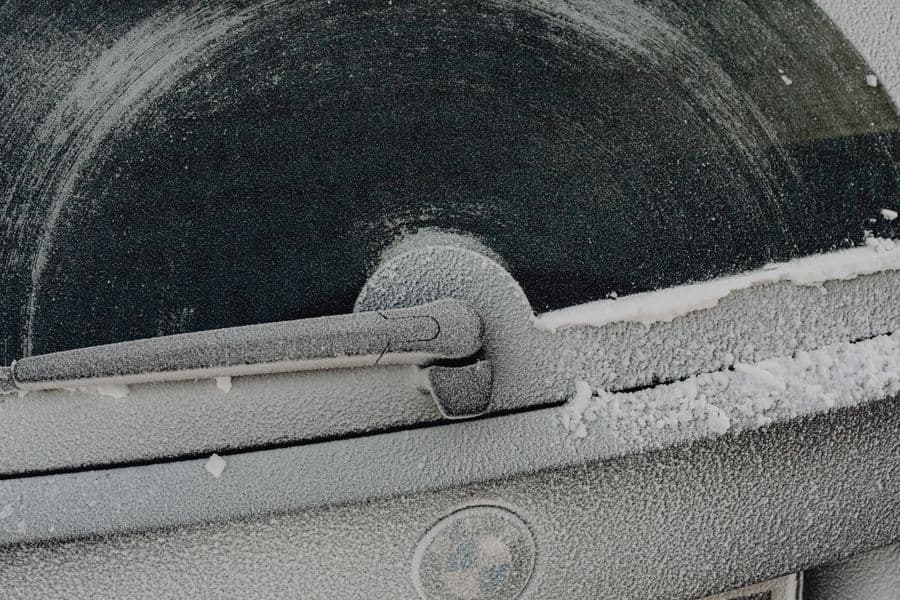
Windshield de-icer is an alcohol-based spray that lowers the freezing point of the thin water film bonding ice to glass, so the ice releases in seconds instead of minutes of scraping. Clear loose snow first, spray the bonded layer, then lift it off. It is a cold-morning tool, not a daily routine — the same alcohols strip wax and dry out rubber seals.
How de-icer spray actually works
Ice sticks to glass through a microscopically thin film of liquid water at the boundary. De-icer works by dumping alcohol into that film: alcohol has a far lower freezing point than water, so the mixture stays liquid at temperatures where it would otherwise be solid, and the bond lets go.
That mechanism explains both the speed and the limits. It is fast, because it only has to break a boundary layer rather than melt a slab. And it is volume-limited, because every ounce you spray onto loose snow is alcohol doing nothing useful.
It is the same freezing-point-depression chemistry our ice melt pages cover for pavement — different salts, same physics.
The order of operations that saves a can
- Start the car and put the defroster on low. Warm glass helps, and high heat on frozen glass is a thermal-shock risk you do not need.
- Brush the loose snow off the whole car, including the roof and the cowl at the base of the windshield where the wipers sit.
- Spray the bonded ice that is left, working top to bottom so the runoff does the lower glass on its way down.
- Wait fifteen to thirty seconds — this is the step people skip, and it is where the chemistry does its work.
- Lift the sheet off with a scraper. The goal is not to melt the ice; it is to break the bond so the ice comes away in one piece.
Used in that order a small can lasts a season. Used as a substitute for a brush, a 12-ounce can is gone in three mornings.
Aerosol or trigger bottle?
Both formats work; they suit different households.
Aerosol against trigger spray
What repeated use costs you
This is the part de-icer labels do not dwell on, and it is the reason we frame these as a cold-snap tool rather than a routine.
Wax. Methanol and isopropanol are solvents. Overspray that lands on the hood and cowl lifts wax, and a season of daily use leaves a visibly duller band below the windshield.
Rubber and plastic. Repeated alcohol exposure dries the wiper blades, the cowl seal and the door weatherstrip it runs into. Dry rubber cracks, and cracked weatherstrip is how water gets where it should not.
Paint edges and trim. CRC states its product is harmless to car finish; most others say nothing at all about it. Where a maker is silent, rinse the bodywork when the weather allows rather than assuming.
None of that is an argument against owning a can. It is an argument for owning a windshield cover as well, so the spray is for the mornings you got caught out.
How we picked
- Format and size, because that decides whether the product lives in the car or the garage
- Published coverage, which almost no maker states — and which is the only way to know what a winter costs
- What the maker says about paint, trim and finish, quoted rather than assumed
- Whether the product covers frozen locks and mirrors, not just glass
- Whether a scraper is integrated, since the spray only breaks the bond — something still has to lift the sheet
- Stated cold performance, and honesty about it: "sub-zero" is a claim, not a number
We have not physically tested these products. We do not own them, we have no lab, and we do not accept free product. Everything above is compiled from published manufacturer specifications, published manuals, published standards and live retailer data - and we tell you which is which on every claim. How we pick.
Quick picks
Ranked against the criteria below. Tap a row to jump to the full write-up; the price button goes straight to Amazon.
| # | Product | Best for | Score | Price |
|---|---|---|---|---|
| 1 |  CRC Ice-Off Windshield Spray De-Icer, 12 oz The industrial-supply answer: melts on contact, states it is harmless to car finish, and explicitly covers frozen locks and headlights as well as glass. | Frozen locks and glass, from a chemical company | 8.2/10 | $6.98 - View on Amazon #ad affiliate link · Price as of September 21, 2026 |
| 2 | 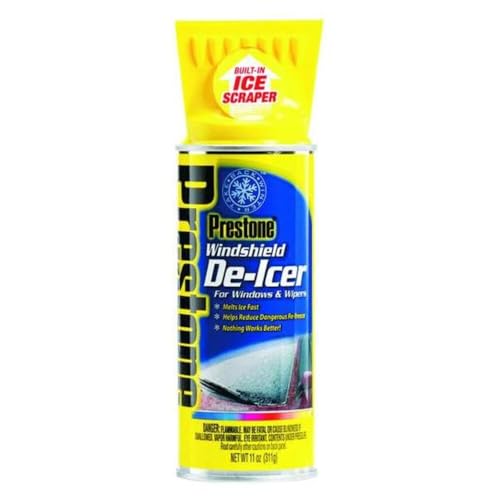 Prestone AS242 Windshield De-Icer with Scraper Cap, 11 oz High-methanol formula with a polycarbonate scraper built into the cap, so the can is also the tool that clears what it loosens. | One-handed mornings — spray and scrape from the same can | 7.9/10 | $5.98 - View on Amazon #ad affiliate link · Price as of September 21, 2026 |
| 3 |  Polar Windshield De-Icer Spray, 2 x 17 oz The only de-icer here that publishes a coverage figure — 32 square feet per 17-ounce can — in a two-pack sized for a full winter. | Published coverage you can plan around | 7.8/10 | $18.99 - View on Amazon #ad affiliate link · Price as of September 21, 2026 |
| 4 |  Splash Red Hot De-Icer Trigger Spray, 32 oz (3-Pack) Three 32-ounce trigger bottles — roughly eight times the volume of a single aerosol, for people who de-ice more than one vehicle. Our skip-this pick | Whole-windshield coverage without an aerosol | 7.7/10 | $18.05 - View on Amazon #ad affiliate link · Price as of September 21, 2026 |
Frozen locks and glass, from a chemical company
CRC Ice-Off Windshield Spray De-Icer, 12 oz
The industrial-supply answer: melts on contact, states it is harmless to car finish, and explicitly covers frozen locks and headlights as well as glass.
De-icer spray is the tool for the morning you are already late and there is a quarter inch of clear ice welded to the glass. It works by depressing the freezing point of that layer so it releases from the windshield, which takes seconds where a scraper takes minutes.
CRC's version is the one we would keep in the car, mostly because of what it says about the jobs around the windshield. It states it thaws frozen locks and is safe on headlights and finish — and a frozen lock is the failure that actually strands you, not a frosted screen.
What no spray will do is clear six inches of snow. Clear the loose snow first with a brush, then spray the bonded layer underneath; used the other way round you empty a can wetting powder. Our snow brushes for cars page covers the brush half of that job.
The long-run caveat is chemical. These formulas are largely alcohols, and alcohol lifts wax. Using a can across a bad week is nothing; using it every morning all winter will dull a waxed hood where the overspray lands. If you are reaching for it daily, a windshield cover is the cheaper and kinder fix.
What works
- States it thaws frozen locks, which is the job that leaves you stranded rather than merely late
- Explicitly stated as harmless to car finish — many sprays leave that to your imagination
- From a chemical manufacturer with a long industrial line, not a seasonal marketplace brand
- Cheapest per can of anything here
What does not
- No published melt rate or temperature figure beyond "sub-zero"
- Aerosol: it empties fast if you use it as a substitute for clearing the whole windshield
- No scraper cap, so you still carry a scraper
- Methanol-based de-icers strip wax over time — this is a tool for cold mornings, not a routine
One-handed mornings — spray and scrape from the same can
Prestone AS242 Windshield De-Icer with Scraper Cap, 11 oz
High-methanol formula with a polycarbonate scraper built into the cap, so the can is also the tool that clears what it loosens.
The scraper cap is a small idea that solves a real problem: the moment you need de-icer is the moment you discover the scraper is in the other car.
Prestone is also unusually direct about the chemistry. The listing says high methanol content, and that is the honest reason a spray works at a temperature where warm water would simply refreeze. Methanol has a very low freezing point and pulls the melt point of the surface film down with it.
The same sentence is the warning. Methanol is a solvent: it lifts wax, it dries rubber, and repeated use around the cowl and wiper seals is not free. For a cold snap it is exactly right; as a daily routine all winter it is the wrong tool.
Expect the cap scraper to handle a patch big enough to see through, not the whole screen. If you routinely need the whole screen, keep a full-size scraper and use the spray on the bonded edges where the wipers are frozen down.
What works
- The scraper cap means one item in the door pocket instead of two
- Polycarbonate is genuinely tougher than the soft plastic on giveaway scrapers
- High methanol content is what makes a de-icer work at low temperature, and Prestone states it plainly
- The claim to reduce refreeze matters on a drive that starts cold and stays cold
What does not
- A cap-sized scraper is for a patch of glass, not a whole windshield
- 11 oz is the smallest can here
- High methanol is also what strips wax and dries out rubber seals with repeated use
- No stated lowest working temperature
Published coverage you can plan around
Polar Windshield De-Icer Spray, 2 x 17 oz
The only de-icer here that publishes a coverage figure — 32 square feet per 17-ounce can — in a two-pack sized for a full winter.
Nearly every de-icer sells on speed and none of them tell you how far a can goes, which makes it impossible to know whether you are buying a week or a season. Polar publishes a figure: up to 32 square feet per 17-ounce can.
That number is worth doing something with. A sedan windshield is roughly 10 to 12 square feet, so on the maker's own figure a can covers two to three full-screen applications — which tells you immediately that spraying the entire windshield every morning is not the intended use.
The intended use is in the instructions, and it is the same advice every honest source gives: take the loose snow and ice off first, then apply to the bonded film that is left. Read that as the method for all of these sprays rather than a weakness of this one.
It also covers the small frozen things — mirrors, locks, headlights — which along with the wiper blades are the parts of a frozen car that a cover does not help with.
What works
- A published coverage figure is rare here and lets you work out what a winter actually costs
- Trigger action across a large can — aerosol convenience without aerosol volume
- Covers locks and headlights, not just the windshield
- Two cans is a realistic season's supply for one car
What does not
- The maker's own instructions tell you to scrape loose ice off first, which undercuts the fantasy of a one-step fix
- Costs more per ounce than the bulk trigger bottles
- No published lowest working temperature
- A 17-ounce can is awkward in a door pocket
Whole-windshield coverage without an aerosol
Splash Red Hot De-Icer Trigger Spray, 32 oz (3-Pack)
Three 32-ounce trigger bottles — roughly eight times the volume of a single aerosol, for people who de-ice more than one vehicle.
Skip this one
Not a bad product — a bad first purchase. It is sold as three 32-ounce bottles and formulated, in the maker's own words, for frost and light ice. If what you have is a quarter inch of bonded glaze on a single car, the aerosols hit harder and live in the door pocket where you need them. Buy this when you are de-icing several vehicles every morning and the aerosol cans have become an expensive habit.
Aerosols are convenient and small. If you are clearing two or three vehicles every morning for four months, they are also an expensive way to buy a mostly-alcohol liquid.
This is the same job in bulk: three 32-ounce trigger bottles, about eight times the liquid of a single can, at a price that makes daily use rational. The trigger also puts the liquid exactly where you point it, which matters at the base of the windshield where the wipers freeze down.
Read the claim carefully, though. Splash describes it as formulated for frost and light ice, and that is the honest range. On a heavy glaze it wets the surface and works slowly; the aerosols above hit harder on contact.
One cold-weather caution specific to trigger bottles: liquid sitting in the tube and nozzle can freeze if the bottle lives in an unheated garage, and then nothing comes out when you need it. Keep one bottle indoors and top up the outside one.
What works
- Volume: 96 ounces total against 11 or 12 in an aerosol can
- A trigger bottle sprays where you aim it, with no propellant to waste
- Explicitly aimed at wiper blades, which is where ice does the expensive damage
- Bottles work upside down and in the cold, where aerosols lose pressure
What does not
- Formulated for frost and light ice — it is not the can to reach for on a quarter inch of bonded glaze
- 32-ounce bottles are too big for a door pocket, so this lives in the garage
- A three-pack is more than a single-car household will use in a season
- Liquid left in the trigger tube can freeze and block it if stored outdoors
Frozen locks and other things that strand you
A frosted windshield makes you late. A frozen door lock or a door frozen shut makes you take another car, and it is the failure most people have no plan for.
Two of the products here state that they cover locks, and that is worth more than a few seconds off the glass. Aim a short burst into the lock barrel and work the key gently — never force a key in a frozen lock, because keys snap and the broken half stays in the barrel.
For doors frozen shut, the fix is the seal rather than the lock: a silicone or Teflon treatment applied to dry weatherstrip in the fall stops the rubber bonding to the frame at all. The DuPont Teflon spray we cover for shovels and chutes lists door gaskets on the same can.
What not to do
- Never pour hot water on a frozen windshield. The thermal shock can crack the glass, and what does not run off refreezes into a worse sheet than you started with.
- Do not run the wipers to clear frost. Blades frozen to glass tear, and torn blades smear for the rest of the winter.
- Do not use household antifreeze or washer fluid concentrate as a de-icer. Both are formulated for closed systems, not for spraying onto paint and into drains.
- Do not spray it on the pavement. These are vehicle products; walkway ice needs a pavement de-icer, which is a different chemistry at a different price.
Questions people ask
Does windshield de-icer spray damage paint?
What is the fastest way to de-ice a windshield?
Can I make my own de-icer with rubbing alcohol?
Does de-icer spray work on frozen car locks?
How much de-icer spray do I need for a winter?
Is de-icer spray better than a windshield cover?
Sources
- Amazon listing — CRC Ice-Off windshield spray de-icer, 12 oz, states harmless to car finish and thaws locks
- Amazon listing — Prestone AS242, 11 oz, high methanol, polycarbonate scraper cap
- Amazon listing — Polar windshield de-icer, 2 x 17 oz, up to 32 sq ft per can
- Amazon listing — Splash Red Hot de-icer trigger spray, 32 oz, 3-pack
Next stage
Stop needing the can
De-icer is the fix for ice that already formed. A cover fitted the night before means there is nothing to melt in the morning.
Keep goingAbout the author
Scooter M.
An enthusiast who is genuinely into this. I read the manuals, compile the published specs, and do the math on door clearances. No lab coat, no test bench, and nothing here is a product I have used - which is exactly why every claim carries a source.
Published by Slate Mill Group, with the Shovel Report team. Published September 21, 2026; last updated September 21, 2026. Editorial policy.
Read next
Best Windshield Snow Cover
Best Windshield Snow Covers
Covers judged on fabric weight, published size and how many ways they attach.
Best for Cars
Best Snow Removal Tools for Cars
Foam versus bristles for paint safety, plus the reach a truck roof actually needs.
Best Liquid De-Icer
Liquid Ice Melt and De-Icer
What liquid de-icer is genuinely better at, what it is worse at, and the jugs worth owning.
By Temperature
What Temperature Does Ice Melt Stop Working?
Published working temperatures by chemistry, and what to spread below them.