By Scooter M. · Last updated October 3, 2026
Shovel Report earns a commission when you buy through the links on this page, at no extra cost to you. It does not change what we recommend, and we publish a skip-this verdict on products we could otherwise earn from. Full disclosure.
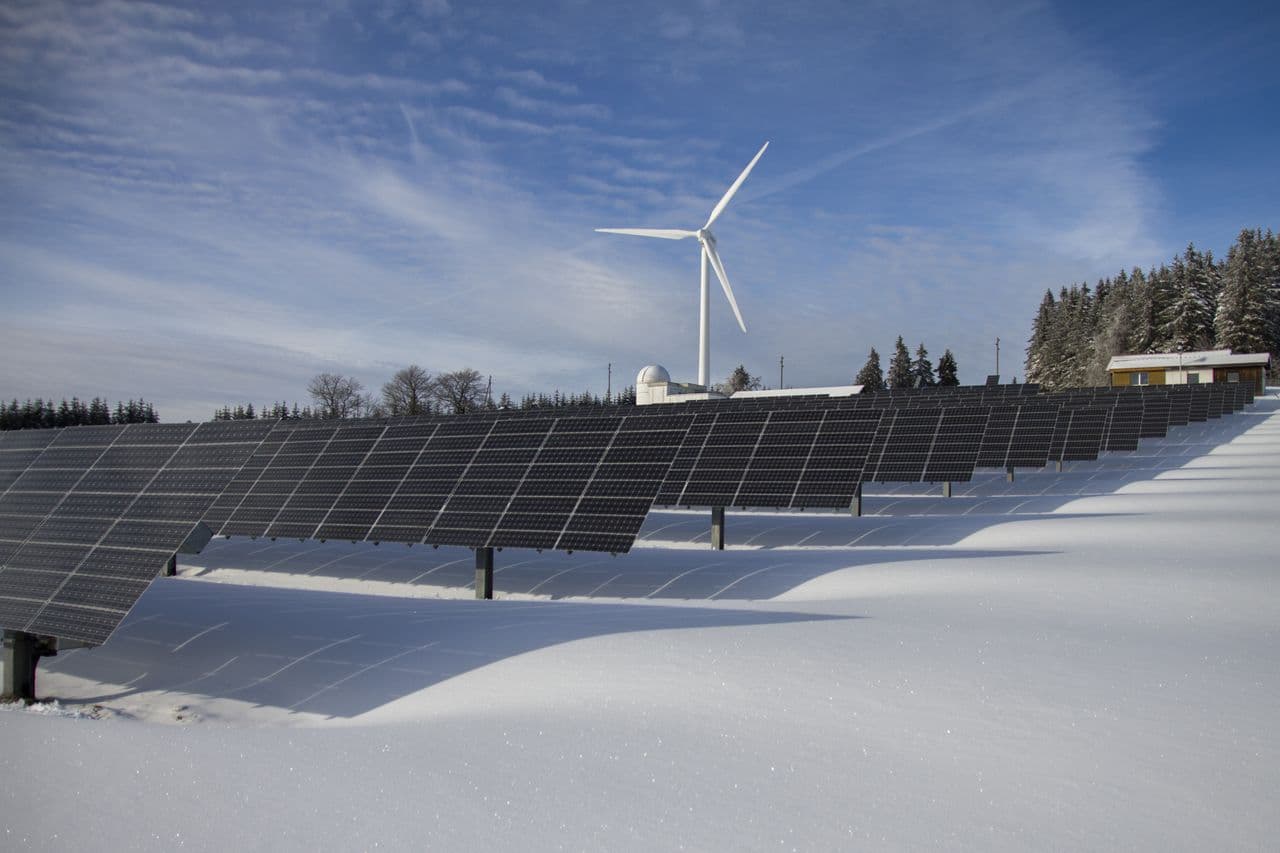
Clear snow off solar panels only with a soft foam blade or a soft brush on a telescoping pole, worked from the ground, pulling downward with the slope. Never use a metal or hard plastic blade, never scrape ice, and never pour hot water on cold glass. In most cases the array clears itself within a day or two once sun reaches the glass.
Why panels are a special case
The surface of a solar panel is tempered glass with an anti-reflective coating, and that coating is the reason you cannot treat it like a roof. It is thin, it is optical, and marking it is permanent.
A scratch does two things: it scatters light that should have reached the cell, and it gives dirt somewhere to key into. Neither polishes out. Where a scratched shingle is cosmetic, a scratched panel is a small permanent reduction in output.
The second consideration is the mounting. Panels sit on rails above the roof with a gap underneath, and leaning weight on the middle of a panel — or standing on one, which people genuinely do — stresses glass that was engineered for even distributed load.
And the third is the one that actually hurts people: an array is on a roof, the glass under the snow is slick, and in winter it is one of the most dangerous surfaces on a property. Everything on this page is designed to be used from the ground.
What is safe, and what is not
Tools against a solar array
When clearing is actually worth it
Snow on panels is a production problem, not a damage problem — the array is not harmed by sitting under snow. So the decision is economic, and it turns on how long the snow will stay.
- Worth doing: an off-grid or battery-backed system where lost production means a generator running; a long cold spell with no sun forecast; a very shallow roof pitch where snow will not slide; or panels low enough to reach safely from the ground.
- Usually not worth doing: a grid-tied array in a sunny cold snap, where exposing a strip of glass is enough to start it shedding within a day.
- Never worth doing: anything that involves a ladder, a roof, or a hard tool. The output you recover is worth less than the panel you scratch, and far less than the fall.
One trick is worth more than any tool: clear the bottom edge first if you can reach it. Snow slides downhill, and a cleared strip at the lower edge gives the rest somewhere to go, where a cleared patch in the middle does not.
Why arrays usually clear themselves
Three things work in your favor, and understanding them is what stops people climbing onto a roof unnecessarily.
Panels are dark, so the moment sunlight reaches any exposed glass the surface warms faster than the snow sitting on it. They are also mounted at a pitch, on a slick surface, with an air gap underneath that lets the panel warm from both sides. Once a strip at the lower edge is clear, the thin melt layer against the glass does the rest and the slab slides.
That is why a cleared strip at the bottom of a panel is worth more than a cleared patch in the middle, and why a sunny day after a storm usually does the whole job for free.
When partial cover costs more than it looks
There is one case where impatience is rational, and it depends on how your system is wired.
On a string system, panels are connected in series, so the output of a string is pulled down by its weakest panel. A band of snow left across the bottom of several panels can cost a string far more than the fraction of glass it covers. On a system with microinverters or power optimizers, each panel is managed independently, so a covered panel costs you that panel and little more.
If you do not know which you have, the inverter is the clue: one box on the wall usually means a string system, while small units under each panel mean microinverters. It changes whether clearing a partially covered array is worth any risk at all.
Ground-mounted arrays change the calculation
Everything above is written around roof arrays, because that is where the danger is. A ground mount removes the fall risk entirely and makes clearing a reasonable routine rather than a last resort.
The tools stay the same — foam head, soft brush, no metal — but you can work close, see what you are doing, and clear the lower edge properly. The one new hazard is drifting: a ground array acts like a fence, and the snow that piles against its lower edge is the snow that keeps the bottom row covered. Clearing a trench along the downhill side is often more useful than brushing the glass.
How we picked
- Head material first: foam or soft bristle only, because the anti-reflective coating is the thing being protected
- Published reach, since every safe method here is a ground-level method
- Pole rigidity at extension, which decides whether reach is usable or theoretical
- Head width against weight — a wide head on a long pole is hard to control at full extension
- Whether the tool has an honest second season of use, because a snow-only tool at this price is poor value
- What the maker does not say, stated plainly — weights are routinely missing in this category
We have not physically tested these products. We do not own them, we have no lab, and we do not accept free product. Everything above is compiled from published manufacturer specifications, published manuals, published standards and live retailer data - and we tell you which is which on every claim. How we pick.
Quick picks
Ranked against the criteria below. Tap a row to jump to the full write-up; the price button goes straight to Amazon.
| # | Product | Best for | Score | Price |
|---|---|---|---|---|
| 1 |  Leanaco Foam-Blade Roof Rake and Brush, 24 ft A 16-inch EVA foam head with a brush on the other side, on a 24-foot telescoping pole — the one roof tool here designed not to mark the surface it touches. | Solar panels and anything you must not scratch | 7.9/10 | $99.99 - View on Amazon #ad affiliate link · Price as of October 3, 2026 |
| 2 |  SnoBrum Push-Broom, 28-63 in The same foam head on a four-piece handle that extends to a published 63 inches — the reach a tall vehicle actually needs. | Trucks and SUVs | 8.3/10 | |
| 3 |  SnoBrum Original Snow Remover A dense foam head instead of bristles — it pushes snow off paint rather than dragging grit across it. | Paint safety | 8.2/10 | $34.00 - View on Amazon #ad affiliate link · Price as of October 3, 2026 |
| 4 |  VEVOR Aluminum Roof Rake, 26-in Blade A 26-inch aluminum blade on a 7.5-to-20-foot adjustable handle, with wheels — the cutting option, with the granule risk that aluminum brings. Our skip-this pick | Cutting crusted snow, accepting the risk | 7.3/10 | $62.90 - View on Amazon #ad affiliate link · Price as of October 3, 2026 |
Solar panels and anything you must not scratch
Leanaco Foam-Blade Roof Rake and Brush, 24 ft
A 16-inch EVA foam head with a brush on the other side, on a 24-foot telescoping pole — the one roof tool here designed not to mark the surface it touches.
Nearly every roof rake sold has an aluminum or hard poly blade, because snow is heavy and a stiff blade moves it efficiently. On a solar array that is exactly the wrong property: the blade rides on tempered glass with an anti-reflective coating, and a scratch there is permanent and costs output.
This one leads with an EVA foam head instead. Foam is soft enough to push snow off glass without marking it, and the reverse side carries a brush for the lighter work.
The reach is the other half of why it belongs on this page. Panels are on a roof, roofs in winter are slippery, and almost every serious injury in this category involves a ladder. A pole that extends to 24 feet lets you work with both feet on the ground.
Be realistic about what foam does. It is good at pushing loose or lightly settled snow downhill off a smooth surface. It is poor at a layer that has thawed and refrozen onto the glass — and the correct response to that is to wait rather than to lean harder, because panels are more fragile than they look and the array is usually generating something anyway once the top edge clears.
The honest alternative is patience: most arrays shed snow themselves once the sun reaches the glass. Clearing snow off solar panels covers when intervening is worth it and when it is not.
What works
- EVA foam will not scratch tempered glass or an anti-reflective coating, which rules in solar panels
- Twenty-four feet of reach keeps you off a ladder, which is the main safety argument in roof work
- Dual-sided head means one tool for snow and for the moss-and-leaves job the rest of the year
- Published minimum and maximum pole lengths, so you can check it against your roof height
What does not
- No published weight, and a 24-foot aluminum pole fully extended is hard work whatever it weighs
- Foam is gentler and slower than a hard blade — it pushes powder well and bonded snow poorly
- Foam wears and tears where a poly blade would shrug it off
- "Stays wobble-free at 21FT" is a maker's claim about a long cantilevered pole, and we cannot verify it
Trucks and SUVs
SnoBrum Push-Broom, 28-63 in
The same foam head on a four-piece handle that extends to a published 63 inches — the reach a tall vehicle actually needs.
The problem with clearing a truck or a tall SUV is not the snow, it is that you cannot reach the middle of the roof, and leaving it there means it slides onto your windshield at the first stop sign. In much of the US that is also a ticketable offense.
This is the SnoBrum foam head on a four-piece handle the maker publishes as adjusting from 28 to 63 inches. Sixty-three inches gets a person of ordinary height to the center of a pickup roof from beside the vehicle, which is the whole job.
Take the adjustability seriously rather than running it at full length by default. A 63-inch handle with a load of wet snow at the end is a long lever, and the same physics that governs a snow shovel applies here: the force at your hands scales with how far out the weight sits. Use the shortest setting that reaches.
Like the shorter model it carries no scraper, so pair it with one. Foam is for snow; ice needs a hard edge and, ideally, the defroster running while you work.
What works
- 63 inches of published extension clears the roof of a truck or tall SUV from the ground
- Four-piece handle means you can run it short for a sedan and long for the truck
- Same no-scratch foam head as the original
What does not
- Still no scraper — ice remains a separate problem
- A 63-inch lever with wet snow on the end is a real load at full extension
- More joints than the one-piece version, and joints are the failure point
Paint safety
SnoBrum Original Snow Remover
A dense foam head instead of bristles — it pushes snow off paint rather than dragging grit across it.
The argument for foam over bristles is the same argument this site makes about poly over steel on a driveway: the soft tool cannot damage the surface, and the surface here is your paint. A bristle brush does not scratch by itself — it scratches because grit, road salt and windblown sand lodge between the bristles and then get dragged across clear coat under pressure.
A closed-cell foam head has nowhere for that grit to lodge and no stiff filament to hold it against the paint. You push snow off rather than sweep it, which is also faster on a big surface like a roof or hood.
The trade is total: this tool does nothing to ice. There is no scraper on it, and foam against a frozen windshield accomplishes nothing. If you park outside overnight in a freeze-thaw climate, this is half your kit and a scraper is the other half.
The 47-inch stainless handle is long enough to reach the center of most car roofs from beside the vehicle. On a tall SUV or a truck it will be marginal, which is what the longer four-piece version is for.
What works
- Foam cannot trap the grit that makes a bristle brush act like fine sandpaper
- Push-broom motion sheds snow off a roof or hood in one pass
- 47-inch handle reaches the middle of most car roofs without climbing
What does not
- No scraper, so it does nothing about a frozen windshield
- Foam is useless on ice — it is strictly a snow-removal tool
- Does not collapse as small as a telescoping brush for in-car storage
Cutting crusted snow, accepting the risk
VEVOR Aluminum Roof Rake, 26-in Blade
A 26-inch aluminum blade on a 7.5-to-20-foot adjustable handle, with wheels — the cutting option, with the granule risk that aluminum brings.
Skip this one
Here as the warning, not the recommendation. A 26-inch aluminum blade is an excellent roof rake and precisely the wrong thing to drag across a solar array — tempered glass carries an anti-reflective coating, and metal on that coating leaves marks that do not polish out and that cost you output for the life of the panel. Buy it for shingles; keep it off the panels.
The Snow Joe RJ205M aluminum rake we used to list is no longer available. The VEVOR is the closest comparable rake we can verify is in stock that keeps the point of this entry: an aluminum blade, for snow a poly blade cannot cut.
Aluminum earns its place on packed, crusted or refrozen snow. Poly skates over a hard crust; an aluminum edge bites into it and pulls material down the slope. VEVOR's blade is 26 inches wide, which is the widest on this page, on a handle that adjusts from 7.5 to 20 feet.
The risk is the same one that applies to every metal roof rake. Asphalt shingles are protected by mineral granules, and a metal edge dragged across them under pressure strips granules off. The damage is cumulative and shortens the roof's life. VEVOR fits wheels to the blade assembly, which help hold the edge off the surface — a genuinely useful feature — but a wheel does not guarantee the edge never touches.
So the decision is about your snow and your roof. On a metal roof, or where you routinely face crust, it is the right tool. On an asphalt shingle roof that only sees fresh snow, the poly rake above does the job without the granule risk.
What works
- Aluminum cuts packed and refrozen snow that a poly blade rides over
- 26 inches is the widest blade on this page
- Wheels on the head help hold the edge off the roof surface
- Adjustable from 7.5 to 20 feet, so it works on a low roof without extra poles
What does not
- Aluminum under pressure can strip the mineral granules off asphalt shingles
- 20 feet maximum is the shortest reach on this page
- No published weight
- A 26-inch blade full of wet snow is a heavy load at full extension
Technique, in four lines
- Stand clear of the slide path. What you loosen comes down, in a sheet, at the bottom edge where you are standing.
- Work from the lowest edge upward, pulling snow down the slope rather than pushing it across the glass.
- Let the tool's weight do it. Pressing harder on glass is how coatings get marked; if it needs force, stop.
- Leave bonded ice alone. Ice frozen onto glass is not coming off safely — wait for sun, which usually arrives sooner than you expect.
Things people suggest that you should ignore
- Throwing a rope over the array and sawing it back and forth. This drags grit across the coating and can catch a frame or a clamp.
- Spraying de-icer or antifreeze on the panels. Chlorides and glycols near aluminum frames, roof flashings and electrical connectors are a bad trade for a day of output.
- Dark tarps or heating cable on the array. Heat cable belongs on a roof edge, not on panels; see roof heat cable for what that hardware is actually for.
- Waxing or coating panels to shed snow. Nothing applied to the glass should go on without the panel maker saying so, and most warranties are specific about it.
If your array is on a metal roof, there is a related problem worth knowing about: panels and smooth metal both shed snow suddenly, and a loaded slab coming off together is a hazard at ground level. Snow guards for a metal roof covers the hardware that controls that.
Questions people ask
Should I clear snow off my solar panels?
What can I use to get snow off solar panels?
Will a roof rake scratch solar panels?
Can I pour hot water on snowy solar panels?
Does snow damage solar panels?
How much production do snow-covered panels lose?
Sources
Next stage
The rest of the roof
Panels want foam. The shingles around them want reach and a shingle-safe edge — here is how roof rakes compare on both.
Keep goingAbout the author
Scooter M.
An enthusiast who is genuinely into this. I read the manuals, compile the published specs, and do the math on door clearances. No lab coat, no test bench, and nothing here is a product I have used - which is exactly why every claim carries a source.
Published by Slate Mill Group, with the Shovel Report team. Published October 3, 2026; last updated October 3, 2026. Editorial policy.
Read next
Best Roof Rake
Best Roof Rakes for Snow
Reach against shingle safety — the poly-versus-aluminum blade decision, and honest weight limits.
Best Snow Guards
Snow Guards for a Metal Roof
Adhesive against screw-down, why standing seam changes the answer, and which kits publish holding data.
Best for Cars
Best Snow Removal Tools for Cars
Foam versus bristles for paint safety, plus the reach a truck roof actually needs.
Best for Ice Dams
Roof Heat Cable for Ice Dams
Watts per foot, self-regulating versus constant wattage, and the amp arithmetic that decides whether you can simply plug it in.