By Scooter M. · Last updated October 3, 2026
Shovel Report earns a commission when you buy through the links on this page, at no extra cost to you. It does not change what we recommend, and we publish a skip-this verdict on products we could otherwise earn from. Full disclosure.
Snow guards are small polycarbonate or metal blocks fixed in rows across a metal roof to stop accumulated snow sliding off as one sheet. On standing seam, use adhesive-bonded or clamp-on guards — never screws through the panel. On exposed-fastener panels, screw-down kits with sealing gaskets are acceptable. Adhesive needs about a month of warm weather to cure, so it is a summer job.
Why metal roofs do this
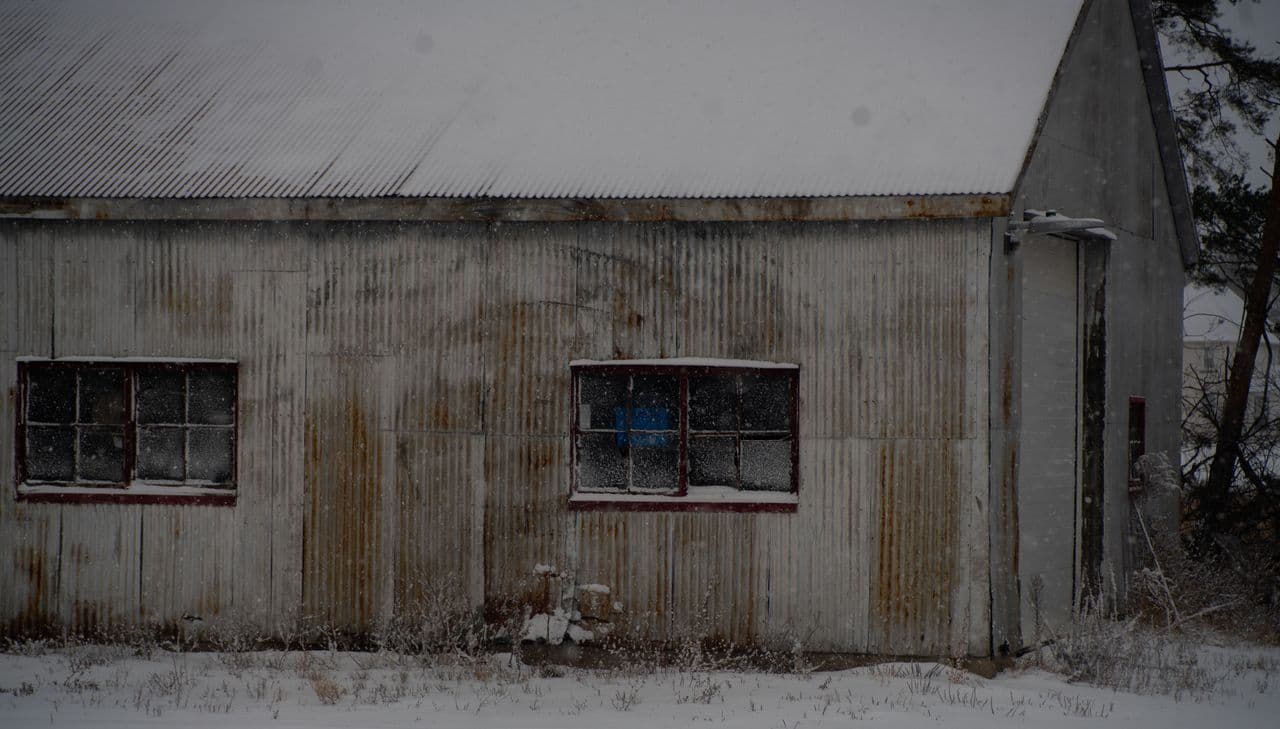
An asphalt shingle roof is rough. Snow grips it, melts in place and mostly drains away. A metal panel is smooth and conducts heat well, so when the sun warms the panel the thin layer touching the metal melts first and the entire slab above it loses its grip at once.
What comes off is not a dusting. A roof carrying a foot of settled snow is carrying serious weight per square foot, and all of it arrives at the eave within a couple of seconds, from the height of your roof.
The damage list is predictable: torn-off gutters, crushed shrubs, dented vehicles, broken deck rails, and — the reason this is a safety product rather than a convenience one — anyone standing at the door below.
Retention or breaking: two strategies
Snow guards do not remove snow. They change how it leaves, and there are two philosophies about that.
- Retention. Hold the whole slab in place until it melts and drains as water. This is the goal of most guard layouts, and it puts a sustained load on every guard — which is why holding strength and spacing matter so much.
- Breaking. Interrupt the sheet so that what does slide comes off in small pieces rather than as one slab. Less load per guard, and it accepts that snow will still leave the roof — just harmlessly.
Neither approach removes the need to think about load. A retention system transfers the weight of held snow into the panel and its fixings, which is precisely why a large or steep roof deserves a proper layout rather than a guessed one.
The mounting question decides everything
This is the single decision that matters, and it is set by your roof rather than your preference.
Mounting methods against roof type
The standing seam rule is the one to remember. Standing seam panels are designed to expand, contract and float on hidden clips. A screw through the flat of the panel pins a thing that is meant to move, and the result over a few seasons is oil-canning, elongated holes and leaks. On standing seam: bond or clamp, never screw.
What a holding figure is worth
Most snow guard listings describe themselves as heavy-duty and leave it there. One here does better: SnoBlox cites an independent ATI laboratory test at 1,379 pounds of holding strength per guard, adhesive-mounted and cured for the full 28 days.
Treat that number as a ceiling achieved under lab conditions rather than a promise about your roof, because it depends entirely on the bond — which depends on panel cleanliness, cure temperature and patience. But a tested figure from a named lab is a different class of evidence from an adjective, and it is the main reason that kit leads this page.
The useful question to ask of any guard is not "how strong is it" but "how many do I need, in what pattern". That is a function of roof pitch, panel width, the distance from ridge to eave and your regional ground snow load — manufacturers publish layout calculators for exactly this, and a steep roof over a doorway is worth running through one.
When to install, which is not when you need it
The uncomfortable scheduling problem in this category: the best mounting method for most metal roofs is adhesive, and adhesive needs about a month above 50°F to reach strength.
So the time to buy snow guards is the summer after the winter that convinced you. Someone searching this in January with a damaged gutter has three honest options: a screw-down kit if the roof is exposed-fastener, a clamp-on system installed by a roofer if it is standing seam, or managing the snow another way this season — roof rakes take the load off the lower roof from the ground.
How we picked
- Whether the maker publishes a holding-strength figure, and whether it names an independent lab
- Mounting method, matched honestly to roof type rather than sold as universal
- Published dimensions and panel fitment, so the guard can be checked against a real roof before ordering
- Material specification — a named polycarbonate grade rather than "plastic"
- What is in the box: adhesive, gaskets, screws, or nothing
- The stated failure mode, because a guard that releases cleanly is better than one that tears a panel
We have not physically tested these products. We do not own them, we have no lab, and we do not accept free product. Everything above is compiled from published manufacturer specifications, published manuals, published standards and live retailer data - and we tell you which is which on every claim. How we pick.
Quick picks
Ranked against the criteria below. Tap a row to jump to the full write-up; the price button goes straight to Amazon.
| # | Product | Best for | Score | Price |
|---|---|---|---|---|
| 1 |  SnoBlox Deuce Snow Guards, 25-Pack with Adhesive Polycarbonate guards bonded with adhesive rather than screws, with an independent lab figure behind them — 1,379 pounds of holding strength per the maker's cited ATI test. | Standing seam, with no holes in the panel | 8.4/10 | $124.75 - View on Amazon #ad affiliate link · Price as of October 3, 2026 |
| 2 | 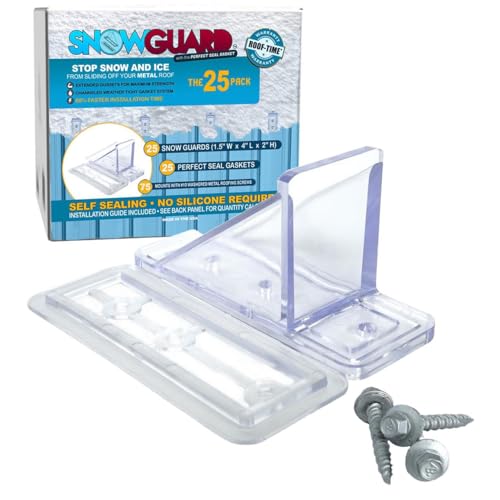 Perfect Seal Snow Guards, 25-Pack with Gaskets and Screws Screw-down polycarbonate guards supplied with sealing gaskets and 75 screws — the kit to buy when the roof already sheds snow and you cannot wait a month for adhesive to cure. Our skip-this pick | Exposed-fastener panels, and fixing a problem this winter | 7.2/10 | $69.99 - View on Amazon #ad affiliate link · Price as of October 3, 2026 |
| 3 |  SnoBlox SnowBreaker Snow Guards, 25-Pack A triangular guard designed to break sliding snow into harmless pieces instead of retaining the whole sheet, and the only one here that can be mounted three different ways. | Breaking the slab up rather than holding it whole | 7.4/10 | $163.49 - View on Amazon #ad affiliate link · Price as of October 3, 2026 |
| 4 | 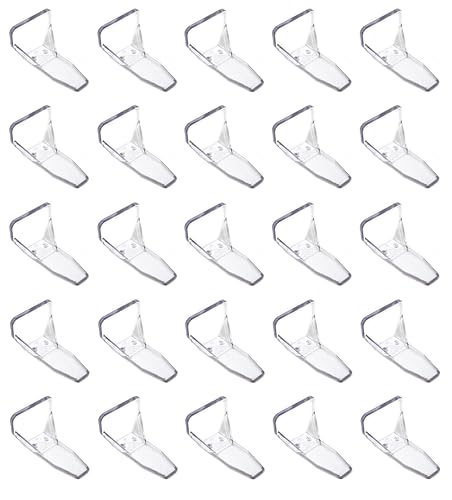 JSP Alpine Mini Snow Guards, 25-Pack, Clear Clear, low-profile polycarbonate guards with published dimensions and panel fitment — the cheapest way onto a metal roof, with the least evidence behind it. | A low-profile look, at the lowest price per guard | 6.9/10 | $59.99 - View on Amazon #ad affiliate link · Price as of October 3, 2026 |
Standing seam, with no holes in the panel
SnoBlox Deuce Snow Guards, 25-Pack with Adhesive
Polycarbonate guards bonded with adhesive rather than screws, with an independent lab figure behind them — 1,379 pounds of holding strength per the maker's cited ATI test.
Snow guards exist to stop a metal roof shedding its entire snow load in one sheet. They do not remove snow; they hold it in place so it melts and drains instead of arriving on a walkway, a car or a person.
The Deuce is the adhesive version of that idea, and adhesive is the important word. Screwing anything through a metal panel puts a hole in the surface whose only job is keeping water out, and every such hole is a gasket waiting to age. Bonding to the panel avoids that entirely.
What sets this listing apart is evidence. The maker cites an independent ATI lab test at 1,379 pounds of holding strength per guard when properly cured — a number, from a named lab, rather than "heavy duty". It also states the honest failure mode: in an overload the guard releases rather than tearing the panel, and can be re-mounted.
The catch is the calendar. The adhesive needs 28 days above 50°F to cure, and colder weather extends that. This is a job for July, not for the week after a roof avalanche took out your gutter. If it is already winter and you need something this season, the screw-down kits are the honest alternative — with the holes that implies.
Layout matters as much as the product: guards are spaced across the roof in rows, and the right count depends on your roof's pitch, panel width and snow load. That is a calculation worth doing properly — snow guards for a metal roof walks through what decides it.
What works
- No holes: nothing is screwed through a panel that is meant to keep water out
- The only snow guard here citing an independent lab figure rather than an adjective
- A release-rather-than-tear failure mode is the right behavior on a roof you cannot easily repair
- Base geometry is specified against real panel layouts, so you can check fitment before buying
What does not
- 28 days above 50°F to cure means you cannot fix an active problem with these — plan a season ahead
- Adhesive mounting demands a genuinely clean panel; surface prep decides whether the lab figure means anything
- Costs roughly twice the screw-down kits per guard
- Polycarbonate on a dark roof lives a hard UV life, whatever the stabilizer package
Exposed-fastener panels, and fixing a problem this winter
Perfect Seal Snow Guards, 25-Pack with Gaskets and Screws
Screw-down polycarbonate guards supplied with sealing gaskets and 75 screws — the kit to buy when the roof already sheds snow and you cannot wait a month for adhesive to cure.
Skip this one
Do not use these on a standing seam roof. Standing seam panels expand, contract and float on clips, and a screw through the flat pins a panel that is designed to move — which is how you get oil-canning, torn holes and leaks. For standing seam, bond them on with adhesive instead, or buy a clamp-on system that grips the seam without penetrating anything.
This is the pragmatic kit. Adhesive guards are the better engineering answer on most metal roofs, and they are useless to someone whose roof dumped its load onto the front steps last week, because the adhesive needs a month of warm weather to reach strength.
Screw-down guards work immediately. The kit supplies 25 guards, a gasket for each and 75 screws — three per guard — with neoprene washers, and the maker states the gasket design removes the need for a bead of silicone.
The cost is honest and unavoidable: you are making 75 penetrations in a roof surface. On an exposed-fastener roof — corrugated or R-panel, where screws already hold the panels down — that is consistent with how the roof was built. On standing seam it is not, and that is a strong enough objection that we have flagged it as a skip rather than a caution.
The specification we would like and do not get is a holding figure. The SnoBlox listing cites an independent lab test; this one says "heavy-duty" and leaves it there. On a part whose entire purpose is to hold a load, that absence is worth weighing.
What works
- Works the day you fit it — no cure time, so a January roof avalanche problem can be addressed in January
- Everything needed is in the box: gaskets and three screws per guard
- Mechanical fixing does not care about panel cleanliness the way adhesive does
- Cheapest per guard of the kits here
What does not
- Seventy-five new holes in your roof — the gaskets are the only thing between those and a leak
- No published holding-strength figure, which is the specification that actually matters
- Wrong choice on standing seam, where the panels are designed to move and not be pinned
- Gasket life is finite, and nobody states how long
Breaking the slab up rather than holding it whole
SnoBlox SnowBreaker Snow Guards, 25-Pack
A triangular guard designed to break sliding snow into harmless pieces instead of retaining the whole sheet, and the only one here that can be mounted three different ways.
There are two philosophies in snow retention. Hold the whole load in place until it melts, or interrupt the sheet so that what does slide arrives in pieces small enough not to matter. SnowBreaker is the second.
That distinction has a practical consequence. A guard retaining a full slab carries a large sustained load, which is why holding strength and spacing calculations matter so much. A breaker takes less load per unit, at the cost of accepting that some snow will still come off the roof — just not as a single sheet onto the path.
The flexibility is the other selling point: the same guard can be bonded with adhesive, stuck down with 3M tape or screwed, with a waffled base for the first and starter points for the last. On a mixed roof, or when you are unsure what the panel will take, that optionality is worth something.
What we cannot do is tell you how much it holds. SnoBlox publishes an independent lab figure for the Deuce and nothing comparable here, and the "breaks snow into harmless pieces" line is a description of intent rather than a tested outcome. At the highest price per guard on this page, that gap is the reason it is not our first pick.
What works
- Three mounting options on one product, so the roof decides the method rather than the purchase
- Breaking the sheet is a lower-stress strategy than holding all of it — less load concentrated at each guard
- Peel-and-stick is far quicker than wet adhesive, with no mixing and no mess
- Same polycarbonate construction and American manufacture as the Deuce
What does not
- No published holding figure, despite being from the maker that publishes one for the Deuce
- Most expensive kit here per guard
- Peel-and-stick tape generally bonds less strongly than cured adhesive, and the listing does not quantify either
- "Breaking into harmless pieces" is a design claim with no test behind it on the listing
A low-profile look, at the lowest price per guard
JSP Alpine Mini Snow Guards, 25-Pack, Clear
Clear, low-profile polycarbonate guards with published dimensions and panel fitment — the cheapest way onto a metal roof, with the least evidence behind it.
Snow guards are visible from the street, in rows, for the life of the roof — and that is a real reason people put off buying them. Clear, low-profile guards are the answer to the aesthetic objection.
JSP publishes the dimensions properly: 4.25 inches long, 3 wide, 2.5 high, on a 1.5-inch base, fitting 36-inch R-panels at the two common rib spacings. That is enough to check against your own roof with a tape measure, which several competitors do not allow.
Where it thins out is evidence and material. The listing says clear plastic rather than naming a polycarbonate grade, and there is no holding figure of any kind. For a part whose job is to resist a load, we would rather pay more and know.
Buy it if appearance is the deciding factor and your snow loads are moderate. If the roof has already shed a slab once, buy on holding evidence instead.
What works
- Publishes full dimensions, which makes checking it against your own panel straightforward
- Clear and low-profile, so a row of them is far less visible than white or colored guards
- Cheapest per guard on this page by a wide margin
- Waffled base plus starter points means either mounting method is available
What does not
- No holding-strength figure at all, and no named adhesive specification
- "Clear plastic" rather than a stated polycarbonate grade — the material claim is looser than the others here
- Low profile means less face area to catch a slab
- Adhesive is not included in the listing description the way it is with the SnoBlox kit
Fitting them without creating a worse problem
- Work out the layout first. Rows, spacing and count come from pitch, panel width and snow load — use the maker's calculator rather than eyeballing a single row at the eave.
- Check the panel flat. Most of these need a flat area of about 1.5 inches between ribs. Measure yours before ordering anything.
- Clean the panel properly if you are bonding. Adhesive mounting is a surface-prep job with a guard attached to the end of it.
- Respect the cure window. 28 days above 50°F, longer if it is cooler. Do not load a fresh bond with the first storm.
- On exposed-fastener roofs, use the gaskets supplied and do not over-torque the screws — a crushed washer leaks.
- Keep guards clear of valleys and off the very edge, and never fasten into a seam you cannot see the structure behind.
How many you need, and what that costs
Kits are sold in 25-packs, which invites people to buy one and space them along the eave. That is not how retention layouts work, and it is the most common way to spend money without solving the problem.
Guards are distributed in rows up the slope, staggered, with the count driven by how much snow the roof can accumulate above each row. A short run from ridge to eave over a porch might genuinely need one row. A long, steep slope above a doorway will want several, and the spacing tightens as the slope and the snow load increase.
The arithmetic follows from the panel. Guards sit on the flats between ribs, so a 36-inch panel with 12-inch rib spacing gives you three possible positions per panel width, and a row across a 30-foot roof face is on the order of 25 to 30 guards. Two rows doubles it. That is why a roof face can absorb two or three kits, and why working out the layout before ordering matters more than saving a few dollars per guard.
Manufacturers publish layout calculators that take pitch, panel type, eave-to-ridge distance and your regional ground snow load. Use one. A guessed single row at the eave carries the entire slab load on one line of guards, which is the scenario where adhesive bonds and panel seams get tested hardest.
When the answer is not snow guards
- Asphalt shingles. Shingles hold snow well on their own; guards are a metal-roof answer to a metal-roof behavior.
- An ice dam problem. Dams are caused by heat escaping into the attic, and holding more snow on the roof does not fix them — see how to remove an ice dam.
- A structural concern. If you are worried about the weight your roof is carrying, retention keeps that weight up there for longer. That is a question for an engineer, not a product page.
- A one-off nuisance. If the issue is a single doorway, a small awning or relocating where people walk may cost less than a roof full of guards.
Questions people ask
Do snow guards really work on a metal roof?
Can you screw snow guards into a standing seam roof?
How long does snow guard adhesive take to cure?
How many snow guards do I need?
Will snow guards damage my roof?
Are plastic snow guards strong enough?
Do I still need a roof rake if I have snow guards?
Sources
- Amazon listing — SnoBlox Deuce 25 pc with adhesive: polycarbonate, 1,379 lb ATI lab figure, 28-day cure above 50F
- Amazon listing — Perfect Seal 25-pack snow guards with gaskets and 75 screws
- Amazon listing — SnoBlox SnowBreaker, 25 pc, adhesive/peel-and-stick/screw mounting
- Amazon listing — JSP Alpine mini snow guards, 25 pc, published dimensions and panel fitment
Next stage
Taking snow off instead
Guards hold snow up there on purpose. If the goal is to get it down — to cut load or starve an ice dam — that is a roof rake job, from the ground.
Keep goingAbout the author
Scooter M.
An enthusiast who is genuinely into this. I read the manuals, compile the published specs, and do the math on door clearances. No lab coat, no test bench, and nothing here is a product I have used - which is exactly why every claim carries a source.
Published by Slate Mill Group, with the Shovel Report team. Published October 3, 2026; last updated October 3, 2026. Editorial policy.
Read next
Best Roof Rake
Best Roof Rakes for Snow
Reach against shingle safety — the poly-versus-aluminum blade decision, and honest weight limits.
Best for Ice Dam Removal
How to Remove an Ice Dam
Emergency removal, the methods that damage a roof, and what actually prevents the next one.
Best for Ice Dams
Roof Heat Cable for Ice Dams
Watts per foot, self-regulating versus constant wattage, and the amp arithmetic that decides whether you can simply plug it in.

Best for Solar Panels
Clearing Snow Off Solar Panels
Foam and soft-brush tools that will not mark the glass, and the metal ones to keep away from an array.