
By Scooter M. · Last updated September 21, 2026
Shovel Report earns a commission when you buy through the links on this page, at no extra cost to you. It does not change what we recommend, and we publish a skip-this verdict on products we could otherwise earn from. Full disclosure.
A wheeled snow shovel is a push blade on two wheels: it moves snow sideways without you lifting any of it. It suits flat, paved driveways and fresh snow. Weight is the specification that matters — the useful ones are 10 to 12 pounds, and the 25-pound steel hand plows are harder work than a good pusher.
What a wheeled shovel actually changes
Shoveling injures people in two ways. The lumbar one comes from lifting a loaded blade at arm's length; the cardiac one comes from sustained exertion in cold air. A wheeled pusher removes the first almost entirely, because the snow never leaves the ground — you push it into a windrow and leave it there.
What it does not remove is the effort. Pushing 30 pounds of wet snow ahead of a four-foot blade is real work, and it is work your legs and shoulders do continuously rather than in the bursts a conventional shovel demands. If your concern is your heart rather than your back, a wheeled shovel is not the fix — a machine is, and snow shovel versus snow blower does that arithmetic.
The other honest limit is snow type. These tools work with fresh snow that a blade can slide under. On a layer that has thawed and refrozen, a wheeled blade rides over the top and achieves nothing, and no amount of pushing changes that — that is chopper and de-icer territory.
Weight is the whole decision
Wheeled shovels look interchangeable and are not, and the number that separates them is the one people ignore in favor of blade width.
Published weight against blade width
That last column is the one to read. A tool at 0.26 to 0.31 pounds per inch is something you steer with your fingertips at the end of a run. At 0.91 you are manhandling a machine that clears a path barely wider than a conventional pusher.
Weight matters here more than on a normal shovel because of where it sits. The mass is out in front of you on wheels, so it helps you in a straight line and fights you at every turn, every lift over a lip, and every time you back it out of a corner. A driveway is mostly turns.
Bi-directional blades, and why they matter at a garage door
Two of the models here are described as bi-directional: the blade works pushed forward or pulled back. It sounds like a marketing line and it is the single most useful feature in the category.
The reason is geometry. In front of a garage door, against a fence, or at the closed end of a parking bay, there is nowhere to turn a four-foot blade around. A one-way blade has to be lifted and carried back to the start of the next pass; a bi-directional one is simply pulled.
Surfaces: this is where wheels lose
A wheeled pusher rides on its wheels with the blade held just off the ground. That geometry is why it glides on pavement and why it is worse than a plain shovel everywhere else.
- Smooth concrete or asphalt — the intended surface. The blade stays at a constant height and clears cleanly.
- Gravel — avoid. The wheels drop into ruts, which drops the blade into the stone, and you spend spring raking gravel out of the lawn. Gravel driveways covers what to use instead.
- Pavers — slowly. A heaved unit stops a wheeled blade dead, and the jolt goes into your wrists.
- Slopes — think first. Gravity helps going down and is entirely against you coming back up with a loaded blade.
- Steps and decks — no. There is no way to steer a wheeled tool in that space at all.
Blade material: plastic, steel, and what each fails at
ABS and other plastics keep the weight down, do not rust and do not mark concrete. They crack when a corner meets a raised expansion joint at walking speed, and on a wide blade that impact lands on one corner.
Steel survives those strikes and brings its own problems: it is most of the reason the heavy models weigh what they do, it leaves marks on pale concrete, and where the powder coat chips, road salt starts working on it. Powder-coated steel with a steel wear edge is the better version of the material, but it is still steel.
How we picked
- Published weight, treated as the primary specification rather than an afterthought
- Blade width, read against that weight as pounds per inch of blade
- Whether the blade is bi-directional — the feature that decides whether you can work a garage door or a dead end
- Blade material and edge, which set surface risk and how the tool fails
- Handle adjustment, because a wheeled tool set to the wrong height loads your shoulders for the entire clear
- Whether the maker is identifiable and states a warranty, rather than a marketplace listing with none
We have not physically tested these products. We do not own them, we have no lab, and we do not accept free product. Everything above is compiled from published manufacturer specifications, published manuals, published standards and live retailer data - and we tell you which is which on every claim. How we pick.
Quick picks
Ranked against the criteria below. Tap a row to jump to the full write-up; the price button goes straight to Amazon.
| # | Product | Best for | Score | Price |
|---|---|---|---|---|
| 1 |  The Snowcaster 30SNC Bi-Directional Wheeled Snow Shovel, 36 in A 36-inch bi-directional blade on wheels at a published 11 pounds — the only wheeled shovel here light enough to steer like a tool rather than wrestle like a plow. | The wheeled pusher we would actually buy | 8.2/10 | $131.99 - View on Amazon #ad affiliate link · Price as of September 21, 2026 |
| 2 |  VEVOR Wheeled Snow Pusher, 38 in A 38-inch ABS blade on an adjustable-height handle at a published 10 pounds, for roughly a third of what the name-brand wheeled shovels cost. | The cheapest honest way into the category | 7.7/10 | |
| 3 | 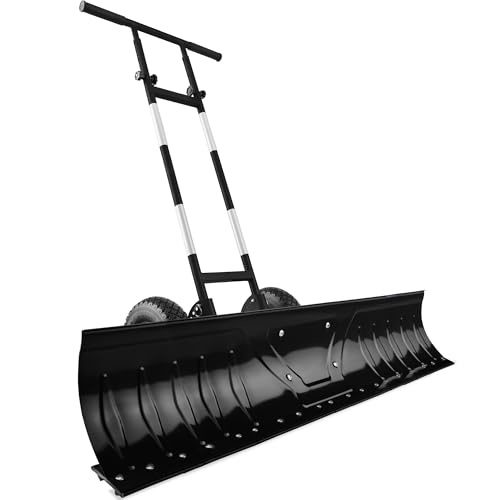 Best Choice Products 2-Wheel Snow Pusher Hand Plow, 48 in A 48-inch steel blade with an adjustable angle and reflective tape, at 27.5 pounds — real hand-plow width, and real hand-plow weight to go with it. | Long, open, paved runs where width wins | 7.0/10 | |
| 4 |  Outvita Snow Shovel with Wheels, 29 in A 29-inch powder-coated steel blade with four handle heights and five blade angles, at 26.5 pounds — narrow enough to place precisely, heavy enough to feel it. Our skip-this pick | Tight driveways where 48 inches will not fit | 6.6/10 |
The wheeled pusher we would actually buy
The Snowcaster 30SNC Bi-Directional Wheeled Snow Shovel, 36 in
A 36-inch bi-directional blade on wheels at a published 11 pounds — the only wheeled shovel here light enough to steer like a tool rather than wrestle like a plow.
The wheeled snow shovel is the category people ask about most and buy least, because the versions that turn up in search results are usually 25-pound steel plows that are harder work than the shovel they replace. This is the exception, and the reason is the published weight: 11 pounds.
That number matters more than the blade width. A wheeled pusher only saves you effort if you can steer it — lift the handles to clear a lip, twist it to dump a windrow, walk it back up a slope. At 11 pounds those movements cost nothing. At 27 pounds they are the job.
Bi-directional is the other genuine feature. The blade works pushed or pulled, which is what you want in front of a garage door where there is no room to turn around, and it is why the maker also sells it as a barn shovel.
The limits are honest ones. It rides on wheels, so it wants a hard, reasonably flat surface: gravel drops the wheels into ruts and feeds stone to the blade, and a heaved paver stops it. And the maker's efficiency claim is marketing, not data — treat the tool as a way to move more snow per pass without lifting, not as a machine.
If your driveway is long and paved and you are not ready for a blower, this is the tool that sits between a snow pusher and a machine. If it is gravel, read gravel driveways first.
What works
- 11 pounds is less than half what the steel wheeled pushers here weigh, and weight is what decides whether you can steer it
- Bi-directional: it pulls snow back out of a garage door or a tight bay, which a one-way blade cannot
- 36 inches clears a normal drive in few enough passes without becoming unsteerable
- The one model in this class with a stated warranty and a named maker rather than a marketplace brand
What does not
- "50% more efficient than traditional snow shovels" is the maker's claim and not a figure we can verify
- No published blade material on the listing we read
- Costs roughly three times a good manual pusher for the same blade width
- Wheels make it worse on gravel than a plain pusher, not better
The cheapest honest way into the category
VEVOR Wheeled Snow Pusher, 38 in
A 38-inch ABS blade on an adjustable-height handle at a published 10 pounds, for roughly a third of what the name-brand wheeled shovels cost.
If the wheeled snow shovel is an experiment you are not sure will work on your driveway, this is the sensible way to run the experiment. It publishes the two numbers that decide the outcome — 38 inches of blade and about 10 pounds — and it costs a fraction of the established names.
The handle adjusts for height, which is worth more on a wheeled tool than on a conventional shovel. You are pushing with arms extended and the blade out in front of you, so a handle set wrong puts the load into your shoulders for the whole clear. Set it so your forearms are roughly level when the blade is down.
The trade against the Snowcaster is material. ABS is light and cheap and it does not mind salt, but it is the part that will fail: a 38-inch plastic blade run into a raised expansion joint at walking speed takes the whole impact in one corner. On smooth concrete that never happens; on a patched asphalt drive with a lip at the apron it eventually does.
The other honest caveat applies to every wide, light pusher. Width is throughput only while the snow is soft. On a packed, half-thawed layer a light blade rides over the top and you end up making the same pass three times — that is where an ice chopper or a de-icer does the work instead.
What works
- The lightest published weight of any wheeled pusher we found in stock
- Height-adjustable handle, which matters more here than on a normal shovel because you steer with your arms extended
- 38 inches is the widest blade here that is still light enough to manage
- Costs a fraction of the name-brand wheeled shovels
What does not
- ABS plastic rather than steel: lighter to push, easier to crack against a raised joint
- VEVOR is a marketplace house brand, and support on wear parts is not comparable to a named maker
- No published warranty on the listing we read
- A wide, light blade skates on a hard-packed layer instead of biting it
Long, open, paved runs where width wins
Best Choice Products 2-Wheel Snow Pusher Hand Plow, 48 in
A 48-inch steel blade with an adjustable angle and reflective tape, at 27.5 pounds — real hand-plow width, and real hand-plow weight to go with it.
This is what most people picture when they hear hand plow: a four-foot steel blade on two wheels, with an angle adjustment so you can throw snow to one side as you walk.
On the right property it is the most productive thing on this page. A long, flat, paved driveway with open ground on both sides is exactly the geometry a 48-inch blade wants, and the angle adjustment means you are windrowing rather than pushing an ever-growing pile to the far end.
On the wrong property it is a liability, and the number that tells you which you have is 27.5 pounds. That weight is fine rolling in a straight line and unpleasant everywhere else: turning at the end of a run, backing out of a corner, lifting the blade over the lip at the apron. If your reason for looking at wheeled shovels is that lifting snow hurts, this is not the answer — the Snowcaster is.
The reflective tape is a small thing worth noticing, because clearing at 6 a.m. in the dark on a drive that meets a road is when it matters. It is the same argument as driveway markers, on the tool rather than the ground.
What works
- 48 inches is the widest blade here — on a long open driveway that is genuinely fewer passes
- An adjustable blade angle lets you windrow snow to one side instead of pushing it all to the end
- Steel takes curb and joint strikes that crack a plastic blade
- Handles lock upright, which is the difference between storing it against a wall and it falling on your car
What does not
- 27.5 pounds is nearly three times the Snowcaster, and you feel every pound at the end of a turn
- Too wide for a single-car drive with a shrub bed on one side — you cannot place the blade precisely
- Steel on concrete leaves marks, and steel plus road salt means rust where the coating chips
- Wrong tool for anyone buying a wheeled shovel because lifting hurts: steering this is its own workout
Tight driveways where 48 inches will not fit
Outvita Snow Shovel with Wheels, 29 in
A 29-inch powder-coated steel blade with four handle heights and five blade angles, at 26.5 pounds — narrow enough to place precisely, heavy enough to feel it.
Skip this one
It weighs 26.5 pounds to clear a 29-inch path. The Snowcaster weighs 11 pounds and clears 36. You are pushing nearly the same mass for two-thirds of the width, which is the wrong end of every trade this category exists to win — and if the reason you are shopping for wheels is that lifting hurts, mass you have to steer is not an improvement. Buy it only if your driveway genuinely cannot take a wider blade.
Narrow wheeled pushers exist for driveways that a 48-inch blade simply cannot be steered around: a single-car drive with a fence one side and a border the other, or a townhouse apron with two cars on it.
Outvita's answer is adjustable in more directions than anything else here — four handle heights and five blade angles — and that is genuinely useful, because a wheeled tool that is set wrong for your height fights you the whole way down the drive.
The problem is the arithmetic. It weighs 26.5 pounds to clear a 29-inch path, where the Snowcaster weighs 11 to clear 36. You are pushing nearly the same mass for two-thirds of the width, which is the wrong end of every trade this category is supposed to win.
Buy it if your driveway rules out the wide blades and you want steel rather than plastic. If width is not your constraint, the lighter tools do more work for less of you.
What works
- 29 inches places precisely: between parked cars, along a path, up to a garage door
- Five blade angles is more adjustment than anything else here
- Powder coating over steel is the right corrosion answer for a salted driveway
- Rubber wheels roll quieter and grip better on ice than the hard plastic ones
What does not
- 26.5 pounds for a 29-inch blade is the worst weight-to-width ratio on this page
- Narrow blade plus high weight means you are working harder per square foot cleared
- Assembly is stated at around 10 minutes and involves fitting the wheels yourself
- Still a wheeled tool: gravel remains out of bounds
How wide should the blade be?
Wider is faster only while you can still steer it, and the constraint is your driveway rather than your strength.
- Under 30 inches — for single-car drives with obstacles: a fence one side, a border the other, two cars parked on it.
- 36 to 38 inches — the sensible default. Enough width to halve the pass count on a normal drive, still narrow enough to place precisely.
- 48 inches — long, open, flat and paved only. On anything else the width becomes a liability at the first turn.
On a long drive the arithmetic favors width right up until the point where the snow is wet, and then it reverses: a full-width bite of heavy snow is more than you can push, so you end up taking half-blade passes anyway. Long driveways works through the distance question properly.
When to buy something else instead
- Your driveway is gravel. Wheels make gravel worse, not better. A pusher with a poly edge, or a two-stage machine, is the answer.
- You need to clear steps, a deck or a path. Nothing wheeled works there. Snow shovels for decks and steps covers that job.
- The snow is usually wet and heavy. Wet snow is where wheeled blades stall; see snow shovels for heavy wet snow.
- You have been told to avoid exertion. A wheeled shovel removes lifting, not effort. That is a machine decision, not a shovel decision — snow blowers for seniors starts there.
Storage, assembly and the things nobody mentions
All of these arrive flat and need assembling, and the makers' stated times — around ten minutes — are optimistic in the way flat-pack times always are. Fitting the wheels is the fiddly part.
Storage is the other practical matter. A 48-inch blade on wheels takes the space of a small bicycle, and the models with handles that lock upright are much easier to live with in a shared garage. Check that before you buy, not after.
Questions people ask
Do wheeled snow shovels actually work?
How much should a wheeled snow shovel weigh?
Are wheeled snow shovels good for a bad back?
Can you use a wheeled snow shovel on gravel?
What does bi-directional mean on a snow shovel?
Is a wheeled snow shovel better than a snow blower?
Sources
Next stage
The version without wheels
A pusher does the same job with less to steer and no wheels to drop into a rut. On most driveways it is still the more sensible tool.
Keep goingAbout the author
Scooter M.
An enthusiast who is genuinely into this. I read the manuals, compile the published specs, and do the math on door clearances. No lab coat, no test bench, and nothing here is a product I have used - which is exactly why every claim carries a source.
Published by Slate Mill Group, with the Shovel Report team. Published September 21, 2026; last updated September 21, 2026. Editorial policy.
Read next

Best Pusher
Best Snow Pushers
Wide pusher blades from 27 to 42 inches, and why the widest is rarely the right buy.

Which Type You Need
Types of Snow Shovels
The seven shapes sold as snow shovels, the mechanism behind each, and which one your surface and your back actually call for.

Best for Long Drives
Best Snow Removal for a Long Driveway
Capacity, not width — sizing battery watt-hours and throughput to distance rather than to price.

Best for a Bad Back
Best Snow Shovels for a Bad Back
Strain-reducing shovels ranked on published weight, leverage geometry and shaft length.

Shovel vs Blower
Snow Shovel vs Snow Blower
The throughput arithmetic that decides whether a machine earns its price on your driveway.