
By Scooter M. · Last updated September 14, 2026
Shovel Report earns a commission when you buy through the links on this page, at no extra cost to you. It does not change what we recommend, and we publish a skip-this verdict on products we could otherwise earn from. Full disclosure.
There are seven types: the scoop, the pusher, the combination, the ergonomic or bent-shaft shovel, the powered shovel, the ice chopper and the specialist reach tools (roof rakes and car brooms). The question that eliminates most of them is whether you will lift snow or push it — a pusher never lifts, which is why it is the right default on a flat paved driveway and useless on stairs.
Seven types, and the job each one is actually for
These are not trim levels of the same product. Each type removes snow by a different mechanism, and matching the mechanism to your surface and your body is the entire decision. Price barely enters into it.
The seven types at a glance
Lift or push: the question that settles it
Strip away the marketing and there are two mechanisms. A shovel lifts snow and throws it. A pusher keeps the blade on the ground and walks the snow to the edge of the drive. Everything else — blade width, handle shape, material — is a refinement inside one of those two.
The reason this matters more than any other spec is physical. Lifting a loaded shovel puts a cantilevered weight at the end of your arms, and you almost always twist to throw it. That combination — load, reach, rotation — is the motion behind most shoveling injuries, and it is also what spikes cardiac demand. A pusher removes all three, because the load never leaves the ground.
The limit is where the snow ends up. A pusher moves snow sideways, so it needs somewhere to put it. On a 20-by-30-foot driveway that is easy. On a long drive the geometry defeats you well before the far end, and on stairs it is simply the wrong shape. The full head-to-head, with the driveway sizes worked out, is in snow pusher vs snow shovel.
Two things that look like types but are not
Blade material is a second axis. Poly, aluminum, steel and UHMW all appear across several of the types above. Material decides what the tool is safe on and how long the edge lasts, not what the tool is for — a steel-edged pusher and a poly-edged pusher are the same type. Which material suits your surface is in blade materials compared.
Handle length is a fit question, not a type. A shovel that is too short forces a stoop no handle design can undo, and assembled length varies by several inches between tools that are otherwise identical. Match it to your height rather than to a category — snow shovels for your height has the measurements.
How we picked
- Whether the type lifts or pushes, because that single mechanical difference decides most of the injury risk
- What the maker publishes about rated surfaces, quoted rather than paraphrased — a type that marks pavers is not a general-purpose tool
- Published tare weight where it exists, since it is added to every one of the several hundred lifts in a driveway clear
- Blade width against that weight, which is the load-per-stroke trade nobody prints on the box
- Whether the type is a genuine primary tool or a specialist that only makes sense as a second purchase
We have not physically tested these products. We do not own them, we have no lab, and we do not accept free product. Everything above is compiled from published manufacturer specifications, published manuals, published standards and live retailer data - and we tell you which is which on every claim. How we pick.
Quick picks
Ranked against the criteria below. Tap a row to jump to the full write-up; the price button goes straight to Amazon.
| # | Product | Best for | Score | Price |
|---|---|---|---|---|
| 1 |  Bully Tools 92814 22-in Combination Shovel A 22-inch steel-edged combination blade on a fiberglass D-grip handle, built to a commercial standard and made in the USA. | Cutting the frozen plow ridge | 7.5/10 | $41.99 - View on Amazon #ad affiliate link · Price as of September 14, 2026 |
| 2 |  The Snowplow Original Snow Pusher, 30 in A UHMW polyethylene blade that snow slides off rather than sticks to, in the width that actually changes your clearing time. | Wide, flat driveways | 8.9/10 | $64.99 - View on Amazon #ad affiliate link · Price as of September 14, 2026 |
| 3 | 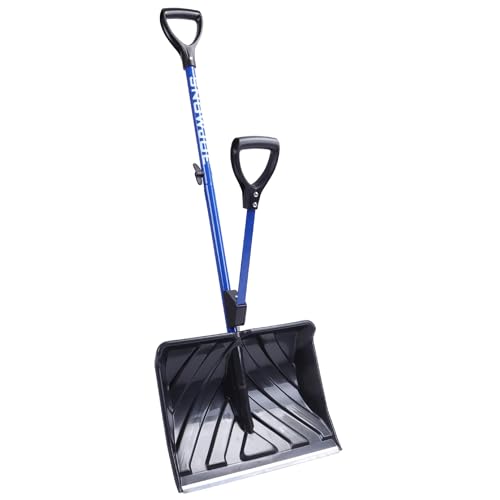 Snow Joe Shovelution SJ-SHLV01 A spring-assisted second handle moves the lifting load down the shaft, and at 3.5 lb the shovel itself adds almost nothing to what you lift. | Backs that already hurt | 8.6/10 | $39.97 - View on Amazon #ad affiliate link · Price as of September 14, 2026 |
| 4 |  Toro 38361 Power Shovel 12 inches, 13 pounds, 300 lb/min, 20-foot throw — Toro publishes every number, which almost nobody else here does. | Best-documented specs in the class | 7.5/10 | Check price on Amazon #ad affiliate link · no live price for this item |
| 5 |  True Temper Mountain Mover 1627300 A big-volume poly blade from the oldest name in American shovels — capacity first, finesse second. Our skip-this pick | Deep, dry snow in volume | 7.0/10 | Check price on Amazon #ad affiliate link · no live price for this item |
| 6 |  Bully Tools 7-in All Steel Ice Chopper, D-Grip A purpose-built chopper rather than a repurposed scraper: all-steel head on an extra-long fiberglass handle with a D-grip, made in the USA. | Breaking bonded ice, without breaking the tool | 8.4/10 | $49.99 - View on Amazon #ad affiliate link · Price as of September 14, 2026 |
Cutting the frozen plow ridge
Bully Tools 92814 22-in Combination Shovel
A 22-inch steel-edged combination blade on a fiberglass D-grip handle, built to a commercial standard and made in the USA.
This is a tool for one job that plastic shovels genuinely cannot do: cutting the compacted, refrozen ridge the municipal plow leaves across the end of your driveway. That ridge is not snow by the time you get to it. It is a slab, and a poly blade skates off it.
A steel edge and a stiff fiberglass shaft give you the ability to chop. That capability comes with an obligation: a steel edge is also perfectly capable of chewing the sealant off asphalt, scoring pavers and destroying a composite deck. This is a concrete tool. If your driveway is anything else, buy a poly blade and accept a slower fight with the ridge.
Bully Tools builds to a commercial spec — the fiberglass handles and heavier gauge steel are what landscaping crews buy — and the practical effect is that it does not become a consumable. Whether that is worth the price depends on how many years you plan to keep it.
The weight is unpublished and it will not be light. If you already have back trouble this is the wrong shovel, and the strain-reducing designs are the right ones. Keep this one for the ridge and use something else for the driveway.
What works
- Steel edge cuts through the crusted plow ridge that stops poly blades dead
- Fiberglass handle does not conduct cold and does not rust
- Commercial-grade construction — the failure mode is you losing it, not it breaking
What does not
- A steel edge on pavers, decking or sealed asphalt will leave marks
- 22 inches of steel is heavy work in wet snow
- No published weight, which for a steel shovel is the number that matters most
Wide, flat driveways
The Snowplow Original Snow Pusher, 30 in
A UHMW polyethylene blade that snow slides off rather than sticks to, in the width that actually changes your clearing time.
UHMW — ultra-high-molecular-weight polyethylene — is the material specification that separates this from a $25 pusher. It is the same family of plastic used for conveyor wear strips and truck-bed liners, chosen for a very low coefficient of friction and high impact resistance at low temperature. The practical consequence is that snow slides off it, including the heavy wet snow that packs solid onto a cheap blade and turns pushing into scraping.
The maker states the edge self-sharpens with use and needs no maintenance, and lists the tool as usable on concrete, blacktop, pavers, decks, roofs and ice rinks. That surface list is unusually broad and is the reason we recommend it where a metal edge would be a liability.
Width is the other half of the argument. A 30-inch blade covers 67 percent more ground per pass than an 18-inch shovel. On a 20-by-30-foot driveway that is the difference between roughly 20 passes and roughly 12 — and each of those passes is a push, not a lift.
It is not a complete answer. Nothing that pushes deals with the plow berm, and on a long driveway you eventually run out of anywhere to push to. Pair it with a shovel, or with a machine.
What works
- UHMW is the reason wet snow releases instead of packing onto the blade
- 30 inches is the width where pass count drops noticeably on a two-car drive
- Rated by the maker for decking and pavers, unlike any steel-edged pusher
What does not
- Costs multiples of a hardware-store pusher
- Still cannot lift, and still cannot cut refrozen crust
- The wider the blade, the more it wanders on uneven ground
Backs that already hurt
Snow Joe Shovelution SJ-SHLV01
A spring-assisted second handle moves the lifting load down the shaft, and at 3.5 lb the shovel itself adds almost nothing to what you lift.
The physics here are simple enough to check without owning one. A snow shovel is a lever, and the load on your lumbar spine depends on how far the weight sits from your hips. A conventional straight-shaft shovel makes your upper hand the fulcrum and your lower back the counterweight. The Shovelution adds a second, spring-loaded grip partway down the shaft, so the lower hand takes the lifting and the spine straightens earlier in the throw.
Snow Joe states the design reduces back strain by up to 30 percent. That is the manufacturer's number and we cannot verify it. What we can verify is the tare weight: 3.5 pounds for an 18-inch blade, which is genuinely low. Weight matters more than it sounds. Twelve pounds of wet snow on a 3.5-pound shovel is a 15.5-pound lift; the same load on a 6-pound steel shovel is 18 pounds, and you are doing it three hundred times.
The blade is poly with an aluminum wear strip. That combination is the right compromise for most driveways: poly is light and does not stick as badly as bare steel, and the aluminum edge keeps the leading lip from rounding off after two seasons. It is not a gravel tool — the wear strip will scoop stone and fling it, and on a composite deck it can leave marks.
The 50-inch assembled height is the real limit. If you are over about six feet you will still bend more than you want, and a longer straight-shaft may serve you better even without the assist. See our straight shaft versus ergonomic comparison for how shovel length maps to user height.
What works
- 3.5 lb is among the lightest 18-inch blades we found published specs for
- The second handle is fixed to the shaft, so the lower hand carries the load instead of your lower back
- Aluminum wear strip on a poly blade — the durable combination at this weight
What does not
- The spring mechanism is one more thing that can fail, and it is not user-serviceable
- 18 inches is a lot of blade for wet snow if you insist on filling it
- 50 inches assembled is short for anyone much over 6 feet
Best-documented specs in the class
Toro 38361 Power Shovel
12 inches, 13 pounds, 300 lb/min, 20-foot throw — Toro publishes every number, which almost nobody else here does.
Toro publishes what everyone else omits: 12 inches of clearing width, up to 6 inches of depth, a 7.5-amp motor, a 20-foot throw, 300 pounds per minute of capacity, 13 pounds of tool weight, and 6 inches of telescoping handle adjustment. On a site that scores products on published specifications, that transparency counts for a lot.
The 300 lb/min figure is the one to reason from, because it lets you do arithmetic nobody usually can. A 20-by-30-foot driveway under 4 inches of fresh snow holds very roughly 1,500 to 2,500 pounds of snow depending on density. At 300 pounds a minute that is something like 5 to 8 minutes of continuous machine time, plus the walking, turning and repositioning. Compare that with the Snow Joe SJ627E's stated 840 lb/min and the size difference becomes concrete rather than vague.
At 13 pounds it is the lightest powered tool here, and for a carried tool that is the spec that determines whether you finish the job or put it down.
It is a light-snow, small-area machine and Toro says so — sidewalks, steps, decks and small driveways. Point it at a two-car driveway after eight inches of wet snow and you will be disappointed for reasons that were printed on the box.
What works
- Every spec we wanted is published on Toro's own product page, including weight and lb/min
- 13 lb is light enough to hold out in front of you for a long clear
- Telescoping handle with 6 inches of adjustment actually fits different-height users
What does not
- 7.5 amps is the least powerful motor here
- 300 lb/min is roughly a third of what a 15-amp corded blower moves
- Corded, with all the cord problems that implies
Deep, dry snow in volume
True Temper Mountain Mover 1627300
A big-volume poly blade from the oldest name in American shovels — capacity first, finesse second.
Skip this one
The large scoop is the type most people default to and the type that suits the fewest situations. A big blade encourages big loads, and a loaded lift-and-twist is the motion behind most shoveling injuries. It earns its place on deep, dry, light snow where volume genuinely is the problem — and nowhere else. If your snow is wet, or your back is the constraint, buy almost any other type on this page.
Volume shovels are for one specific situation: a lot of light, dry snow. If you live where December drops eight inches of powder that weighs almost nothing, a big blade halves your pass count and your arms never notice. If you live where snow arrives at 34°F and lands like wet cement, the same blade is how people hurt themselves.
Snow density is the variable nobody puts on the box. Fresh dry powder runs roughly 5 to 8 percent water content; wet spring snow can be three to five times denser. An 18-inch blade filled with the former is a pleasant lift. Filled with the latter it is well north of 20 pounds, repeatedly, at arm's length.
So the honest guidance is: buy the capacity if your snow is dry, and if you buy it anyway, do not fill it. Half a blade of wet snow is a complete answer and your spine will not file a complaint.
True Temper does not publish a weight or a handle length on the listing we read, which is a real gap for a shovel bought on ergonomics. If those numbers are your deciding factor, the models that do publish them are the safer purchase.
What works
- High-capacity blade moves dry powder in far fewer passes
- True Temper's poly blades are a long-running spec rather than a house brand of unknown provenance
- Widely stocked, so replacement mid-season is easy
What does not
- A high-volume blade is a trap in wet snow — the bigger the scoop, the heavier the lift
- Neither weight nor handle length is published on the listing we read
- No wear strip listed, so the leading edge will round off over seasons
Breaking bonded ice, without breaking the tool
Bully Tools 7-in All Steel Ice Chopper, D-Grip
A purpose-built chopper rather than a repurposed scraper: all-steel head on an extra-long fiberglass handle with a D-grip, made in the USA.
Once ice has bonded to pavement, a snow shovel is the wrong tool and no amount of technique fixes that. A shovel blade meets bonded ice at a shallow angle and skates over it. A chopper meets it vertically, concentrates your weight into a narrow steel edge, and fractures it. Those are different jobs and they want different tools.
This is the one on this page built for the job rather than borrowed from another trade. Bully Tools puts an all-steel high-strength head on an extra-long fiberglass handle and finishes it with a D-grip, and all three of those choices matter. The steel head takes repeated impact. The extra length means you are standing upright instead of bent over a spot you are about to hit hard. The D-grip is what lets you drive down with your shoulders and body weight rather than steering the tool with your wrists.
The fiberglass handle is the underrated part. Chopping ice sends shock back up the handle on every strike, and a solid steel handle transmits essentially all of it into your hands and elbows. Fiberglass damps some of that. On a long session with a stubborn plow ridge, that is the difference between finishing and quitting.
Bully Tools does not publish a weight, which is a genuine gap on a tool where heft does most of the work — we are not going to estimate one. What they do publish is a limited lifetime warranty against defects across the line, and the tool is made in the USA.
Know what it is not. Seven inches of blade breaks ice up; it does not move it anywhere. Plan on a chopper and then a shovel, and read how to get ice off a driveway before you start swinging, because the order of operations matters more than the tool does.
What works
- Built as an ice chopper, not a floor scraper doing overtime
- The D-grip is what lets you drive the blade down with your body instead of your wrists
- Fiberglass handle absorbs the shock a steel handle sends straight into your elbows
- Steel edge can be brought back with a file when it dulls
What does not
- No published weight, and on a chopping tool heft is most of the performance
- Seven inches is narrow — this breaks ice, it does not clear a driveway
- Wrong tool for any decorative or soft surface
- Costs more than a second snow shovel that you would use more often
Most households need two, not one
This is the conclusion the category resists, because every product page wants to be the only purchase. In practice the types are complementary and the sensible kit is a pair.
- A pusher for the open surface. It does the bulk of the driveway without lifting, which is where both the time and the risk are concentrated.
- A scoop or combination for everything the pusher cannot do. The berm at the road, the corners, the steps, the gap behind the car.
- Then, if it applies to you: a chopper for ice that has already bonded, a roof rake if you get ice dams, and a car broom if you park outside.
Buying a pusher and a cheap combination shovel together usually costs less than one premium do-everything shovel, and it does both jobs properly instead of one job adequately.
Which type, by who is holding it
- A back that already hurts. Pusher first, then an ergonomic or spring-assisted shovel for the rest. Never a large scoop. Snow shovels for a bad back goes through the mechanics.
- An older user. Same answer, plus a hard look at whether a powered shovel removes the lifting entirely — see snow shovels for seniors.
- Wet, heavy snow. Narrower blades, not wider. A wide scoop full of wet snow is an enormous load — best for heavy wet snow.
- A deck, pavers or stamped concrete. The type matters less than the edge material. Poly or UHMW only, and never a chopper.
- A gravel drive. No powered shovel, ever — the auger contacts the ground and throws stone. A soft-edged pusher is the tool.
The types we deliberately leave out
Two categories carry the words "snow shovel" and are not in this taxonomy. Avalanche and backcountry shovels are collapsible packs tools built for digging a buried person out of debris in a hurry; they are short, they are designed to be carried up a mountain, and using one on a driveway would be miserable. Telescoping car shovels are a car tool rather than a driveway tool, and they belong with the car snow tools.
If you arrived here trying to work out which shovel to buy and the answer still is not obvious, the shortest route is to answer one question: is the surface flat, paved and open? If yes, start with a pusher. If no, start with a combination shovel and add from there.
Questions people ask
What are the different types of snow shovels?
What type of snow shovel is best?
What is the difference between a snow shovel and a snow pusher?
Which snow shovel is best for a bad back?
Is a bigger snow shovel blade better?
Do I need more than one snow shovel?
Sources
Next stage
Start with the type most people skip
If your driveway is flat, paved and open, the pusher is the type that does most of the work without ever loading your spine. Here are the ones worth buying.
Keep goingAbout the author
Scooter M.
An enthusiast who is genuinely into this. I read the manuals, compile the published specs, and do the math on door clearances. No lab coat, no test bench, and nothing here is a product I have used - which is exactly why every claim carries a source.
Published by Slate Mill Group, with the Shovel Report team. Published September 14, 2026; last updated September 14, 2026. Editorial policy.
Read next

Best Pusher
Best Snow Pushers
Wide pusher blades from 27 to 42 inches, and why the widest is rarely the right buy.

Pusher vs Shovel
Snow Pusher vs Snow Shovel
Sliding versus lifting — when each wins, and why most driveways need both tools.

Blade Material Guide
Snow Shovel Blade Materials, Compared
Poly, aluminum-edged, UHMW and steel blades ranked on snow release, durability and surface safety.

Best Fit by Height
Best Snow Shovels for Your Height
Which shovels are documented long enough for your height, and what to do when none are.